Beauty campaign photography is no longer just about polished skin, premium packaging, or visually appealing content. It has become a central driver of trust, brand perception, and conversion. In a crowded beauty market, where customers compare dozens of brands before they ever test a product, visuals often shape the first and most important impression.
Because of that, beauty campaign photography should never be treated as a decorative layer added after the strategy is complete. Instead, it should be developed as a strategic system that supports positioning, communicates product value, and creates consistent beauty brand visuals across every channel.
While many brands still approach a beauty campaign shoot as a one-off event, stronger brands think differently. They build visual systems. They plan content for e-commerce, paid media, product launches, and long-term brand building at the same time. As a result, their visuals are more cohesive, more premium, and more effective over time.
Need a More Strategic Beauty Campaign?
If your current visuals look good but do not feel consistent, scalable, or conversion-focused, the issue is often strategic rather than aesthetic.
What Is Beauty Campaign Photography?
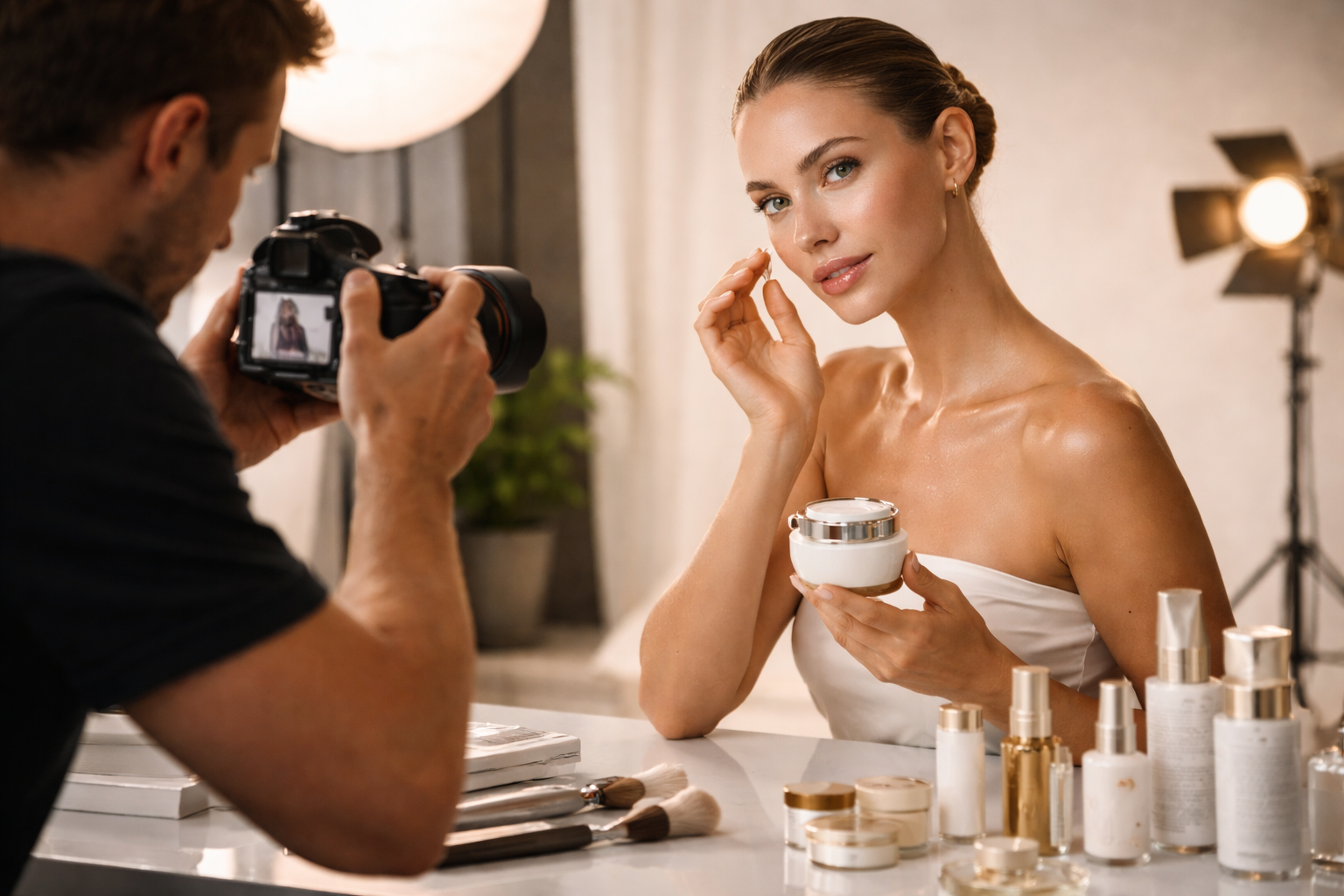
Beauty campaign photography is the strategic creation of visual assets for beauty brands, skincare lines, cosmetic launches, and product-driven campaigns. Unlike purely editorial beauty imagery, which may focus on mood, experimentation, or artistic direction, campaign photography is designed to perform in a commercial environment.
That means the work must serve multiple purposes at once. A successful beauty campaign shoot should create images that feel aspirational enough for brand positioning, while remaining clear enough for advertising, conversion, and product communication. In practice, that includes:
- Hero imagery that defines the campaign
- Close-up skin and texture shots that communicate realism and product benefit
- Product-only images that support e-commerce and advertising
- Format variations for paid social, display, landing pages, and email
- Consistent beauty brand visuals that can be reused beyond a single launch
Therefore, the purpose of beauty campaign photography is not simply to make the product look attractive. It is to create a visual system that makes the product feel credible, desirable, and relevant.
What Will You Learn About Beauty Campaign Photography?
Topics covered:
- What is beauty campaign photography?
- Why does it matter?
- How does it differ from product photography?
- How much does beauty campaign photography cost?
- What assets should a campaign produce?
- What makes a campaign successful?
- How can beauty campaigns improve advertising performance?
- How often should beauty brands run campaigns?
- How can campaigns support long-term growth?
Why Beauty Campaign Photography Matters More Than Ever
Beauty is one of the most visually competitive categories in modern marketing. Customers judge products based on skin finish, packaging quality, texture realism, and overall brand tone before they read claims, reviews, or ingredient lists. Because of this, weak visuals create hesitation immediately.
On the other hand, strong beauty brand visuals communicate trust. They suggest quality, precision, and consistency. They make the product feel like it belongs in a premium routine, premium shelf, or premium campaign environment. As a result, the visuals themselves become part of the perceived value of the product.
This is why beauty campaign photography has such a direct relationship with conversion. If the imagery feels over-retouched, generic, or inconsistent, the customer begins to question the product. If the imagery feels refined, believable, and coherent, the product feels more legitimate. That shift is subtle, but commercially it matters.
Signs Your Beauty Brand Needs Better Campaign Photography
- Your Ads Fatigue Quickly
- Product Launches Feel Weak
- Your Website And Social Media Don’t Match
- You’re Constantly Reshooting Content
- Your Brand Looks Different Across Channels
- Campaigns Generate Attention But Not Sales
Beauty Campaign Photography vs. Standard Product Content
Not all beauty imagery serves the same purpose. Standard catalog or e-commerce photography may show the product clearly, but it does not necessarily build desire. Editorial imagery may create mood, but it does not always support performance. Beauty campaign photography sits between those two extremes and connects them.
A strong campaign creates a bridge between branding and usability. It gives the customer something to feel, while also giving the marketing team something to use. That is why the best beauty product photography campaigns are planned with both emotion and distribution in mind.
In practical terms, that means the campaign should not end with a handful of striking hero images. It should generate a complete asset ecosystem: model-based imagery, packshots, close-up detail, texture storytelling, crops for different placements, and enough consistency to support future work.
Beauty Campaign Photography vs Product Photography
| Product Photography | Beauty Campaign Photography |
|---|---|
| Product-focused | Brand-focused |
| E-commerce support | Marketing support |
| Technical presentation | Emotional storytelling |
| Product details | Customer connection |
| Conversion support | Awareness + conversion |
What Makes Great Beauty Brand Visuals Work?
Strong beauty brand visuals feel coherent, intentional, and believable. They do not just show the product. They show the product in the right visual language. That language is built through a combination of technical control and brand discipline.
Several elements matter more than most teams initially expect. Lighting is one of them. In beauty, lighting does not simply illuminate the subject. It defines texture, finish, softness, dimensionality, and realism. Retouching is another. If retouching is too heavy, trust drops. If it is too loose, the campaign can feel unfinished. Color is equally important. Packaging, skin tone, makeup finish, and texture all need to feel consistent across the set.
Consequently, beauty campaign photography succeeds when those decisions are made intentionally, not reactively. The visual system should feel stable across every image, even when the composition changes.
What Assets Should A Beauty Campaign Produce?
Most beauty brands underestimate asset requirements.
- Website Assets
- Product Launch Assets
- Paid Advertising Assets
- Social Media Assets
- Email Marketing Assets
- Retail Assets
- PR Assets
- Video Assets
Why Precision Matters More in Beauty Than in Most Categories
Beauty photography is unforgiving. Customers notice inaccurate foundation shades, unrealistic skin smoothing, overexposed highlights, unnatural gloss, and inconsistent tone immediately. In other words, cosmetic campaign photography requires an unusually high level of control.
That precision applies across multiple areas:
- Skin texture must look refined, not fake
- Product texture must look tactile and clear
- Packaging must look premium and clean
- Color must remain stable across channels and crops
- Retouching must enhance credibility, not reduce it
Because of this, strong beauty campaign photography is both technical and strategic. It is not enough to create attractive pictures. The imagery must hold up under scrutiny in paid media, on product pages, in retail environments, and in close-up mobile viewing.
How Beauty Campaign Photography Supports the Full Funnel
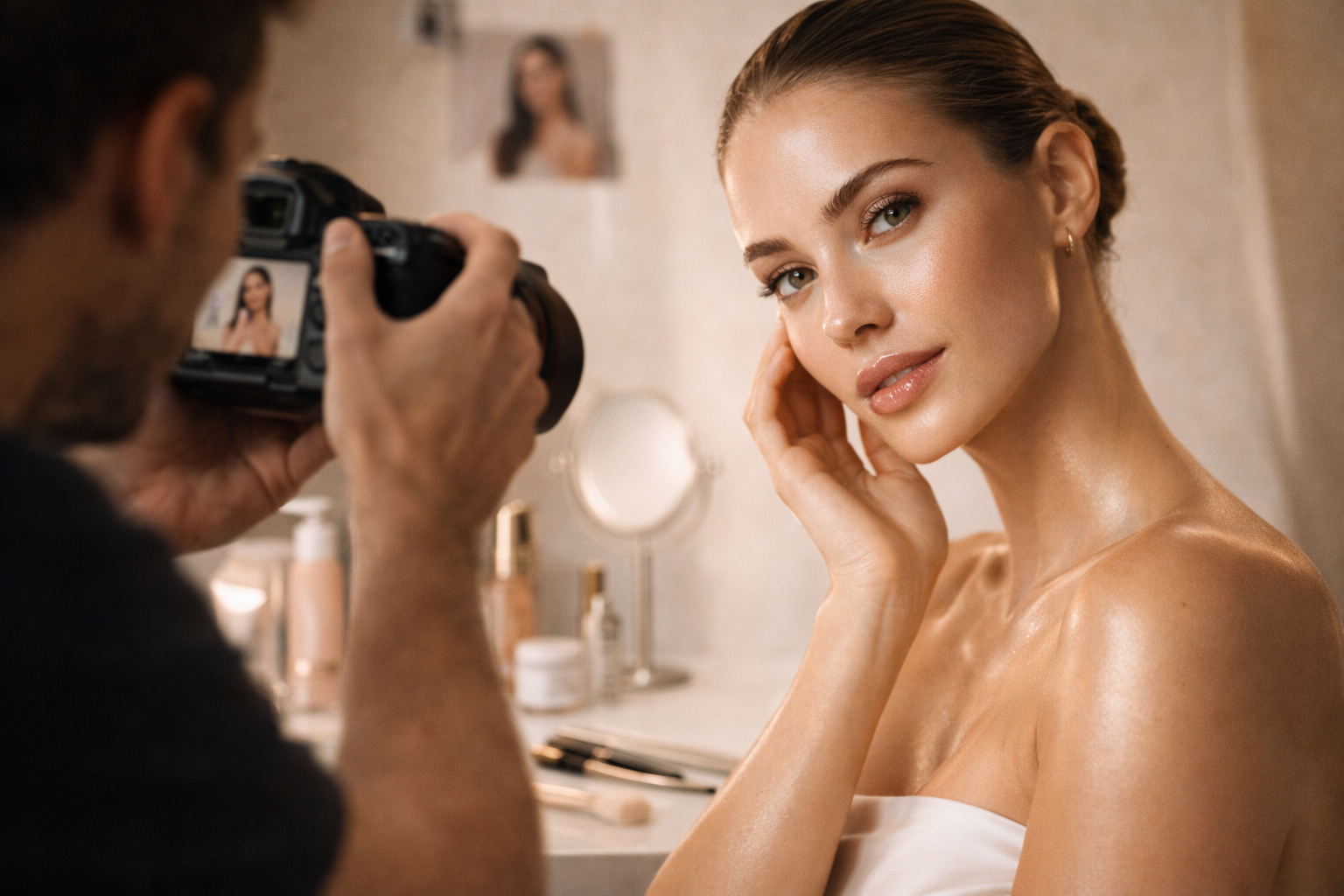
One of the most overlooked strengths of beauty campaign photography is its ability to support every stage of the customer journey. Too often, brands create one set of visuals for awareness, another for e-commerce, and another for paid media. This fragmentation increases costs and weakens consistency.
A better approach is to build one strategic campaign that can serve the full funnel. At the top of the funnel, the imagery should create desire and attention. In the middle, it should reinforce trust through consistency and clarity. At the bottom, it should support conversion with clean product communication and compelling detail.
Therefore, the strongest beauty product photography campaigns are not built around a single deliverable. They are built around a system of outputs. That is what makes the work more scalable, more efficient, and more effective over time.
What Makes Beauty Campaign Photography Effective?
- Clear Product Story
- Consistent Brand Positioning
- Customer-Focused Messaging
- Multi-Channel Asset Planning
- Advertising Variations
- Mobile-First Content
- Long-Term Usability
Most beauty brands focus on visual quality. High-performing brands focus on usability and performance.
How to Plan a High-Performing Beauty Campaign Shoot
A successful beauty campaign shoot begins with strategy, not styling. Before moodboards or references are finalized, the campaign should answer several fundamental questions. What does the product need to communicate? Where will the assets be used? What level of realism fits the brand? What does the audience need to believe within the first few seconds of seeing the image?
From there, planning becomes much clearer. A strong beauty campaign usually includes the following stages.
1. Define the Commercial Objective
Every campaign should have a clear purpose. Is the priority brand elevation? Product launch? Paid media performance? Retail rollout? Website refresh? Each of those objectives changes what the campaign needs to produce. As a result, the creative decisions should be tied directly to commercial use.
2. Build a Clear Visual Direction
Before production starts, the campaign needs a defined visual language. That includes lighting references, texture references, skin finish, set tone, surface materials, model casting, and post-production direction. Without this, beauty brand visuals can become inconsistent very quickly.
3. Plan for Product and Model Integration
Some campaigns are product-led. Some are face-led. Most high-performing campaigns need both. Therefore, beauty campaign photography should be planned to include clear product hero shots as well as lifestyle or close-up model imagery that builds context and desire.
4. Design for Multiple Formats
Modern campaigns do not live in one crop. They need vertical formats for social, wides for landing pages, clean crops for ads, and tighter frames for product storytelling. That means beauty product photography campaigns should be planned with flexibility from the beginning.
5. Create a Shot Architecture, Not Just a Shot List
A shot list is useful, but a shot architecture is better. In other words, the campaign should be structured around content categories: product-only, product-in-hand, texture, application, close-up skin, environmental detail, paid media variations, and e-commerce support. This makes the output more strategic and easier to repurpose later.
Free Visual Audit for Beauty Brands
If your content feels inconsistent, too generic, or not premium enough for your positioning, a visual audit can reveal where the gaps are.
Common Mistakes in Beauty Campaign Photography
Many campaigns underperform for reasons that are predictable and avoidable. One of the most common is over-retouching. While polish matters, customers need to trust what they are seeing. If the result feels artificial, the campaign may look expensive but still fail commercially.
Another mistake is unclear product communication. Beautiful skin alone does not always sell the product. The imagery must still make it obvious what the product is, how it fits into a routine, and why it matters. A third issue is format neglect. If the campaign is only planned for a hero visual, the team often ends up stretching a small number of images too far.
Other common problems include inconsistent lighting across assets, weak packaging presentation, and visual direction that feels trend-led rather than brand-led. In each case, the core issue is the same: the campaign was designed to look good in isolation instead of functioning as a system.
Read more about Why Beauty Product Photography Campaigns Drive Modern Brand Performance
Case Example: Premium Skincare Positioning
A premium skincare brand may already have a strong product and strong packaging, yet still struggle with inconsistent beauty brand visuals. One campaign may feel minimal and clinical, while the next feels soft and editorial. Paid content may look disconnected from the website. The result is visual fragmentation.
In a case like this, the solution is not simply “better photos.” It is a more coherent beauty campaign photography system. By aligning lighting, surfaces, skin finish, styling, retouching, and product framing, the campaign starts to feel like one brand rather than several visual directions competing at once.
Outcome: stronger visual authority, more trust, and a more premium overall perception.
Case Example: Performance-Oriented Beauty Product Photography Campaigns
Some beauty brands have the opposite problem. Their visuals look elevated, but they do not perform well in paid media. In those cases, beauty product photography campaigns often need more variation, more clarity, and more format discipline.
Instead of relying on a small number of polished hero images, the campaign should generate multiple crops, more direct product communication, and clearer visual hooks for ad testing. This does not mean reducing the premium feel. It means extending it into performance-ready formats.
Outcome: stronger paid asset flexibility, better creative testing, and more efficient content reuse.
How Much Does Beauty Campaign Photography Cost?
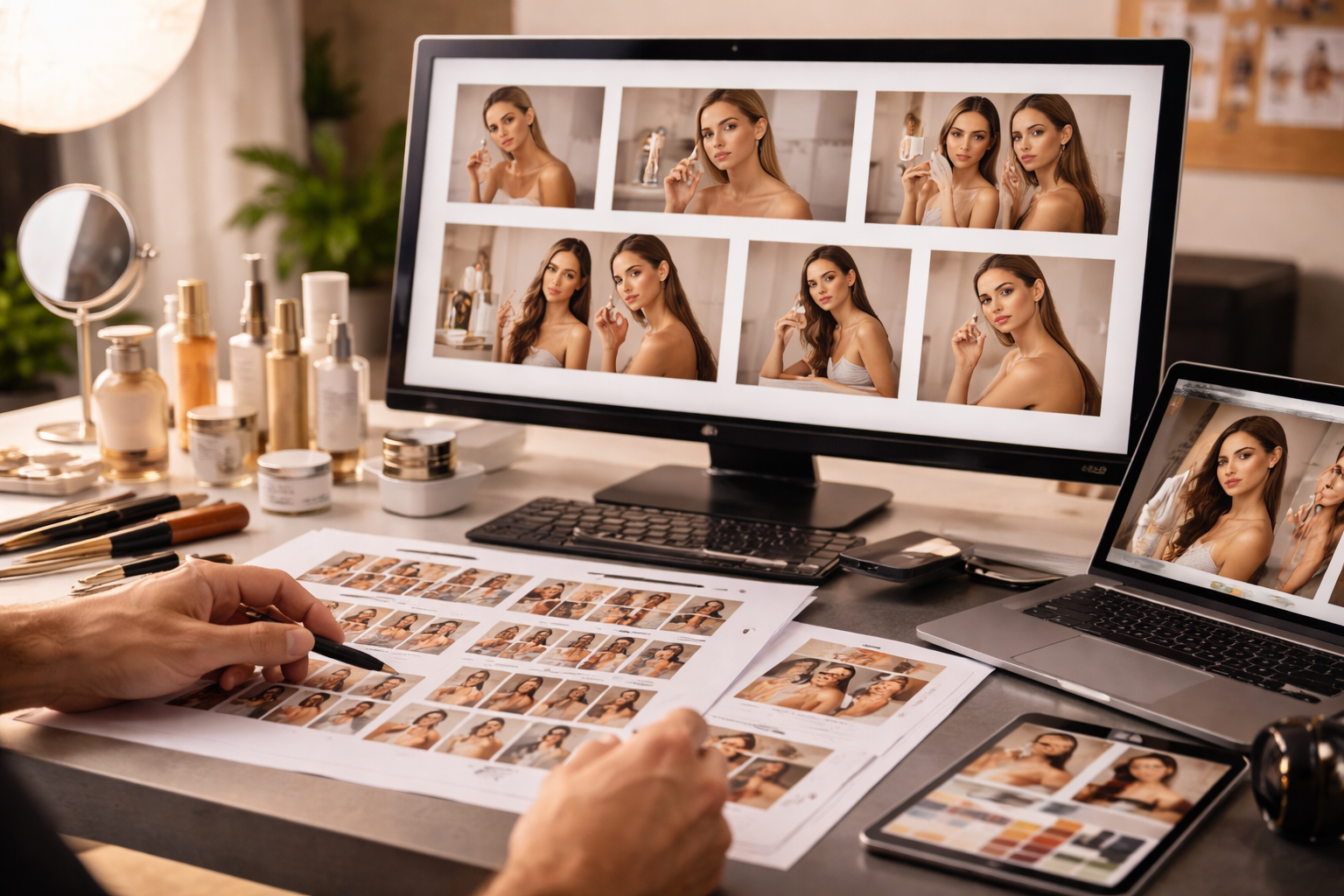
The cost of beauty campaign photography varies based on production complexity, number of deliverables, model and team requirements, retouching depth, and whether the campaign includes both model-based and product-only outputs.
In broad terms, a smaller campaign may sit in the lower commercial range, while a larger production with extensive deliverables, premium retouching, and broader channel planning will sit much higher. However, cost on its own is the wrong decision lens.
The more useful question is this: what level of output, consistency, and long-term asset value does the campaign create?
When beauty campaign photography is planned as a scalable system, the return is not limited to one launch window. It supports future ads, future landing pages, ongoing social, seasonal campaigns, and stronger brand perception over time.
| Category | Typical Allocation |
|---|---|
| Photography | 25 – 40% |
| Models | 10 – 25% |
| Hair & Makeup | 10 – 20% |
| Production | 10 – 20% |
| Retouching | 5 – 10% |
| Licensing | 10 – 30% |
How Much Does a Fashion Campaign Shoot Cost?
One of the most common questions beauty brands ask is: “How much should we budget for beauty campaign photography?”
The answer depends on four primary factors:
- Production
- Talent
- Licensing
- Deliverables
A skincare brand launching a new product line will have very different requirements than a global cosmetics company running paid advertising across multiple countries.
This is why beauty campaign photography can range from a few thousand euros to six-figure investments. The key is understanding what drives the cost and how those assets support business growth.
Production Costs
Production is often the largest portion of a beauty campaign budget and includes all planning, logistics, and execution required to create the final assets.
Creative Direction
Before the shoot begins, campaigns typically require:
- campaign concepts
- moodboards
- visual references
- messaging alignment
- shot planning
Strong creative direction ensures every asset supports the campaign objective.
Studio Or Location Costs
Beauty campaigns may take place in:
- photography studios
- luxury hotels
- custom-built sets
- retail environments
- lifestyle locations
Typical Range: €200 – €5,000+ depending on complexity.
Production Management
Includes:
- scheduling
- logistics
- vendor coordination
- call sheets
- production oversight
Typical Range: €500 – €5,000+
Photography & Equipment
Professional beauty photography often requires:
- high-resolution cameras
- specialized beauty lighting
- macro equipment
- tethered shooting systems
Beauty photography is particularly demanding because skin, texture, packaging, and product details must be captured precisely.
Retouching & Post-Production
Beauty retouching is typically more advanced than many other photography genres.
Services often include:
- skin retouching
- color correction
- product cleanup
- compositing
- file optimization
Typical Range: €20 – €300+ per image depending on complexity.
Talent Costs
The people involved in a beauty campaign significantly influence quality and campaign performance.
Models
Beauty campaigns often require talent that aligns closely with the target audience. Pricing depends on:
- experience
- agency representation
- campaign usage
- exclusivity
Typical Range: €300 – €3,000+ per model per day
Global beauty campaigns often exceed these figures.
Hair Artists
Hair styling is often critical for beauty campaigns.
Typical Range: €300 – €1,500+ per day
Makeup Artists
Beauty campaigns frequently rely on highly specialized makeup artists.
Typical Range: €500 – €2,500+ per day
For cosmetics launches, makeup artistry can directly affect campaign success.
Wardrobe Stylists
Lifestyle beauty campaigns may also require wardrobe support.
Typical Range: €500 – €2,500+ per day
Creative Directors
Larger campaigns often involve dedicated creative leadership.
Typical Range: €1,000 – €10,000+ depending on campaign scope.
Licensing Costs
Licensing is one of the most misunderstood aspects of beauty campaign photography. Most brands are not purchasing image ownership. Instead, they are purchasing usage rights.
Licensing determines:
- where images may be used
- how long they may be used
- how many people may see them
- how much commercial value they generate
Organic Social Media Usage
Examples:
- TikTok
Typical Licensing Impact: Often included.
Website Usage
Examples:
- homepage banners
- landing pages
- e-commerce
Typical Licensing Impact: Often included.
Paid Advertising Usage
Examples:
- Meta Ads
- TikTok Ads
- Google Ads
- Display Advertising
Paid advertising directly supports customer acquisition. Consequently, licensing fees often increase significantly.
Typical Impact: +50% to +300% of production fees
Print Advertising Usage
Examples:
- magazines
- catalogs
- brochures
- billboards
Typical Impact: +25% to +200%
Retail & Point-of-Sale Usage
Examples:
- in-store displays
- retail signage
- promotional materials
Typical Impact: Additional licensing fees often apply.
Global Campaign Usage
Examples:
- international advertising
- multi-country campaigns
- global retailer support
Typical Impact: +100% to +500%+
The larger the campaign reach, the greater the licensing value.
Deliverables
The number and type of deliverables significantly affect campaign pricing. Many beauty brands mistakenly focus only on image count.
However, deliverable complexity is often more important.
Basic Beauty Campaign Package
May Include:
- 20–40 edited images
- website imagery
- social media assets
Typical Investment: €2,000 – €5,000
Best For:
- startups
- indie beauty brands
- limited launches
Growth Beauty Campaign Package
May Include:
- 50–80 edited images
- campaign photography
- paid advertising assets
- email marketing content
Typical Investment: €5,000 – €15,000
Best For:
- growing beauty brands
- DTC brands
- active advertisers
Full Beauty Campaign System
May Include:
- 100+ edited images
- campaign photography
- product photography
- short-form video
- advertising creatives
- retailer assets
- launch content
Typical Investment: €15,000 – €50,000+
Best For:
- established beauty brands
- national campaigns
- international launches
Why Two Beauty Campaign Quotes Can Be So Different
A common mistake is comparing proposals by image count alone.
Proposal A
- 30 images
- one model
- organic usage
- one location
Investment: €4,000
Proposal B
- 30 images
- multiple models
- paid advertising
- video production
- advanced retouching
- global licensing
Investment: €20,000+
The image count is identical. The commercial value is not.
What Should Beauty Brands Budget?
Startup Beauty Brands
€2,000 – €5,000
Goal: Build foundational campaign assets.
Emerging Beauty Brands
€5,000 – €10,000
Goal: Support launches and customer acquisition.
Growth Beauty Brands
€10,000 – €25,000
Goal: Support paid advertising, retail expansion, and content systems.
Established Beauty Brands
€25,000 – €100,000+
Goal: Support national and international campaigns.
The Better Question
Most brands ask: “How much does beauty campaign photography cost?”
However, the better question is: “How much value will these assets create?”
A well-planned beauty campaign can support:
- product launches
- paid advertising
- email marketing
- retailer partnerships
- PR campaigns
- social media
- website conversions
for months or even years.
When viewed this way, beauty campaign photography becomes less of a creative expense and more of a strategic marketing investment.
The Hidden Cost Of Poor Beauty Campaign Photography
Poor campaigns often create:
- Wasted Ad Spend
- Weak Product Launches
- Inconsistent Branding
- Content Shortages
- Lower Conversion Rates
- More Frequent Reshoots
Beauty Campaign Photography ROI Calculator
Example:
Campaign Investment: €10,000
Average Order Value: €80
Gross Margin: 60%
Required Revenue To Break Even: €16,700
Required Customers: 209
How Often Should Beauty Brands Run Campaign Shoots?
Startup Brands
2 – 4 campaigns annually
Emerging Brands
4 – 6 campaigns annually
Growth Brands
6 – 12 campaigns annually
Established Brands
Monthly or ongoing production
Beauty Campaign Photography vs Content Retainers
| Campaign Shoot | Content Retainer |
|---|---|
| Launch-focused | Ongoing content |
| One-time project | Continuous production |
| Fixed deliverables | Consistent asset creation |
| Reactive | Proactive |
When Should You Invest In A Content Retainer?
Beauty Campaign Photography Process
- Discovery
- Audience Research
- Campaign Planning
- Creative Direction
- Production Planning
- Shoot Execution
- Asset Delivery
- Distribution & Optimization
About My Approach to Beauty Campaign Photography
I approach beauty campaign photography as a balance of precision, restraint, and strategy. The objective is not to create imagery that is simply polished. It is to create imagery that feels premium, believable, and commercially useful.
That means every beauty campaign shoot is planned around more than visual taste. It is built around output architecture, consistency, and long-term use. I focus on how the campaign will function across the full ecosystem: brand pages, e-commerce, social, paid, and future campaign extensions.
As a result, the deliverables are not just individual images. They become a coherent set of beauty brand visuals that can support the brand over time.
What Brands Need From a Beauty Campaign Photographer
A beauty photographer should do more than execute a moodboard. They should understand how to translate positioning into images, how to build repeatable standards, and how to create campaign output that supports both brand and performance.
That is why strong cosmetic campaign photography is as much about decision-making as it is about aesthetics. The right creative partner brings clarity to the process, not just polish to the final result.
Take a look at What Makes a High-Performing Cosmetic Campaign Shoot? A Strategic Guide for Beauty Brands
What Beauty Brands Say
“The visuals finally matched the quality of our product. That changed how the entire launch felt.”
— Beauty Founder
“We had stronger consistency across paid, e-commerce, and social than we had ever achieved before.”
— Marketing Lead, Skincare Brand
“The difference was not just the images. It was the clarity and system behind them.”
— Brand Director
Final Thoughts
Beauty campaign photography is one of the most powerful tools beauty brands have for building trust, communicating quality, and driving conversion. When treated strategically, it does far more than improve aesthetics. It improves clarity, consistency, and commercial performance.
Therefore, brands that invest in structured beauty product photography campaigns, strong beauty brand visuals, and a more system-led approach to content are better positioned to grow. They look more premium, launch more efficiently, and create campaigns that keep delivering value beyond the first release.
Start Your Beauty Campaign
If you want beauty visuals that feel premium and perform across channels, build the campaign strategically from the start.
Next Recommended Reads
Brand Photography for Fashion Brands: The System Behind Strong Visual Identity and Scalable Growth