Free Resources

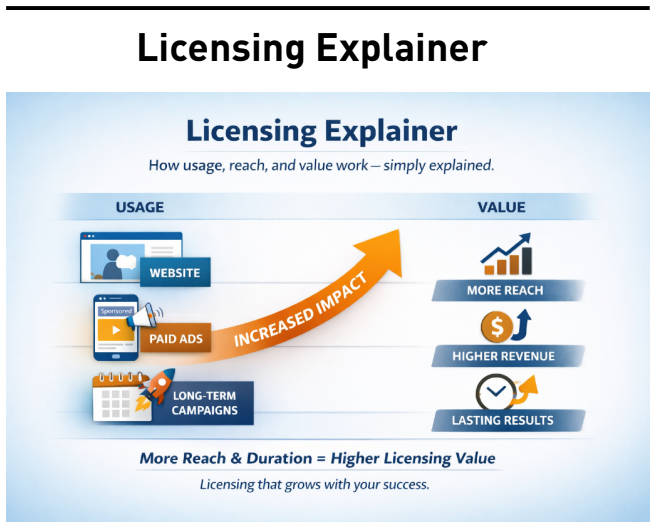
Licensing Explainer

How usage, reach, and value work — simply explained.

What Is Image Licensing?

Image licensing defines how, where, and for how long imagery can be used. It’s not based on how many images you receive — it’s based on the value those images create once they’re in the world.

Why Licensing Is Structured This Way
Different types of usage create different levels of impact.

  • A homepage image supports brand presence
  • A paid ad scales reach instantly
  • A long-running campaign compounds value over time

Licensing ensures costs match real-world exposure and performance, keeping retainers efficient and usage fair.

The Core Idea (At a Glance)
More reach = more value = adjusted usage rights
This allows brands to:

  • Pay only for what they use
  • Scale campaigns confidently
  • Extend high-performing creatives without reshooting
  • Avoid surprises or interruptions

What’s Typically Included

✔ Websites & e-commerce
✔ Organic social media
✔ Email marketing
✔ Internal & investor materials

Paid ads, print, and extended campaigns are licensed separately so costs stay flexible and performance-driven.

Bottom Line:
Licensing isn’t a limitation — it’s a clarity system. It keeps creative costs predictable, usage transparent, and allows your campaigns to grow without friction.

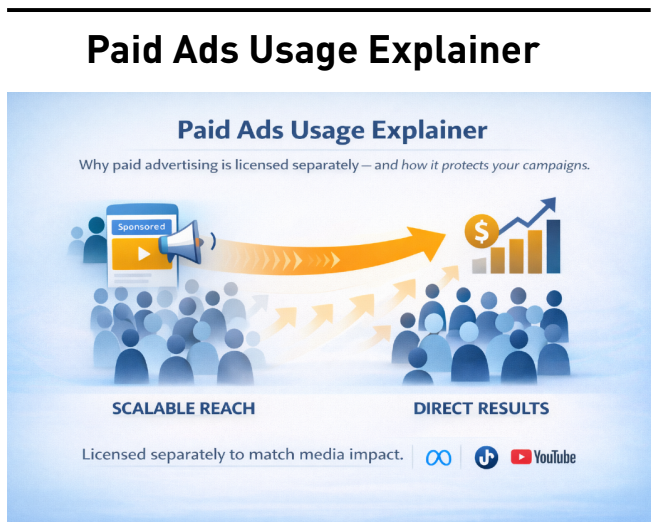
Paid Ads Usage Explainer

Why paid advertising is licensed separately — and how it protects your campaigns.

Why Paid Ads Are Different
Paid advertising fundamentally changes how imagery performs.
Unlike organic or owned channels, paid ads:

  • Scale reach instantly
  • Increase exposure based on media spend
  • Drive direct commercial results
  • Stay live as long as campaigns run

Because paid ads amplify value so quickly, usage is licensed separately to keep costs aligned with actual performance and scale.

What Counts as Paid Advertising?
Paid usage applies to imagery used in:

  • Meta (Facebook & Instagram) ads
  • TikTok ads
  • Google Display & YouTube ads
  • Pinterest ads
  • Paid influencer amplification
  • Any content with paid distribution behind it

If media spend is applied, paid usage applies.

How Paid Ads Licensing Helps You
This structure is designed to support growth — not restrict it.

✔ You don’t pay upfront for ads you may never run
✔ Media teams can scale spend without legal concerns
✔ Creative costs stay predictable
✔ High-performing ads can run freely
✔ Usage is always confirmed before launch

No campaigns are paused due to unclear rights.

How Paid Ads Are Typically Licensed
Paid usage is usually based on:

  • Campaign duration
  • Platforms used
  • Geographic reach

It’s commonly structured as:

  • A flat paid-ads license per campaign
  • Or a percentage of the monthly retainer

All terms are confirmed in advance for full clarity.

FAQ

Why isn’t paid ads included by default?
Paid ads can scale infinitely depending on spend, audience size, and duration. Including them upfront would mean charging for reach that may never be used. Separating paid usage keeps licensing fair, flexible, and performance-based.

Bottom Line
If imagery is driving paid reach and revenue, licensing ensures:

  • Clear usage rights
  • No legal ambiguity
  • No campaign interruptions
  • Fair value alignment

Paid ads licensing exists to protect momentum — not slow it down.

Resources / Lead Magnet-Copy

Required Downloads

  • Campaign Shoot Planning Guide
  • Visual Content Checklist (2026)
  • Licensing Explainer
  • Paid Ads Usage Explainer

Technical Requirements

  • Email capture (before download)
  • Tag users by download type
  • Redirect to custom thank-you pages
  • Trigger automated email sequences

High-Converting CTAs & Lead Magnets

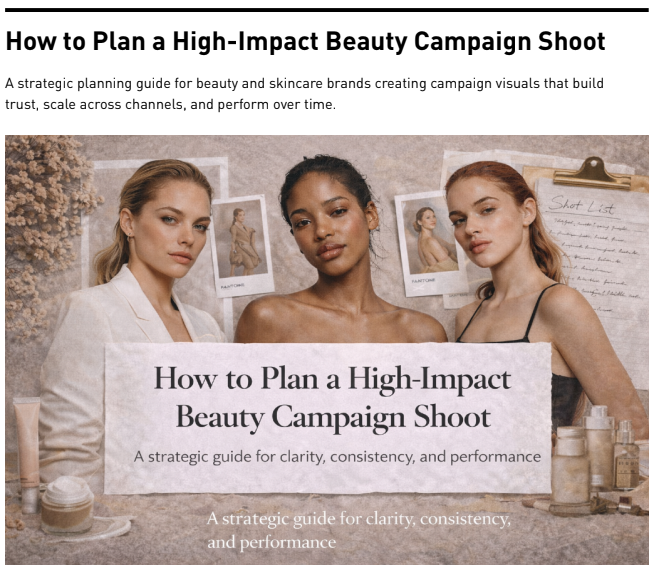
How to Plan a High-Impact Beauty Campaign Shoot

A practical guide for beauty and skincare brands creating campaign visuals that convert and scale.

Why Beauty Campaigns Are Built on Trust
Beauty campaigns sell trust before desire. Consumers want proof — not perfection. A successful beauty campaign shoot must communicate authenticity, efficacy, and credibility before it inspires aspiration.
High-performing beauty campaigns:

  • Show real results and texture
  • Feel honest and relatable
  • Build confidence in the product
  • Perform well in close-up formats

Step 1: Clarify the Role of the Campaign
Beauty campaigns often support:

  • Product launches
  • Performance marketing
  • Brand credibility building
  • Long-term paid advertising

Clarifying this early shapes lighting, composition, and deliverables.

Step 2: Beauty-Focused Creative Direction
Beauty photography requires technical precision.
Creative direction should prioritize:

  • Lighting optimized for skin and texture
  • Accurate color representation
  • Clean vs expressive aesthetics
  • Balance between scientific credibility and lifestyle appeal

The goal is clarity, not distraction.

Step 3: Build a Conversion-Focused Shot List
A strong beauty campaign shot list includes:

  • Hero product shots
  • Texture and formula details
  • Application moments
  • Skin close-ups
  • Negative space for claims, copy, and ads

These variations ensure strong performance across platforms.

Step 4: Licensing & Advertising Strategy
Beauty brands rely heavily on:

  • Paid social campaigns
  • Performance marketing
  • Long-running ad sets

Clear licensing ensures your campaign can scale without limitations, delays, or legal friction.

Final Thoughts
A well-planned beauty campaign shoot combines precision, authenticity, and strategy. When executed correctly, it builds trust and delivers measurable results across marketing channels.
Planning a beauty campaign shoot? Get a free beauty campaign visual audit by clicking the button below.

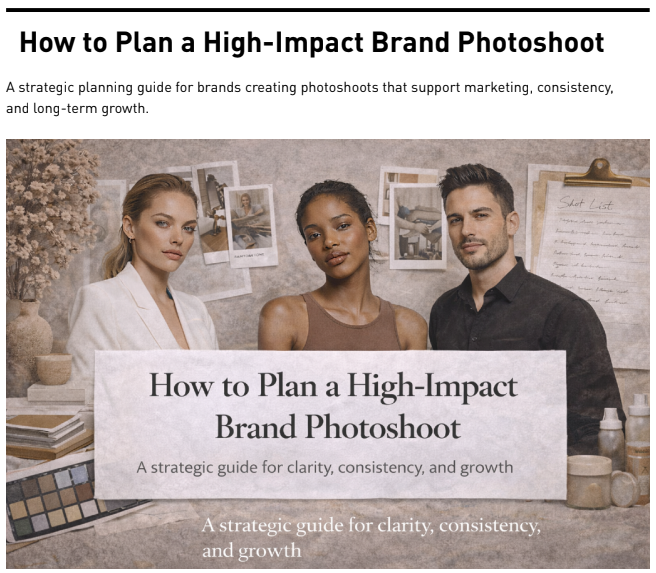
How to Plan a High-Impact Brand Photoshoot

A step-by-step guide for brands planning photoshoots that support marketing, growth, and consistency.

Why Most Brand Photoshoots Fail
Most brand photoshoots fail because they’re treated as creative exercises instead of marketing investments.
Without strategy, brands end up with:

  • Disconnected visuals
  • Content gaps
  • Inconsistent messaging
  • Low ROI

A strategic approach turns a photoshoot into a scalable content system.

Step 1: Define the Marketing Objective
A brand photoshoot should support:

  • Growth
  • Consistency
  • Platform scalability

Before planning visuals, clarify how the content will be used and measured.

Step 2: Distribution-First Planning
Effective brand photoshoots are planned around distribution.
Key platforms include:

  • Social media
  • Website
  • Email marketing
  • Paid ads
  • PR and press

This ensures the shoot delivers usable assets — not just beautiful images.

Step 3: Strategic Shot Lists
Shot lists should focus on:

  • Versatility
  • Evergreen visuals
  • Cropping flexibility
  • Cross-platform adaptability

The goal is to create a content library, not one-off visuals.

Step 4: Measure Performance & ROI
Brands that grow consistently:

  • Track performance
  • Reuse content strategically
  • Refine future shoots based on data

This transforms photoshoots into repeatable growth tools.

Final Thoughts
A high-impact brand photoshoot is about alignment — between visuals, messaging, and marketing goals. When planned strategically, it reduces chaos and increases consistency.
Want help planning your brand photoshoot? Book a free brand visual audit by clicking the button below.

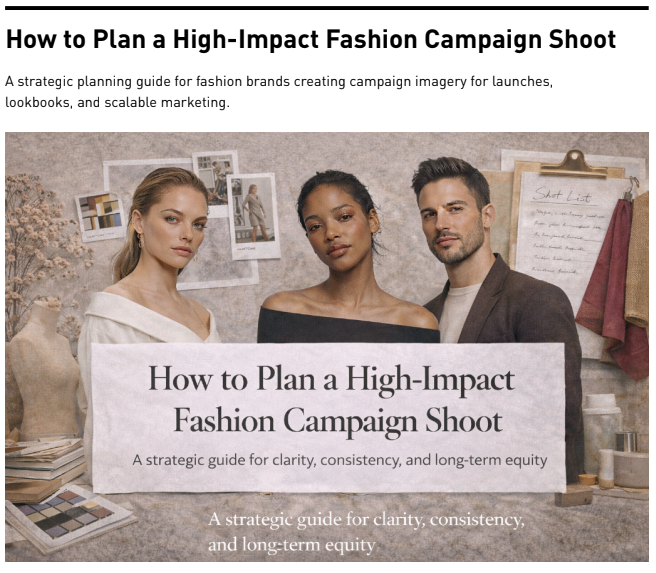
How to Plan a High-Impact Fashion Campaign Shoot

A strategic guide for fashion brands creating campaign imagery for launches, lookbooks, and paid advertising.

Why Fashion Campaign Photography Matters
Fashion campaigns are not just about clothes — they define how a brand is perceived. In an increasingly saturated fashion market, fashion campaign photography plays a critical role in shaping brand identity, positioning, and long-term value. Strong campaign imagery doesn’t just showcase products; it creates emotion, aspiration, and recognition.

High-impact fashion campaign photography:

  • Creates desire and emotional connection
  • Signals brand positioning and price point
  • Builds long-term visual equity
  • Differentiates your brand from competitors

A successful campaign shoot is never accidental — it’s strategically planned.

Step 1: Define the Intent of the Campaign

Before creative decisions are made, define whether your shoot leans toward:

  • Editorial storytelling (aspirational, expressive, conceptual)
  • Commercial performance (clear messaging, product-forward, conversion-focused)

Understanding this balance ensures your visuals support the actual business goal, not just aesthetics.

Step 2: Develop a Clear Creative Direction
Strong creative direction creates consistency and recognition across seasons. Key elements to define:

  • Editorial vs commercial tone
  • Runway influence vs lifestyle realism
  • Visual consistency across campaigns
  • Core brand codes (silhouettes, color language, attitude, movement)

A well-defined direction ensures your campaign feels intentional, recognizable, and scalable.

Step 3: Styling & Wardrobe Strategy
Styling should support both creativity and longevity. Effective fashion campaign styling focuses on:

  • Seasonal relevance without being overly trend-dependent
  • Layering to create multiple looks efficiently
  • Understanding movement and fabric behavior
  • Styling that works for stills and motion

This approach maximizes output while maintaining a cohesive brand aesthetic.

Step 4: Plan for Usage & Distribution
Fashion campaign imagery should be planned for multi-channel use, not a single placement.
Common usage includes:

  • Lookbooks and collection launches
  • Website hero imagery
  • Paid fashion ads
  • Campaign announcements
  • Wholesale and buyer decks

Knowing this in advance ensures the shoot delivers the right formats, crops, and compositions.

Final Thoughts
High-impact fashion campaign photography is an investment in brand perception. When creative direction, styling, and distribution planning align, your campaign becomes a powerful marketing asset — not just a visual moment.

Planning a fashion campaign shoot?
Book a free fashion campaign visual audit by clicking the button below.

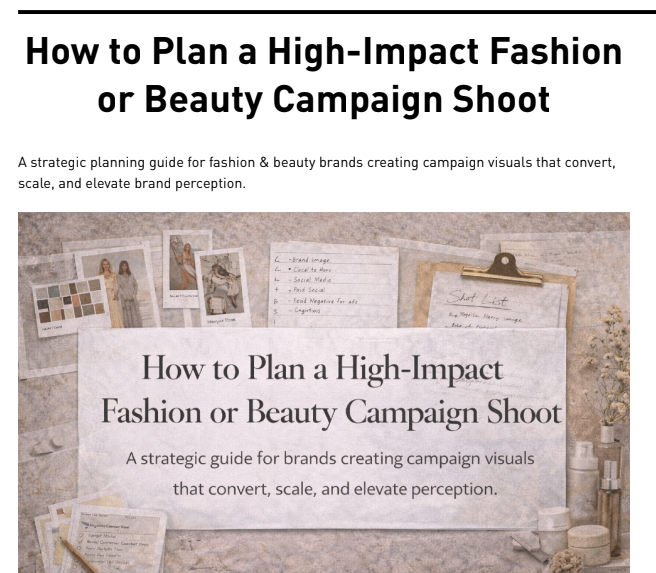
How to Plan a High-Impact Fashion or Beauty Campaign Shoot-10–12 PAGE PREMIUM GUIDE

A strategic guide for brands that want visuals that convert, scale, and elevate perception. Created for fashion & beauty brands planning campaigns, launches, and paid advertising.

Why Most Campaign Shoots Underperform
Most fashion and beauty campaign shoots fail for one simple reason: They are planned as photo shoots, not as marketing assets.
Beautiful imagery alone doesn’t guarantee:

  • Brand recognition
  • Sales
  • Long-term usability

High-performing brands approach campaign shoots as strategic content production — designed to work across platforms, formats, and time.
This guide shows you how to do exactly that.

Step 1 — Define the Business Goal (Not the Aesthetic)
Before you discuss mood boards, locations, or models, you must define what success looks like.
Ask:

  • Is this a product launch?
  • A seasonal campaign?
  • A brand repositioning?
  • Paid advertising content?
  • Website or e-commerce refresh?

Each goal requires:

  • Different compositions
  • Different formats
  • Different creative priorities

Without a clear goal, even the most beautiful images become expensive guesswork.

Step 2 — Plan for Distribution First
The biggest mistake brands make is shooting without knowing where the images will live.
Modern campaigns typically require:

  • Vertical formats (Reels, TikTok, Ads)
  • Square formats (feeds, carousels)
  • Horizontal formats (website heroes, banners)
  • Tight crops (ads)
  • Negative space (copy overlays)

If distribution isn’t planned in advance, you lose flexibility — and money.

Step 3 — Build a Strong Creative Direction
Creative direction is the bridge between brand identity and campaign messaging.
A strong direction defines:

  • Mood & emotional tone
  • Lighting style
  • Color palette
  • Casting approach
  • Styling & textures

This ensures:

  • Visual consistency
  • Brand recognition
  • Longevity across channels

Campaigns without strong direction often feel generic — and forgettable.

Step 4 — Casting & Talent Strategy
Talent choices shape how your brand is perceived.
Consider:

  • Does the talent align with your target audience?
  • Does it reflect your brand values?
  • Is it aspirational or relatable (or both)?

Casting should support:

  • Authenticity
  • Diversity
  • Brand positioning

Talent isn’t just a face — it’s part of your messaging.

Step 5 — Styling, Hair & Makeup for Campaign Longevity
Campaign styling should prioritize versatility.
Smart planning includes:

  • Layered looks
  • Easy swaps
  • Timeless over trendy choices
  • Neutral base looks with bold accents

This allows images to:

  • Stay relevant longer
  • Be reused across campaigns
  • Adapt to different platforms


Step 6 — Shot Lists That Maximize ROI
A high-impact shot list focuses on variety and adaptability, not quantity.
Key shot types:

  • Hero images
  • Detail shots
  • Lifestyle context
  • Clean compositions for ads
  • Negative space options

The goal: Create a content library, not just a gallery.

Step 7 — Licensing & Usage (Critical but Often Ignored)
Licensing defines:

  • Where images can be used
  • For how long
  • In which markets

Brands that clarify licensing early:

  • Avoid legal issues
  • Can scale campaigns faster
  • Protect their investment

Always align licensing with:

  • Marketing goals
  • Paid advertising plans
  • Growth projections


Step 8 — Think Beyond the Shoot Day
High-performing campaigns don’t end when the shoot wraps.
Plan to capture:

  • Short-form video
  • Behind-the-scenes content
  • Alternate crops & variations

This multiplies:

  • Content output
  • Campaign lifespan
  • ROI


Step 9 — Post-Production & Asset Delivery
Editing should support:

  • Brand consistency
  • Platform optimization
  • Fast deployment

Professional delivery includes:

  • Platform-ready formats
  • Clear file naming
  • Organized folders

This saves your marketing team time and friction.

Step 10 — Measure Performance & Iterate
After launch, evaluate:

  • Engagement
  • Conversion
  • Ad performance
  • Audience feedback

Successful brands treat campaigns as learning systems, not one-off events.

Final Thoughts
A well-planned campaign shoot is an investment in brand equity. When strategy, creativity, and execution align, visuals become a growth tool — not just decoration.
Want expert feedback on your next campaign? Request a free visual audit or book a discovery call.

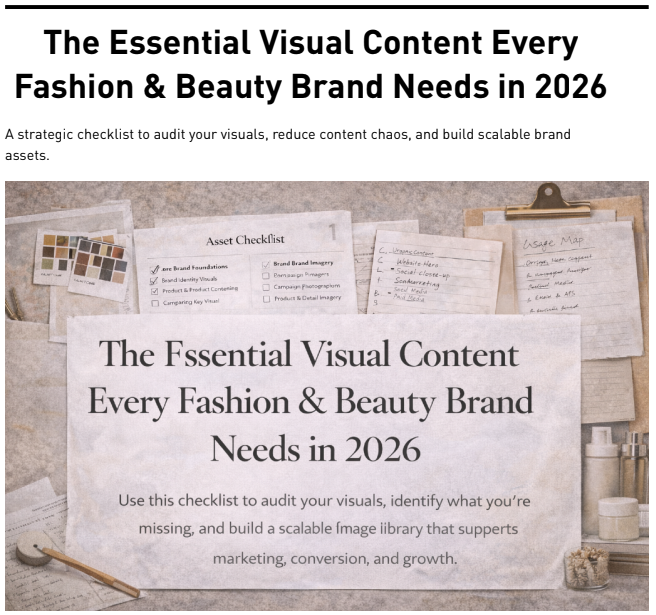
The Essential Visual Content Every Fashion & Beauty Brand Needs in 2026

Use this checklist to audit your current visuals and identify what you’re missing.

Why This Checklist Matters in 2026
Fashion and beauty brands are no longer competing on aesthetics alone.
In 2026, high-performing brands win by having:

  • Consistent visuals across platforms
  • Content designed for performance, not just beauty
  • Scalable image libraries that reduce content chaos

If your visuals don’t support marketing, ads, and growth, they’re costing you time and revenue.

CORE BRAND FOUNDATIONS (Non-Negotiable)
 Brand Identity Visuals
These define how your brand is recognized everywhere.

  • Logo usage imagery (light, dark, contextual)
  • Brand color storytelling
  • Visual tone reference images
  • Consistent lighting and mood

 Hero Brand Imagery
Your most important visuals.

  • Homepage hero image(s)
  • Campaign key visual
  • Founder or brand story image
  • Vertical + horizontal crops


CAMPAIGN & PRODUCT CONTENT
 Campaign Photography
Used for launches, ads, and announcements.

  • Key campaign hero shots
  • Secondary campaign images
  • Lifestyle variations
  • Clean negative space versions

 Product & Detail Imagery
Especially critical for beauty and fashion.

  • Product on white / clean background
  • Texture or material close-ups
  • Fabric movement or formula texture
  • Packaging details

 On-Model Content
Builds trust and relatability.

  • Natural poses
  • Movement shots
  • Detail crops (hands, face, fabric)
  • Multiple model types (when applicable)


PERFORMANCE & MARKETING ASSETS
 Paid Advertising Visuals
Designed to convert, not just impress.

  • Ad-safe compositions
  • Multiple aspect ratios (1:1, 4:5, 9:16)
  • Text-friendly negative space
  • High-contrast, scroll-stopping frames

 Social Media Content
Supports consistency and frequency.

  • Feed-ready hero images
  • Story and reel covers
  • Behind-the-scenes content
  • Detail and filler visuals

 Website Content
Guides users toward conversion.

  • Homepage sections
  • Collection/category headers
  • Product page lifestyle images
  • Trust-building visuals


TRUST, AUTHORITY & PR
 Editorial & PR-Ready Imagery
Makes your brand press-friendly.

  • Clean, high-resolution images
  • Editorial-style portraits
  • Minimal backgrounds
  • Brand-aligned storytelling shots

 Founder / Team Visuals (If Applicable)
Humanizes the brand.

  • Natural portraits
  • Environmental images
  • Process-driven visuals


SCALABILITY & FUTURE-PROOFING
 Content Variations

Maximize the life of every shoot.

  • Horizontal & vertical versions
  • Tight crops & wide shots
  • Still + motion captures
  • Seasonal adaptability

 Licensing & Usage Clarity
Prevents future limitations.

  • Clear usage rights
  • Paid ad coverage
  • Platform flexibility
  • Long-term usage planning


QUICK SELF-AUDIT
Answer honestly:

  • ☐ Can you run ads tomorrow without reshooting?
  • ☐ Do your visuals feel consistent across platforms?
  • ☐ Can your team easily find the images they need?
  • ☐ Does your content support growth goals?

If you checked “no” more than once — your visuals need a strategic update.

Want Help Auditing Your Visual Content?
If you want an expert review of your current visuals — and clear guidance on what to fix next — I offer a free visual audit for fashion & beauty brands.

Click the button below to Book your free visual audit.