

This case study shows how asset lifespan extended from weeks to months by changing planning and distribution — not increasing production.
Instead of making “campaign-only” assets, the team built an evergreen content system, mapped a content distribution plan, and implemented a repeatable content reuse strategy. As a result, marketing asset utilization improved and content stopped expiring after launch.
The client was a growth-focused brand running regular campaigns across paid, website, and social. Although they produced strong creative, their content behaved like short-term inventory. Consequently, assets were used heavily for a few weeks and then abandoned.
Meanwhile, demands increased. Therefore, the goal became clear: achieve asset lifespan extended without increasing budget or production frequency.
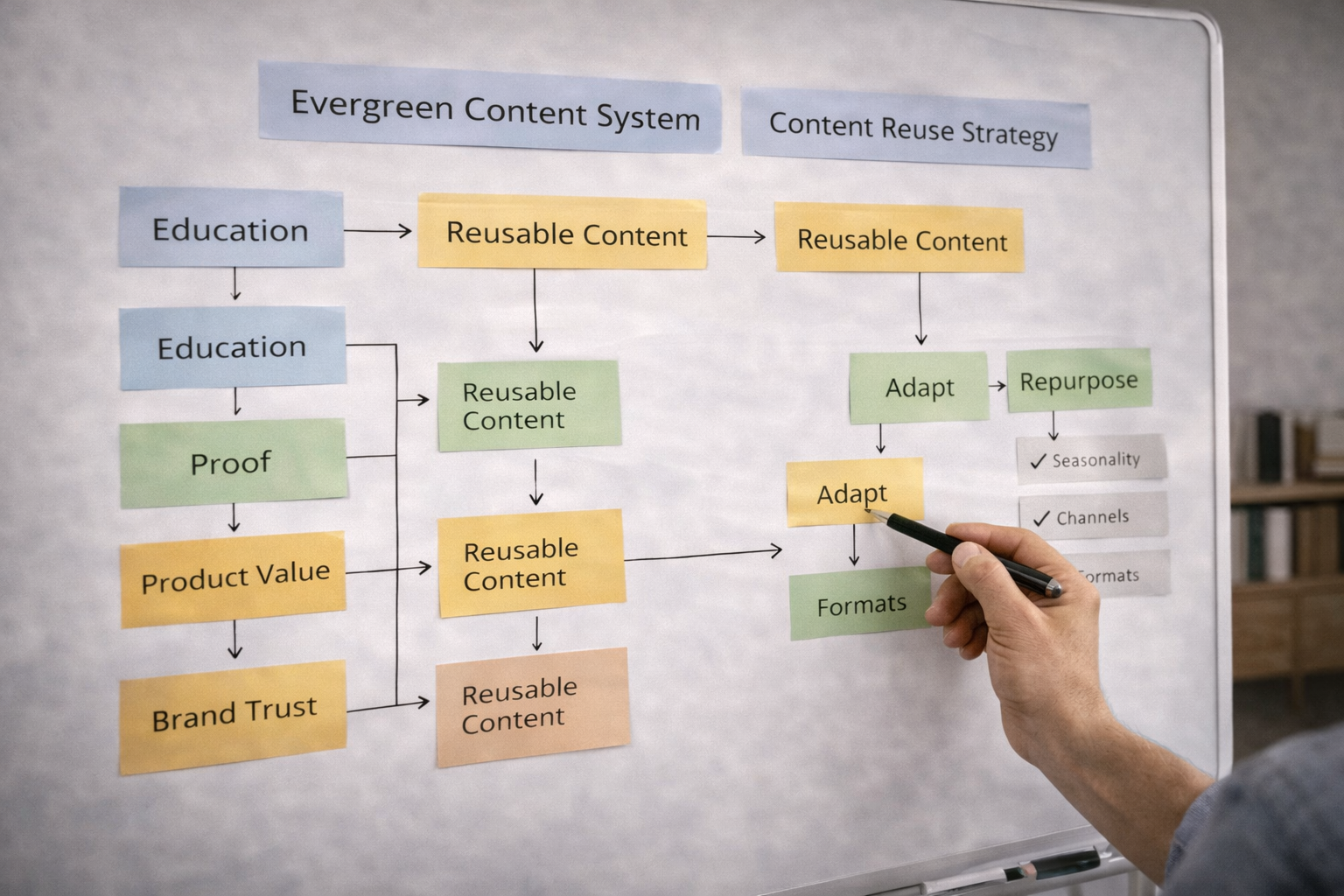
The problem was not output — it was expiration. Assets were designed for a single campaign moment. As a result, the team struggled to keep channels fresh without constant new shoots.
Although the team produced high-quality work, it didn’t compound. Consequently, the content machine kept restarting.

The strategy focused on extending value across time. First, the team built an evergreen content system that could run between campaigns.
Next, they created a clear content distribution plan that sequenced assets over months. Then, they formalized a content reuse strategy so every shoot produced modular inventory.
As a result, asset lifespan extended became a predictable outcome — not a hope.
Instead of relying only on launches, the team defined evergreen pillars: education, proof, product value, and brand trust.
Therefore, content remained useful even when campaigns ended. Moreover, the evergreen content system reduced pressure to constantly “create something new.”

Execution followed the system. The team planned assets in formats that could travel across channels and timelines. Consequently, each campaign shoot produced both launch assets and evergreen variants.
Because the content distribution plan was mapped before publishing, the team scheduled content rollouts in waves: launch week, post-launch proof, and evergreen education.
As a result, asset lifespan extended naturally across months.
The results were visible quickly. Instead of fading after launch, content continued performing in later weeks and months. Consequently, marketing asset utilization improved as teams reused assets across multiple moments.
Additionally, because the evergreen content system was in place, the team maintained baseline visibility. Therefore, campaigns became amplifiers, not the only engine.
The lesson is simple: assets don’t expire because audiences stop caring—assets expire because teams stop distributing them. When a team builds an evergreen content system and follows a content distribution plan, content keeps working.
Moreover, a disciplined content reuse strategy makes every shoot more valuable. As a result, asset lifespan extended becomes a strategic advantage.
Related reading:
If your content stops performing after launch week, you don’t necessarily need more production. Instead, you need a system that extends value across time. Therefore, the fastest path to asset lifespan extended is:
Want help applying this to your next campaign? Share your channels and your next business moment, and we’ll map a distribution and reuse plan that keeps assets working for months.