

Marketing performance alignment doesn’t happen because teams “communicate more”. Instead, it happens when both sides operate inside the same system. When a content system connects briefs, outputs, and learning cycles, marketing and performance stop pushing in different directions.
As a result, a shared content roadmap forms, a creative feedback loop becomes normal, and campaign performance insights turn into better content — not just better reports.
The client had a capable brand marketing team and a strong performance marketing function. However, they operated on different clocks.
While brand planned campaigns and launches, performance optimized week-to-week based on results.
Consequently, content creation didn’t consistently reflect what was working.
They weren’t short on talent. Yet the business needed marketing performance alignment so that creative decisions and performance learnings could compound over time.
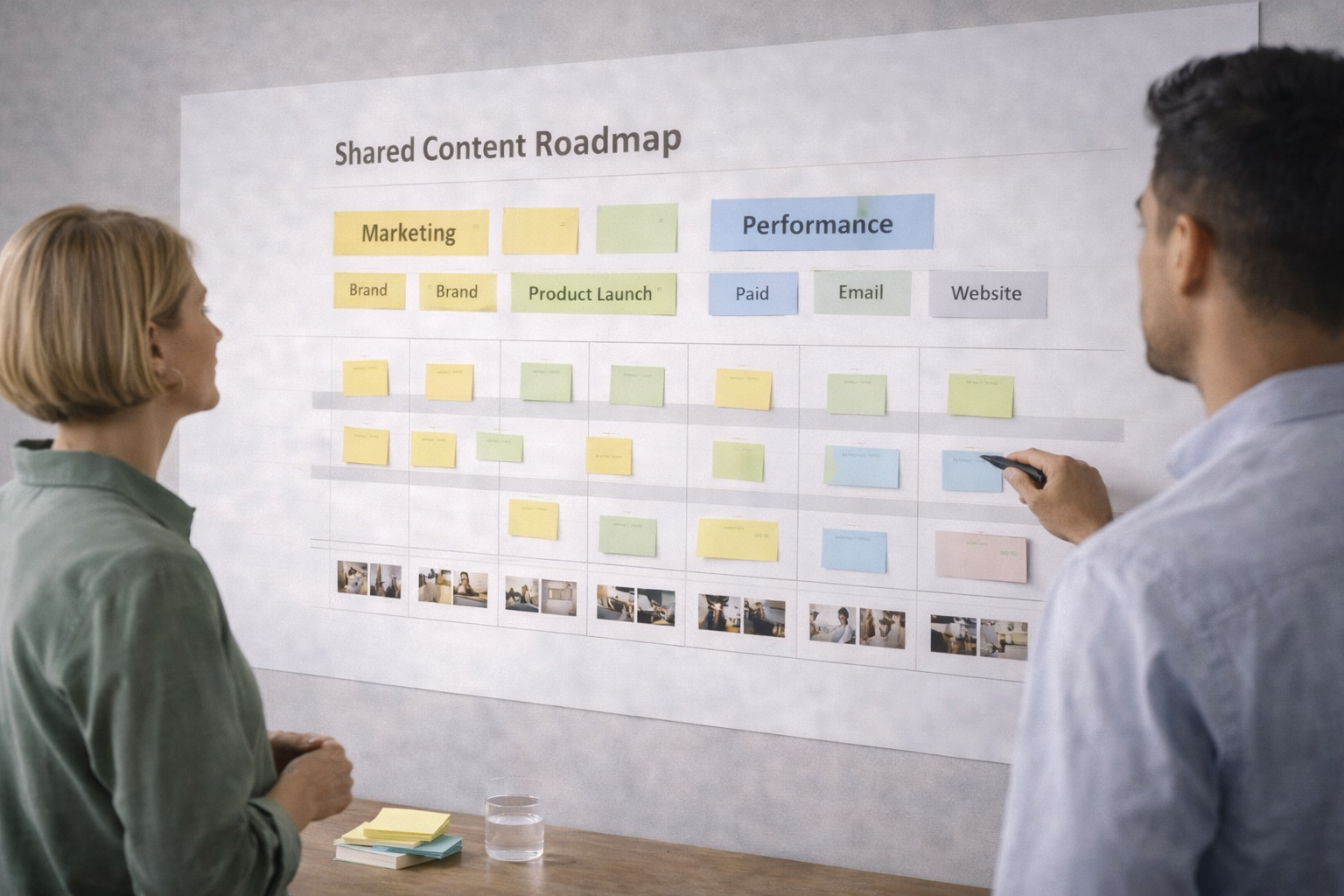
The core challenge was misalignment, not effort. Brand wanted consistency and storytelling. Performance needed speed and iteration. Therefore, content decisions were often debated instead of resolved.
As a result, both teams worked hard, but the system didn’t learn. Consequently, marketing performance alignment remained inconsistent.

The strategy was to stop treating content as one-off deliverables. Instead, the client built a content system that created a shared operating layer. First, both teams agreed on a common definition of “useful content.”
Next, they mapped a shared content roadmap. Then, they formalized a creative feedback loop that connected iteration to outcomes. As a result, marketing performance alignment improved without adding meetings.
A shared content roadmap clarified priorities by week and by channel. Therefore, marketing could plan for launches and brand consistency, while performance could plan for testing cycles.
Moreover, the roadmap reduced reactive requests because needs were visible early. Additionally, roadmap items included expected formats and outcomes.
Consequently, the content system aligned production to usage — not just aesthetics.

Execution focused on building learning into the workflow. Rather than shipping content and moving on, the teams created a consistent creative feedback loop: performance shared learnings, marketing translated them into next outputs, and production shipped iterations.
As a result, campaign performance insights became inputs — weekly. The content system standardized how requests were made and how results were reviewed.
Therefore, teams spent less time clarifying and more time improving. Additionally, because both teams used the same roadmap, decisions became faster.
Consequently, marketing performance alignment held even when priorities changed.
Results showed up in speed, confidence, and consistency. Because the shared roadmap reduced ambiguity, the teams moved faster without sacrificing quality. Moreover, because campaign performance insights fed the system, creative improved with every cycle.
Consequently, marketing performance alignment became measurable.
Additionally, fewer conflicts appeared late in the process. Therefore, reviews became refinement rather than negotiation. As a result, output stayed predictable across campaigns.
Marketing and performance teams don’t align by trying harder. They align when they share a system. When a content system defines how work is requested, produced, and improved, a shared roadmap becomes normal.
Moreover, a creative feedback loop ensures that campaign performance insights directly shape what gets made next. As a result, marketing performance alignment becomes durable — not fragile.
If marketing and performance feel like separate worlds, your issue isn’t talent. It’s the operating layer. Therefore, the fastest path to marketing performance alignment is to:
Want to align your teams in one planning cycle? Share your top channels and current workflow, and we’ll map a shared roadmap and feedback loop that makes performance insights usable — not just visible.