
1. The Problem
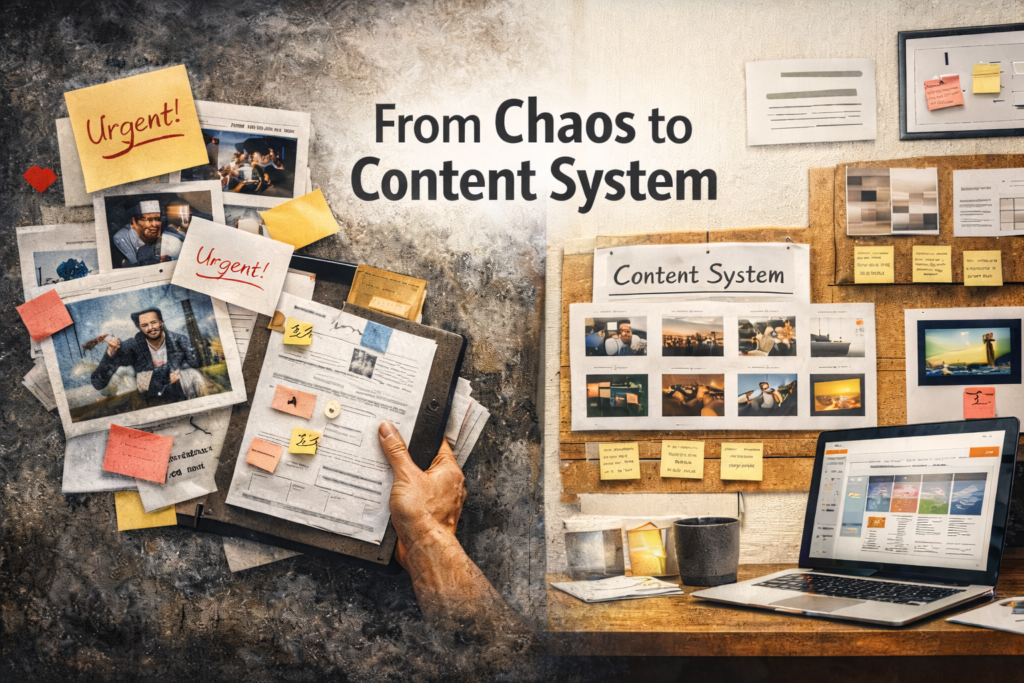
When Prestige Artists came to us, the issue wasn’t a lack of creativity — it was the absence of a content system strategy. Without a system, content became a series of isolated projects, and every new initiative triggered another one-off sprint. The organization was relying on one-off shoots to solve immediate needs, but those shoots weren’t designed to support a repeatable content production workflow. Over time, the same pattern emerged: brief, shoot, post, scramble, repeat.
- One-off shoots planned in isolation
- Constant requests for “new content” from multiple stakeholders
- No continuity across channels — ads, website, and launches drifted visually
They weren’t short on content. They were short on a planned content system that could make content compound.
Internally, this showed up as stress: repeated onboarding, last-minute asks, unclear file ownership, and inconsistent outputs.
Externally, it showed up as weaker brand recognition — because visual content consistency couldn’t hold across channels.
2. The Shift: A Content System Strategy Built Around Use Cases

The turning point was introducing a content system strategy that treated photography and video like owned media. Instead of asking “What should we shoot?”, we asked: “What does the business need content to do”?
A planned content system starts with distribution. Production is built to serve ads, website, and launches — by design.
We implemented a planned content system by mapping the brand’s most common use cases and building a repeatable content production workflow around them. This is where campaign photography strategy became essential: shoots were no longer “creative days” — they became planned inputs into a content engine.
- Introduced a planned content system with a consistent cadence
- Planned shoots around use cases: ads, site updates, launches, evergreen brand assets
- Defined content outputs before production (formats, ratios, variations, modules)
- Standardized the content production workflow to reduce resets and bottlenecks
- Built visual content consistency into the process, not as an afterthought
With a clearer campaign photography strategy, Prestige Artists could capture versatile assets in fewer sessions, with fewer surprises, because every shot had a purpose and a destination. The system also made approvals faster — because expectations were defined upfront.
3. The Outcome: Predictable Output And Multi-Channel Reuse
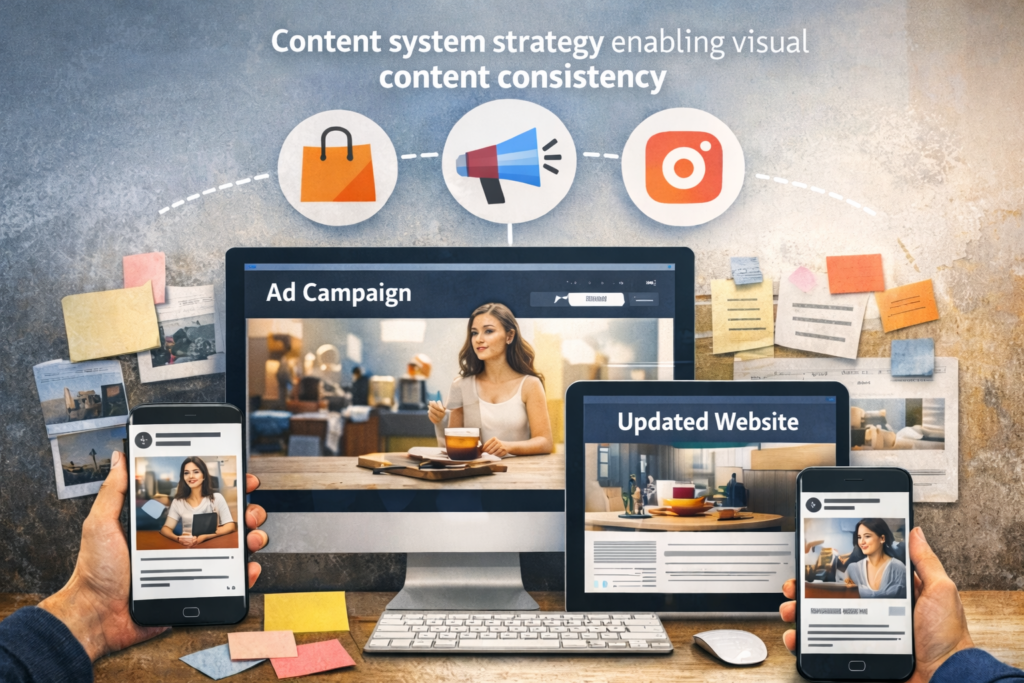
After adopting the content system strategy, content stopped being a recurring emergency. The team gained predictability: a reliable planned content system, clearer roles, and an improved content production workflow that removed friction.
- Content used across multiple channels — ads, website, launches—with minimal rework
- Reduced creative firefighting because outputs were planned and accessible
- Clear internal alignment through shared priorities and a common content inventory
- Stronger visual content consistency across the customer journey
The same shoot supported ads, website, and launches because the campaign photography strategy was planned like media.
The biggest change wasn’t that Prestige Artists “made more content.” It was that their content finally worked like a system: planned, reusable, and aligned to real use cases — supported by a repeatable content production workflow.
4. The Takeaway: Systems Create Leverage

This case study is a reminder that content scale isn’t a volume problem — it’s a structure problem. A content system strategy makes every shoot more valuable because the outputs are designed to compound. With a planned content system, teams stop resetting and start building.
- Systems > volume (predictability compounds)
- Planning creates leverage (one shoot supports multiple channels)
- Visual content consistency is built through process, not willpower
- A strong campaign photography strategy turns content into media inventory
Core Lesson
If you want content to deliver ROI, stop buying isolated shoots. Invest in a content system strategy and a repeatable content production workflow—so your planned content system keeps delivering long after launch day.