
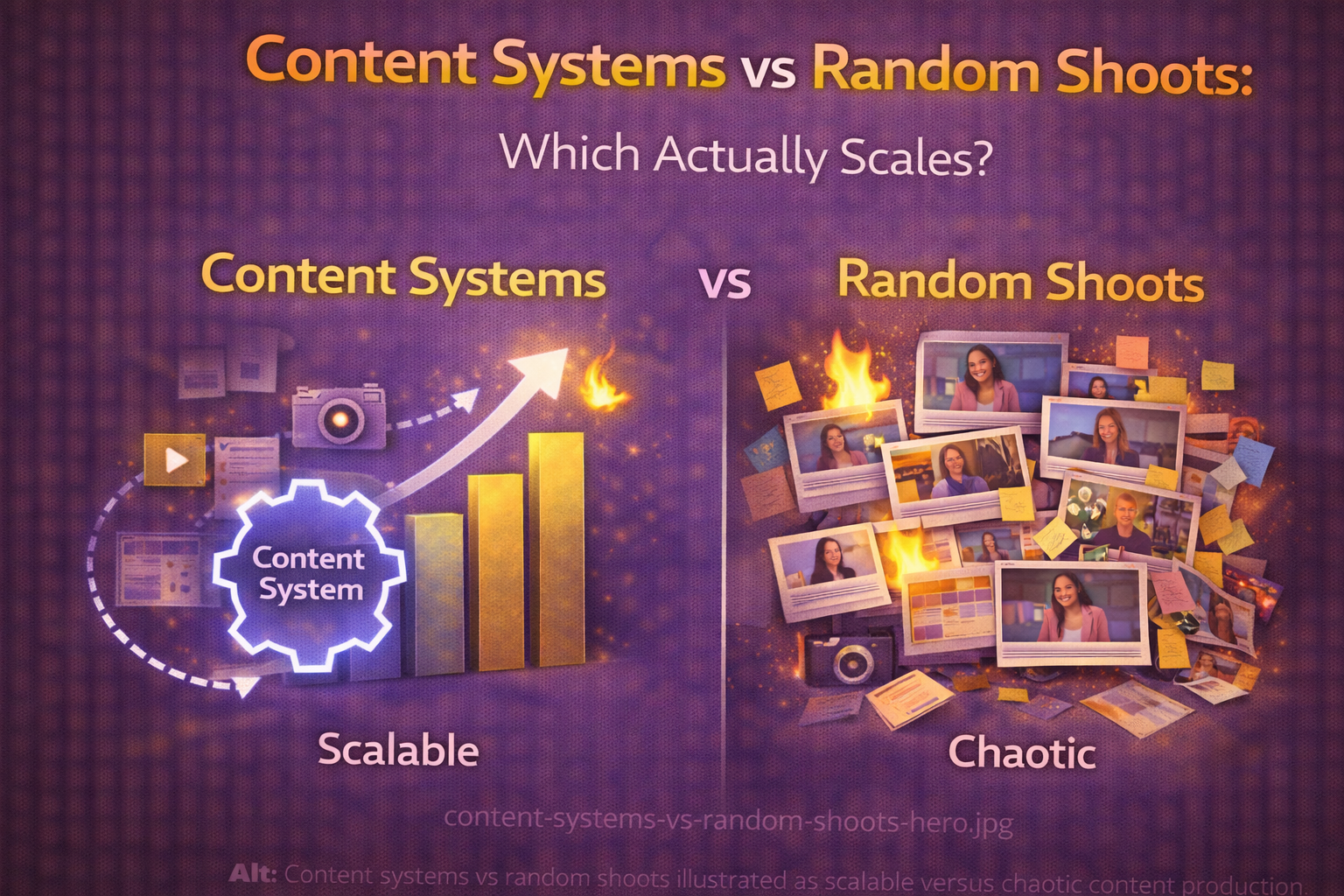
Content systems vs random shoots is one of the most important decisions modern marketing teams face. While random shoots can feel flexible and creative, they rarely scale. In contrast, content systems are built for repetition, efficiency, and growth. Over time, the difference becomes impossible to ignore.
In short, systems scale. Chaos does not.
What You Will Learn About Content Systems vs Random Shoots?
- What are random shoots?
- What is a content system?
- What is the hidden cost of random shoots?
- Why random content can’t scale?
- What is the difference between creating content and building infrastructure?
- How do content systems improve scalability?
- Why content systems don’t mean system-led creative?
- What is the difference between before the system vs after the system?
- How to transition from random shoots to a content system?
What Are Random Shoots?
Many brands create content only when a problem appears. A product launch needs images. Social media content is running low. An advertising campaign requires creative assets. A website needs updating.
As a result, a shoot is scheduled to solve the immediate need. This approach is commonly known as a random shoot. Random shoots are not necessarily poorly executed.
The photography may be excellent, creative direction may be strong and problem is not the quality of the content. The problem is that production is often disconnected from a larger strategy, campaign plan, or content system.
Instead of supporting long-term marketing objectives, the shoot exists primarily to solve a short-term problem.
For a broader comparison of these approaches, see One-Off Shoot vs Content System: A Side-By-Side Comparison and Why Random Content Can’t Win In A Competitive Market.
Reactive Production
One of the defining characteristics of random shoots is reactive production. Content is created in response to an immediate requirement. Examples include:
- A Product Launch Is Approaching
- Social Media Content Is Running Low
- Advertising Needs New Creative
- Website Assets Are Missing
- A Marketing Deadline Is Approaching
The production becomes a reaction to a problem rather than part of a long-term strategy. This often creates a cycle of:
- Content Shortages
- Emergency Productions
- Last-Minute Decisions
- Repeated Production Costs
Instead of planning content proactively, brands continuously respond to immediate needs.
Content-On-Demand
Random shoots often function as content-on-demand. Whenever marketing teams require assets, new production is commissioned. The workflow typically looks like:
- Need Content
- Schedule Shoot
- Create Assets
- Use Assets
- Need More Content
- Schedule Another Shoot
While this approach can solve short-term challenges, it rarely creates long-term efficiency. Each production operates independently. Assets are often created without considering future:
- Campaigns
- Advertising Needs
- Product Launches
- Marketing Requirements
As a result, brands remain dependent on continuous production.
Last-Minute Shoots
Many random shoots are organized under time pressure. Examples include:
- Upcoming Launches
- Advertising Deadlines
- Missing Campaign Assets
- Seasonal Promotions
- Unexpected Opportunities
Because planning time is limited, teams often focus on solving the immediate problem. This can create:
- Compressed Timelines
- Higher Stress
- Reduced Strategic Thinking
- Missed Asset Opportunities
- Lower Asset Utilization
The shoot may successfully address the immediate requirement, but it rarely supports broader marketing objectives.
Project-Based Photography
Random shoots are often project-based. Each production exists as an isolated initiative. Examples include:
- Product Launch Shoot
- Seasonal Campaign Shoot
- Website Refresh Shoot
- Advertising Shoot
- Social Media Content Shoot
Each project begins with a specific need and ends once the deliverables are produced. The challenge is that every new requirement often triggers a completely new production cycle.
This creates repeated:
- Planning
- Costs
- Production Effort
- Content Gaps
Instead of building momentum, marketing teams continually start over.
Unplanned Content Creation
Perhaps the biggest characteristic of random shoots is unplanned content creation. Content is produced without a larger framework connecting:
- Business Objectives
- Campaign Planning
- Asset Libraries
- Distribution Strategies
- Performance Tracking
As a result, assets often become:
- Underutilized
- Difficult To Find
- Difficult To Reuse
- Campaign-Specific
- Short-Lived
The content itself may be valuable. The problem is that it is rarely integrated into a larger system capable of maximizing its value.
Why Random Shoots Feel Productive
Random shoots often create a sense of progress. New content is produced. Campaigns launch. Marketing activity increases. However, activity and scalability are not the same thing. Many brands find themselves repeatedly facing:
- Content Shortages
- Campaign Gaps
- Asset Waste
- Reactive Marketing
- Production Bottlenecks
The reason is simple: Random shoots create content. They do not create infrastructure.
The Difference Between Random Shoots And Content Systems
Random shoots focus on:
- Immediate Needs
- Individual Projects
- Short-Term Content Requirements
- Reactive Production
- Deliverables
Content systems focus on:
- Planning
- Campaign Support
- Asset Libraries
- Distribution
- Long-Term Marketing Value
Both approaches produce content. The difference is what happens after the shoot.
Random Shoots Solve Today’s Problem
Random shoots are often effective at solving immediate content needs. They can support:
- Product Launches
- Campaign Deadlines
- Website Updates
- Advertising Requirements
- Social Media Demands
However, because they are reactive by nature, they rarely solve the underlying issue. The content shortage eventually returns. The next campaign requires new assets and the next marketing initiative triggers another production.
Ultimately, random shoots create content for today’s problem. Content systems create infrastructure that supports tomorrow’s opportunities as well.
What Is A Content System?
A content system is a structured framework that helps brands consistently plan, create, manage, distribute, and improve content over time. Many brands focus almost entirely on content creation.
They schedule photoshoots when content is needed, create assets for campaigns and publish content across marketing channels. Then the cycle repeats.
While content creation is important, it is only one part of the process. Without a system, content often becomes:
- Reactive
- Inconsistent
- Difficult To Scale
- Hard To Manage
- Expensive To Maintain
A content system solves these challenges by connecting every stage of the content lifecycle into a repeatable process.
Instead of treating content as individual projects, brands create a framework that supports ongoing marketing activities, campaign execution, and business growth.
For a deeper exploration of this concept, see Why Brands Need Content Infrastructure, Not More Shoots and One-Off Shoot vs Content System: A Side-By-Side Comparison.
Planning
Every successful content system begins with planning. Planning ensures content is created intentionally rather than reactively. Before production begins, brands define:
- Business Objectives
- Marketing Goals
- Campaign Priorities
- Customer Acquisition Targets
- Distribution Requirements
- Content Needs
Planning helps answer important questions such as:
- What Content Do We Need?
- Why Do We Need It?
- Where Will It Be Used?
- Which Business Objective Will It Support?
Without planning, content is often created to solve immediate problems. With planning, content becomes part of a larger growth strategy.
Production
Production is where strategy becomes assets. This stage includes creating the content required to support marketing initiatives. Examples include:
- Campaign Photography
- Product Photography
- Lifestyle Content
- Advertising Assets
- Website Content
- Short-Form Video
- Brand Storytelling Assets
In a content system, production is designed around future usage. Instead of creating assets for a single purpose, brands create content that can support multiple channels, campaigns, and objectives.
This dramatically increases the value generated from every production investment.
Asset Management
Creating content is only valuable if teams can find, access, and reuse it. Asset management ensures content remains organized and usable after production. Examples include:
- Asset Libraries
- File Organization
- Asset Tagging
- Searchability
- Accessibility
- Usage Tracking
Effective asset management helps brands organize:
- Campaign Photography
- Product Photography
- Advertising Creative
- Video Content
- Website Assets
- Marketing Resources
Without asset management, valuable content often becomes lost, forgotten, or underutilized. Strong asset management helps maximize asset lifespan and improve content ROI.
Distribution
Content only creates value when it reaches the right audience. Distribution determines where and how assets are deployed. Examples include:
- Websites
- E-Commerce
- Paid Advertising
- Social Media
- Email Marketing
- Public Relations
- Retail Marketing
- Sales Materials
A strong content system plans distribution before production begins. This ensures assets are intentionally created for the channels that will use them. As a result:
- Asset Utilization Improves
- Campaign Performance Improves
- Marketing Efficiency Improves
- Content ROI Improves
The goal is not simply to create content but to ensure content is used effectively.
Performance Tracking
The final stage of a content system is performance tracking. Many brands stop once content is published. The strongest brands continue by measuring outcomes. Examples include:
- Asset Performance
- Campaign Results
- Advertising Performance
- Conversion Metrics
- Engagement Metrics
- Content Utilization
- ROI
Performance tracking helps answer questions such as:
- Which Assets Perform Best?
- Which Campaigns Generate Results?
- Which Channels Deliver The Highest Return?
- What Should We Create More Of?
- What Should We Improve Next Time?
These insights improve future planning, production, and distribution decisions. Every campaign becomes an opportunity to learn and optimize.
Why Content Systems Scale Better Than Random Shoots

Random shoots often focus on solving immediate content needs. The process typically looks like:
- Need Content
- Schedule Shoot
- Create Assets
- Publish Content
- Run Out Of Content
- Repeat
Content systems take a different approach. They connect:
- Planning
- Production
- Asset Management
- Distribution
- Performance Tracking
into a repeatable framework. The result is:
- Better Organization
- Better Campaign Support
- Better Asset Utilization
- Better Marketing Efficiency
- Better ROI
- More Predictable Growth
Content Systems Create Infrastructure
A content system is not simply a content production process. It is marketing infrastructure. It provides the foundation for:
- Campaign Planning
- Content Creation
- Asset Libraries
- Multi-Channel Distribution
- Performance Optimization
- Long-Term Marketing Growth
Ultimately, random shoots create content. Content systems create a framework that allows content to work harder, last longer, and generate significantly more value over time.
That is why the brands that scale most effectively are often not the brands producing the most content—they are the brands building the strongest content systems.
The Hidden Cost Of Random Shoots
At first glance, random shoots often seem like a practical solution. A content need appears, production is scheduled and assets are created. The immediate problem is solved.
For many brands, this approach feels efficient because each shoot has a clear purpose and a clear outcome. However, the true cost of random shoots is rarely visible on the production invoice.
The largest expenses often appear later through repeated production cycles, underutilized assets, campaign limitations, operational inefficiencies, and lower marketing performance.
While a single random shoot may seem cost-effective, the long-term impact can significantly reduce marketing efficiency and content ROI.
Repeated Production Costs
One of the most significant hidden costs of random shoots is repetition. The workflow often looks like this:
- Need Content
- Schedule A Shoot
- Create Assets
- Launch Campaign
- Run Out Of Content
- Schedule Another Shoot
The cycle repeats continuously. Each production requires:
- Photography
- Creative Direction
- Models
- Styling
- Hair And Makeup
- Locations
- Post-Production
- Project Management
Individually, each investment may appear reasonable. Collectively, the costs accumulate rapidly.
The problem is not the cost of a single shoot but repeatedly recreating the same process because content was never planned for long-term use.
Asset Waste
Many brands already own valuable content assets. Unfortunately, a large percentage of those assets never reach their full potential. Common examples include:
- Campaign Photography Used Once
- Product Images Buried In Folders
- Advertising Assets Forgotten After Launch
- Social Content With No Future Use
- Website Assets Never Repurposed
As a result, brands often commission new productions while existing assets remain underutilized. This creates significant waste.
The issue is not a lack of content but a lack of systems designed to maximize the value of content already created. Every unused asset represents unrealized return on the original production investment.
Campaign Gaps
Random shoots are typically planned around immediate needs. For example:
- Product Launches
- Seasonal Promotions
- Social Media Content
- Website Updates
- Advertising Requests
Because production focuses on a specific objective, other marketing requirements are frequently overlooked. Examples include:
- Missing Advertising Variations
- Limited Email Marketing Assets
- Insufficient Website Content
- Missing Retargeting Creative
- Limited PR Resources
As campaigns evolve, new content requests emerge.
The result is:
- Additional Production
- Shorter Timelines
- Marketing Delays
- Reactive Decision-Making
- Reduced Campaign Efficiency
The campaign may launch successfully, but often lacks the complete asset ecosystem needed for maximum performance.
Operational Inefficiencies
Random shoots often create operational challenges that remain hidden behind production activity. Marketing teams frequently spend time:
- Searching For Assets
- Coordinating New Productions
- Managing Content Requests
- Filling Content Gaps
- Recreating Existing Assets
- Solving Workflow Problems
These activities consume valuable resources. As content demands increase, operational complexity increases as well. Without systems, teams often find themselves solving the same problems repeatedly.
The result is:
- Slower Execution
- Increased Workload
- Higher Internal Costs
- Reduced Marketing Agility
Many brands assume they have a content problem when they actually have an operational problem.
Lower ROI
Perhaps the most important hidden cost is lower return on investment. Content ROI is not determined by how much content is produced. It is determined by how much value that content creates over time.
Random shoots often generate lower ROI because assets typically have:
- Short Lifespans
- Limited Reuse
- Narrow Applications
- Minimal Campaign Extensions
- Limited Cross-Channel Support
As a result, brands must continue investing in new production simply to maintain marketing activity. By contrast, content systems focus on:
- Asset Reuse
- Content Repurposing
- Campaign Support
- Multi-Channel Deployment
- Long-Term Value Creation
The difference in ROI can be substantial.
Why These Costs Often Go Unnoticed
The hidden costs of random shoots rarely appear immediately. Most brands focus on:
- Production Budgets
- Deliverables
- Shoot Logistics
- Campaign Deadlines
What often goes unnoticed are the long-term consequences:
- Repeated Production Costs
- Asset Waste
- Campaign Gaps
- Operational Inefficiencies
- Lower ROI
Because these costs accumulate gradually, they can become embedded within the marketing process without being questioned.
The Real Cost Is Not The Shoot
Random shoots can produce excellent photography. The issue is not quality. The issue is scalability. As marketing demands increase, random production becomes increasingly difficult to sustain.
What initially appears flexible often becomes expensive, inefficient, and difficult to manage.
The hidden costs of random shoots include:
- Repeated Production Costs
- Asset Waste
- Campaign Gaps
- Operational Inefficiencies
- Lower ROI
Ultimately, the most expensive part of a random shoot is often not the production itself. It is the marketing value that never gets fully realized because the content was created without a system designed to maximize its long-term impact.
Why Random Content Can’t Scale
Many brands believe they have a content volume problem. When content runs low, the solution seems obvious:
- Create More Content
- Schedule Another Shoot
- Produce More Assets
- Publish More Frequently
At first, this approach can appear effective. Marketing continues moving. Campaigns launch. Social media remains active.
However, as content demands increase, many brands discover that random content creation becomes increasingly difficult to sustain.
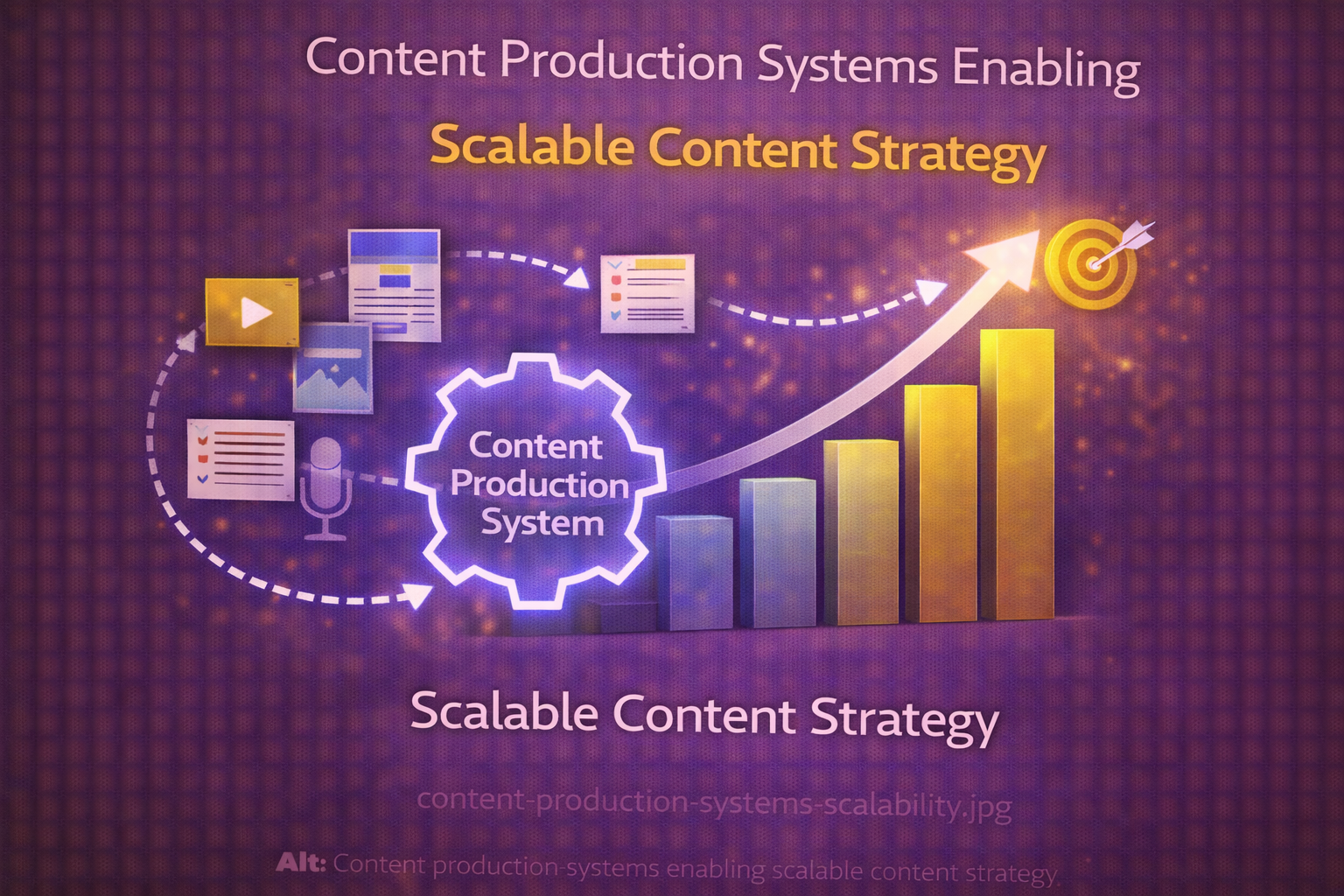
The issue is not the quality of the content but the absence of a system. Without planning, asset management, distribution processes, and performance tracking, content creation often becomes reactive and inefficient.
Over time, this creates operational challenges that make scaling difficult. For a broader discussion of this topic, see Why Random Content Can’t Win In A Competitive Market.
Short Asset Lifespans
One of the biggest limitations of random content is its short lifespan. Most random productions are designed to solve a specific need.
Examples include:
- Product Launches
- Seasonal Promotions
- Social Media Content
- Website Updates
- Advertising Requests
The content is created, published, and then quickly replaced. As a result, many assets remain valuable for only:
- Days
- Weeks
- A Single Campaign Cycle
When content is not planned for future use, brands continuously need new production. This creates a dependency on constant content creation simply to maintain marketing activity.
No Asset Libraries
Random content creation rarely prioritizes long-term asset management. Assets are often stored across:
- Hard Drives
- Shared Folders
- Cloud Storage Platforms
- Email Threads
- Agency Deliveries
Over time, valuable content becomes difficult to locate and difficult to reuse. Marketing teams frequently experience:
- Lost Assets
- Duplicate Production
- Repeated Requests
- Unused Content
- Asset Waste
Without asset libraries, content remains disconnected from future marketing opportunities. The brand owns the assets but struggles to access their full value.
Repeated Production Cycles
Random content often creates a predictable cycle.
- Need Content
- Schedule Shoot
- Create Assets
- Publish Content
- Run Out Of Content
- Repeat
Every new campaign, launch, or marketing initiative triggers another production request. This repeated cycle creates additional:
- Costs
- Planning
- Coordination
- Operational Complexity
Instead of building momentum, marketing teams continually restart the process. The result is a content operation that becomes increasingly dependent on production rather than strategy.
Inconsistent Workflows
Random content creation rarely follows a consistent framework. Each project may involve different:
- Objectives
- Timelines
- Teams
- Creative Directions
- Deliverables
As a result, workflows often become unpredictable. Examples include:
- Last-Minute Requests
- Missing Deliverables
- Inconsistent Asset Standards
- Communication Challenges
- Variable Production Outcomes
Without repeatable processes, scaling becomes difficult because every project requires significant manual coordination.
Marketing Bottlenecks
As content demands increase, operational bottlenecks become more visible. Marketing teams often spend time:
- Searching For Assets
- Coordinating Productions
- Filling Content Gaps
- Managing Requests
- Solving Workflow Problems
- Recreating Existing Content
These activities slow execution and consume resources that could otherwise be invested in strategy and growth. The larger the brand becomes, the more severe these bottlenecks often become.
What worked at a smaller scale becomes increasingly difficult to manage.
Why Scaling Requires More Than Content
Many brands attempt to solve scalability challenges through production volume. The assumption is: More Content = More Growth
In reality, scalability often comes from creating more value from existing content. The brands that scale successfully focus on:
- Planning
- Asset Libraries
- Distribution Systems
- Campaign Frameworks
- Performance Measurement
- Content Infrastructure
These systems allow content to support growth without requiring constant new production.
The Difference Between Activity And Scalability
Random content creates activity. There is always another shoot, campaign, asset request or deadline. However, activity alone does not create scalability.
Scalability requires:
- Repeatable Processes
- Organized Assets
- Consistent Workflows
- Long-Term Planning
- Efficient Resource Allocation
Without these elements, content creation becomes increasingly difficult to sustain as marketing demands grow.
Why Content Systems Scale Better
Random content often creates:
- Short Asset Lifespans
- No Asset Libraries
- Repeated Production Cycles
- Inconsistent Workflows
- Marketing Bottlenecks
Content systems help brands achieve:
- Longer Asset Lifespans
- Organized Asset Libraries
- More Efficient Production
- Consistent Workflows
- Faster Marketing Execution
- Better ROI
Ultimately, random content can support short-term marketing needs. But scaling requires something more. It requires a system that allows content to be planned, managed, distributed, and optimized over time.
That is why the brands that scale most effectively are rarely the brands creating the most content. They are the brands creating the strongest systems around the content they produce.
The Difference Between Creating Content And Building Infrastructure
Many brands believe content creation is the solution to their marketing challenges and when content runs low, they schedule another shoot. When campaigns need assets, they create more content and when advertising requires fresh creative, they commission another production.
At first, this seems logical. Marketing requires content. However, there is a fundamental difference between creating content and building content infrastructure.
Creating content produces assets. Building infrastructure creates systems that allow those assets to generate value repeatedly over time.
Understanding this distinction is often what separates reactive marketing from scalable marketing.
For a deeper exploration of this concept, see Why Brands Need Content Infrastructure, Not More Shoots.
Assets vs Systems
Content creation focuses on assets. Examples include:
- Campaign Photography
- Product Photography
- Videos
- Advertising Creative
- Social Media Content
- Website Assets
These assets are essential. Without them, marketing cannot function. However, assets alone do not create scalability. A content system focuses on building the framework around those assets.
Examples include:
- Campaign Planning
- Asset Libraries
- Content Workflows
- Distribution Systems
- Performance Tracking
- Marketing Operations
Assets are what a brand creates. Systems determine how effectively those assets are used. The strongest brands understand that assets and systems must work together.
Production vs Operations
Many brands invest heavily in production. They focus on:
- Photoshoots
- Video Productions
- Creative Direction
- Content Creation
- Deliverables
Production is highly visible. It is where content comes from. However, operations often determine whether content succeeds.
Content operations include:
- Organizing Assets
- Managing Content Libraries
- Planning Campaigns
- Coordinating Distribution
- Tracking Performance
- Supporting Marketing Teams
Without strong operations, even exceptional content can become underutilized. A great production creates assets. Great operations ensure those assets continue generating value.
Deliverables vs Outcomes
Traditional content creation often revolves around deliverables. Questions include:
- How Many Images?
- How Many Videos?
- How Many Assets?
- What Is Included?
These questions focus on output. Infrastructure focuses on outcomes. Questions become:
- How Will These Assets Support Marketing?
- Which Campaigns Will They Power?
- How Will They Support Customer Acquisition?
- How Long Will They Remain Valuable?
- What Return Will They Generate?
Deliverables measure what was created. Outcomes measure what was achieved. This distinction fundamentally changes how content investments are evaluated.
Content vs Infrastructure
Content is what customers see. Infrastructure is what enables content to perform. Content examples include:
- Photography
- Video
- Advertising Assets
- Website Content
- Social Media Posts
Infrastructure includes:
- Planning Processes
- Asset Libraries
- Distribution Frameworks
- Campaign Calendars
- Content Systems
- Performance Measurement
Content attracts attention. Infrastructure helps content scale. Without infrastructure, brands often experience:
- Content Shortages
- Repeated Production
- Asset Waste
- Reactive Marketing
- Inconsistent Execution
Infrastructure solves these challenges by creating repeatable systems that support long-term growth.
Why Many Brands Stay Stuck
Many marketing teams spend most of their time creating content. The cycle often looks like:
- Need Content
- Produce Content
- Publish Content
- Need More Content
- Produce More Content
While this creates activity, it rarely creates scalability. The underlying infrastructure remains unchanged. As content demands increase, the workload increases as well.
The result is more:
- Production
- Complexity
- Costs
- Content Requests
- Operational Challenges
The business creates more assets without improving the system that manages them.
Infrastructure Creates Leverage
The purpose of infrastructure is leverage. A content system allows a single production to support:
- Multiple Campaigns
- Multiple Channels
- Multiple Marketing Objectives
- Future Initiatives
- Long-Term Brand Building
Instead of relying on constant production, brands maximize the value of assets they already own. The result is:
- Better Asset Utilization
- Longer Asset Lifespans
- Faster Campaign Execution
- Better Marketing Efficiency
- Higher Content ROI
Infrastructure helps every asset work harder.
Content Creation Solves Immediate Needs
Content creation is important. It solves immediate marketing requirements. It provides:
- Photography
- Video
- Advertising Creative
- Campaign Assets
- Marketing Resources
However, content creation alone does not solve:
- Content Shortages
- Asset Waste
- Marketing Inefficiencies
- Scalability Challenges
- Operational Complexity
Those challenges are solved by infrastructure.
The Brands That Scale Build Both
The most successful brands do not choose between content and infrastructure. They build both. Content creation provides:
- Assets
- Creative Resources
- Campaign Support
Infrastructure provides:
- Systems
- Processes
- Asset Libraries
- Distribution Frameworks
- Performance Optimization
Together, they create a marketing engine capable of supporting long-term growth. Ultimately, creating content produces assets. Building infrastructure ensures those assets continue generating value long after they are created.
That is why scalable brands focus not only on producing content—but also on building the systems that allow content to perform at its highest potential.
How Content Systems Improve Scalability
As brands grow, content demands increase. More campaigns, channels, products and more marketing initiatives.
Many brands respond by creating more content. They schedule more shoots, produce more assets, and expand production efforts. However, producing more content does not automatically create scalability.
In fact, without the right systems, increased production often creates more complexity, more operational challenges, and more content waste.
Scalability comes from creating more value from existing assets rather than continuously creating new ones. This is where content systems create a significant advantage.
By improving asset management, distribution, reuse, and optimization, content systems help brands support growth without requiring production to increase at the same rate.
For a practical example of this transformation, see Before The System vs After The System: A Content Transformation.
Asset Libraries
One of the foundations of scalability is access to content. Many brands already own valuable assets but struggle to find, organize, or reuse them. Without asset libraries, content often becomes:
- Difficult To Locate
- Difficult To Reuse
- Underutilized
- Forgotten
- Recreated Unnecessarily
Content systems solve this problem through centralized asset libraries. These libraries organize:
- Campaign Photography
- Product Photography
- Advertising Assets
- Video Content
- Website Assets
- Brand Resources
As content libraries grow, brands become less dependent on constant production because valuable assets remain accessible and ready to deploy.
The result is greater efficiency and better utilization of every content investment.
Repurposing
Scalable brands rarely create assets for a single use. Instead, they design content for repurposing. A single production may generate assets that support:
- Social Media
- Paid Advertising
- Email Marketing
- Product Launches
- Website Content
- Public Relations
- Retail Marketing
Examples include:
- Campaign Images Repurposed For Advertising
- Product Photography Used In Email Campaigns
- Website Assets Adapted For Social Content
- Lifestyle Photography Used In PR Initiatives
Repurposing allows brands to create significantly more marketing value from the same production investment. Instead of constantly producing new content, brands maximize the usefulness of existing assets.
Multi-Channel Deployment
Modern customers interact with brands across multiple channels. Examples include:
- TikTok
- Paid Advertising
- Websites
- Email Marketing
- Product Pages
- Retail Environments
- Public Relations
Without a content system, brands often create separate assets for each channel. This increases production requirements and operational complexity.
Content systems improve scalability by planning assets for multi-channel deployment from the beginning. A single asset may support:
- Advertising
- Website Content
- Social Media
- Email Marketing
- Sales Materials
- Retail Displays
The more channels an asset can support, the greater the return generated from its creation.
Campaign Extensions
Many campaigns end while valuable assets remain underutilized. Content systems extend the lifespan of campaigns by creating opportunities for continued use. Examples include:
- Retargeting Campaigns
- Seasonal Promotions
- Product Relaunches
- Customer Retention Initiatives
- Brand Awareness Campaigns
- Future Collection Support
Instead of treating campaigns as isolated events, brands treat them as sources of long-term marketing assets. This dramatically increases asset value while reducing future production requirements.
The campaign becomes an ongoing resource rather than a temporary activity.
Performance Optimization
Scalability is not only about producing and distributing content. It is also about improving future decisions. Content systems include performance tracking and optimization.
Examples include:
- Asset Performance Analysis
- Campaign Results
- Advertising Metrics
- Conversion Data
- Engagement Metrics
- Content Utilization Tracking
These insights help brands understand which:
- Assets Generate Results?
- Channels Perform Best?
- Campaigns Create The Most Value?
- Content Should Be Produced More Often?
Instead of relying on assumptions, future production decisions become informed by data. This creates a feedback loop that continuously improves marketing performance.
Why Random Content Struggles To Scale
Random content creation often creates:
- Short Asset Lifespans
- Repeated Production Cycles
- Content Shortages
- Operational Bottlenecks
- Marketing Inefficiencies
The business becomes increasingly dependent on new production simply to maintain activity. As growth accelerates, the workload increases proportionally. This makes scaling expensive and difficult.
Why Content Systems Scale Better
Content systems improve scalability through:
- Asset Libraries
- Repurposing
- Multi-Channel Deployment
- Campaign Extensions
- Performance Optimization
These elements allow brands to create more value from every asset while reducing dependency on constant production.
The result is:
- Better Asset Utilization
- Greater Marketing Efficiency
- Faster Campaign Execution
- Longer Asset Lifespans
- Higher Content ROI
- More Sustainable Growth
Scalability Comes From Systems
Many brands assume scalability comes from producing more content. In reality, scalability often comes from building systems that help content work harder. Content systems create leverage.
A single production can support more:
- Channels
- Campaigns
- Marketing Objectives
- Customer Touchpoints
- Business Growth
Ultimately, content systems improve scalability because they transform content from isolated assets into a coordinated marketing infrastructure.
That infrastructure allows brands to grow more efficiently, operate more consistently, and generate greater value from every content investment over time.
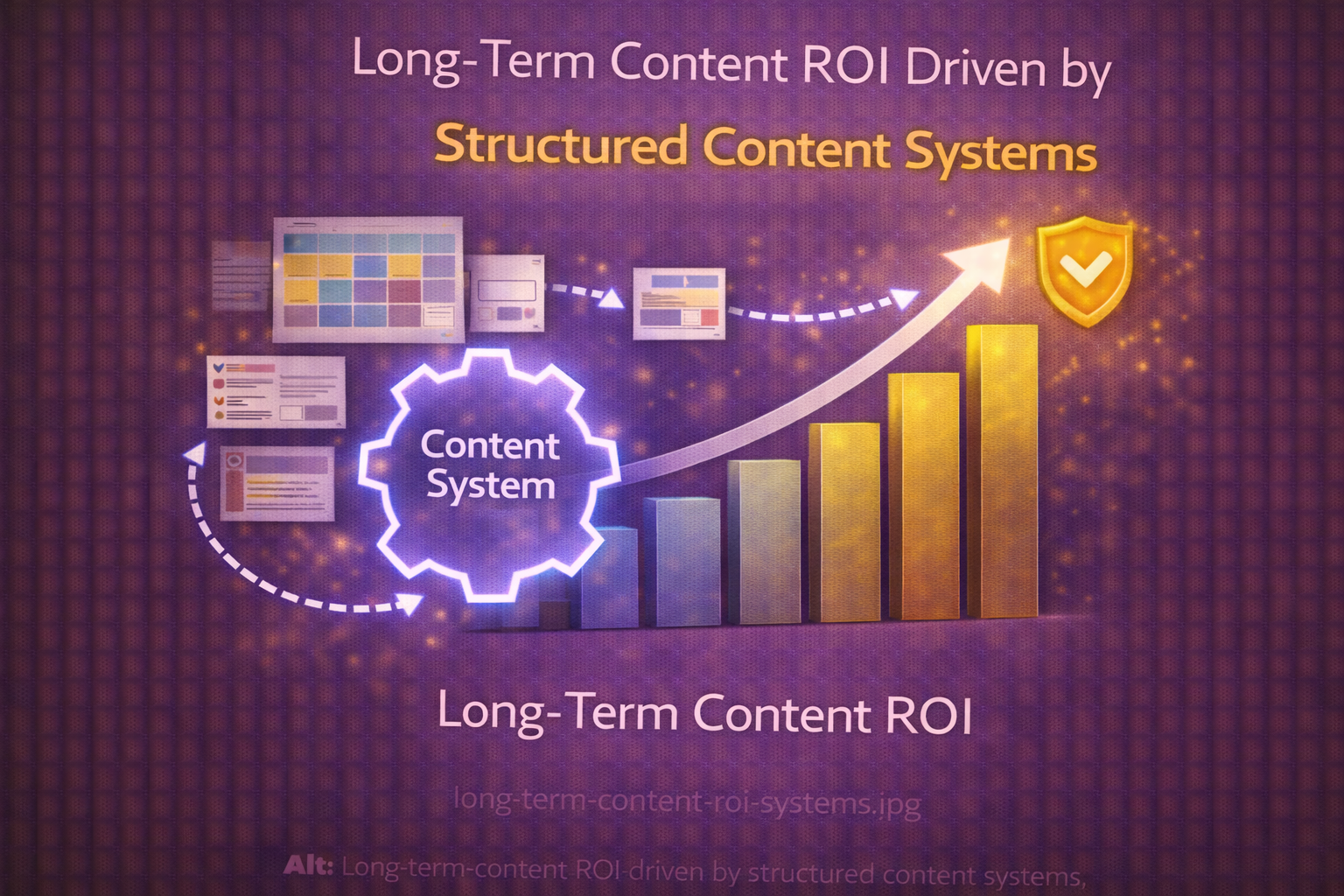
Long-term content ROI is driven by accumulation. Each asset should reinforce what already exists. Content systems enable reuse, adaptation, and distribution at scale — while random shoots expire quickly.
Content Systems Don’t Mean System-Led Creative
One of the most common misconceptions about content systems is that they reduce creativity. Many marketers hear terms such as:
- Systems
- Processes
- Workflows
- Infrastructure
and immediately assume creativity will become restricted. They imagine repetitive content. Predictable campaigns. Formulaic production. Generic outputs.
However, this is not what effective content systems are designed to do. A strong content system does not replace creativity. It supports creativity.
The goal is not to build a system that dictates creative decisions but to build a system that allows great creative work to perform more effectively.
This distinction is one of the reasons we discuss in Why We Don’t Believe In System-Led Creative that brands should never allow systems to become the primary driver of creative decisions.
Structure Supports Creativity
Many people view structure and creativity as opposites. In reality, the opposite is often true. Without structure, creative teams frequently spend time dealing with:
- Content Shortages
- Last-Minute Requests
- Missing Assets
- Production Delays
- Marketing Emergencies
- Unclear Objectives
These challenges reduce the time and energy available for creative thinking. A content system removes unnecessary friction.
By providing:
- Planning
- Asset Libraries
- Clear Objectives
- Production Frameworks
creative teams gain more freedom to focus on the work itself. Structure does not eliminate creativity. It creates the conditions for creativity to thrive.
Brand Strategy First
The strongest brands do not build content systems first. They build brand strategy first. A content system should always support:
- Brand Positioning
- Brand Identity
- Brand Values
- Customer Perception
- Marketing Objectives
The system exists to help execute the strategy. Not the other way around.
When systems become the primary focus, brands often drift toward efficiency at the expense of differentiation. The result can be content that is organized but forgettable.
Effective content systems ensure that strategy remains the foundation of every creative decision.
Creative Direction Matters
Content systems are operational frameworks. Creative direction is what gives content meaning. Creative direction determines:
- Visual Identity
- Brand Personality
- Storytelling
- Emotional Impact
- Customer Perception
- Market Positioning
Two brands may have identical content systems. However, if their creative direction differs, the resulting content will look completely different.
This is why creative direction remains one of the most important factors in marketing performance. The system organizes production. Creative direction creates distinction.
Systems Enable Better Creative Execution
One of the greatest advantages of a content system is that it improves execution. Without a system, creative teams often face:
- Compressed Timelines
- Missing Deliverables
- Production Bottlenecks
- Resource Constraints
- Inconsistent Processes
These issues can limit the quality of the final work. Content systems improve execution by creating better:
- Planning
- Resource Allocation
- Production Coordination
- Asset Management
- Campaign Support
As a result, creative concepts have a greater chance of being executed at a high level. The system becomes an enabler rather than a constraint.
Avoiding Commodity Content
Perhaps the biggest danger of system-led creative is the creation of commodity content. When brands prioritize efficiency above everything else, content often becomes:
- Predictable
- Generic
- Interchangeable
- Trend-Driven
- Forgettable
This is increasingly common in a world where:
- Templates Are Everywhere
- AI Generates Content Instantly
- Trends Spread Rapidly
- Platforms Encourage Similar Formats
As more brands adopt identical content approaches, differentiation becomes more valuable. Strong brands avoid commodity content by ensuring that:
- Brand Strategy Leads
- Creative Direction Leads
- Storytelling Leads
- Customer Understanding Leads
The system supports these elements but never replaces them.
The Difference Between System-Led And Brand-Led Content
System-Led Content
Often prioritizes:
- Efficiency
- Volume
- Workflows
- Processes
- Output
Brand-Led Content
Prioritizes:
- Differentiation
- Brand Identity
- Customer Perception
- Storytelling
- Strategic Objectives
The strongest brands combine both approaches. They use systems to improve execution while allowing brand strategy and creative direction to shape the content itself.
The Best Systems Stay Invisible
The most effective content systems are often invisible to the audience. Customers do not notice:
- Asset Libraries
- Workflow Processes
- Campaign Calendars
- Production Frameworks
What customers notice is:
- Strong Creative
- Consistent Branding
- Memorable Campaigns
- Distinctive Visual Identity
- Emotional Connection
A great content system operates behind the scenes, making these outcomes easier to achieve.
Creativity Leads. Systems Support.
Content systems should never dictate creative decisions. Their role is to support them. The strongest brands understand that:
- Structure Supports Creativity
- Brand Strategy Comes First
- Creative Direction Matters
- Systems Improve Execution
- Commodity Content Must Be Avoided
Ultimately, content systems are not a replacement for creativity. They are a framework that allows creativity to be planned, produced, distributed, and leveraged more effectively.
The brand should never serve the system. The system should serve the brand.
Before The System vs After The System
Many brands do not realize they have a content system problem. From the outside, marketing activity appears healthy. Photoshoots happen regularly. Content is published consistently. Campaigns launch throughout the year.
However, behind the scenes, teams often struggle with content shortages, reactive production, operational inefficiencies, and inconsistent execution.
The challenge is not a lack of effort but the absence of a structured system. A content system fundamentally changes how marketing operates.
Instead of constantly reacting to immediate content needs, brands create a framework that supports long-term growth. The transformation can be dramatic.
Before The System
Before implementing a content system, many brands experience a similar set of challenges. Content creation is often driven by immediate needs rather than long-term planning.
Marketing becomes reactive. Production becomes unpredictable. Assets become difficult to manage.
The result is a cycle that continuously consumes time, budget, and resources.
Content Shortages
One of the most common symptoms is running out of content. The workflow often looks like:
- Launch Campaign
- Publish Content
- Use Available Assets
- Run Out Of Content
- Schedule Another Shoot
This cycle repeats throughout the year. Marketing teams frequently find themselves asking:
- Do We Have Anything New To Post?
- Do We Have Assets For This Campaign?
- Do We Need Another Shoot?
Content shortages become a constant challenge.
Random Shoots
Without a content system, production is often reactive. Shoots are scheduled because:
- A Campaign Needs Assets
- Social Media Is Running Low
- Advertising Requires New Creative
- A Product Launch Is Approaching
Rather than following a strategic production plan, content creation becomes driven by urgency. Every new marketing requirement creates another production request.
Reactive Marketing
Marketing teams spend significant time responding to problems. Examples include:
- Filling Content Gaps
- Solving Asset Shortages
- Managing Last-Minute Requests
- Coordinating Emergency Productions
- Replacing Missing Assets
Instead of executing planned campaigns, teams often operate in constant catch-up mode.
Inconsistent Branding
When content is created reactively, consistency often suffers. Different shoots may involve different:
- Visual Styles
- Creative Directions
- Messaging
- Objectives
Over time, customers experience a fragmented brand presence. The result may include:
- Lower Recognition
- Reduced Trust
- Weaker Brand Recall
- Less Differentiation
After The System
After implementing a content system, the marketing operation begins to function very differently. Content becomes planned. Assets become organized. Campaigns become more predictable. Marketing teams gain visibility into future needs.
Instead of constantly creating content to solve immediate problems, brands create content that supports long-term objectives.
Planned Campaigns
Campaigns become the foundation of content production. Brands begin planning around:
- Product Launches
- Seasonal Initiatives
- Advertising Campaigns
- Customer Acquisition Goals
- Marketing Priorities
Rather than asking: What Content Do We Need Today?
the question becomes: What Content Will We Need Over The Next Quarter?
This shift improves both efficiency and execution.
Asset Libraries
Content becomes organized into structured asset libraries. Assets are categorized and managed for future use.
Examples include:
- Campaign Photography
- Product Photography
- Advertising Creative
- Website Assets
- Social Content
- Brand Resources
Instead of searching for content, teams can quickly access what they need. Asset utilization improves significantly.
Predictable Production
Production becomes proactive rather than reactive. Shoots are planned around:
- Campaign Calendars
- Marketing Objectives
- Asset Requirements
- Channel Needs
- Future Initiatives
This creates:
- Better Resource Allocation
- Better Production Efficiency
- Fewer Emergency Shoots
- More Consistent Execution
Marketing teams gain confidence because production is no longer driven by urgency.
Stronger ROI
Perhaps the most important transformation is improved return on investment. Assets become:
- More Reusable
- More Accessible
- More Valuable
- Longer Lasting
- Better Utilized
The same production investment supports more:
- Campaigns
- Channels
- Marketing Objectives
- Customer Touchpoints
As a result, content generates more value over time.
Side-By-Side Comparison
| Before The System | After The System |
|---|---|
| Content Shortages | Planned Content Pipelines |
| Random Shoots | Strategic Production Planning |
| Reactive Marketing | Proactive Campaign Execution |
| Inconsistent Branding | Consistent Brand Presence |
| Scattered Assets | Organized Asset Libraries |
| Emergency Productions | Predictable Production Cycles |
| Short Asset Lifespans | Extended Asset Lifespans |
| Asset Waste | Higher Asset Utilization |
| Marketing Bottlenecks | Streamlined Workflows |
| Lower ROI | Stronger Content ROI |
The Real Transformation
The biggest difference is not the amount of content being created. It is how the content supports the business.
Before the system:
Content Solves Immediate Problems
After the system:
Content Supports Long-Term Growth
Before the system:
Marketing Reacts
After the system:
Marketing Plans
Before the system:
Assets Are Deliverables
After the system:
Assets Become Infrastructure
Why Systems Create Scale
The brands that scale most effectively are rarely the brands producing the most content. They are the brands creating the most value from every asset they produce. Before the system, growth often requires more:
- Shoots
- Content
- Resources
- Complexity
After the system, growth is supported through:
- Planned Campaigns
- Asset Libraries
- Predictable Production
- Stronger ROI
Ultimately, the transition from reactive content creation to a structured content system is not simply an operational improvement.
It is a transformation in how marketing functions. The result is greater efficiency, stronger performance, and a foundation that can support growth long into the future.
How To Transition From Random Shoots To A Content System
Many brands recognize the symptoms of reactive content creation. They experience:
- Content Shortages
- Last-Minute Productions
- Campaign Gaps
- Asset Waste
- Inconsistent Marketing
The typical response is to create more content. Schedule another shoot. Produce more assets. Increase output.
Unfortunately, this rarely solves the underlying problem. The issue is not usually a lack of content but a lack of structure. Transitioning from random shoots to a content system is not about producing more assets.
It is about creating a framework that helps those assets support marketing objectives more effectively over time. The good news is that this transition does not require a complete overhaul overnight.
It can be implemented through a series of practical steps that improve planning, organization, and performance.
Step 1: Quarterly Planning
The first step is moving beyond immediate content needs. Many brands operate month-to-month or even week-to-week. The workflow often looks like:
- Need Content
- Schedule Shoot
- Create Assets
- Launch Campaign
- Need More Content
This creates a reactive cycle. Quarterly planning changes the conversation.
Instead of asking: What Content Do We Need Today?
brands begin asking: What Marketing Objectives Must We Support Over The Next 90 Days?
Planning typically includes:
- Product Launches
- Seasonal Campaigns
- Advertising Initiatives
- Website Updates
- Email Marketing Needs
- Retail Marketing Requirements
- Customer Acquisition Goals
By identifying future requirements in advance, brands gain visibility into what content will be needed before shortages occur.
Step 2: Build Campaign Calendars
Once quarterly objectives are established, the next step is organizing marketing activity around campaign calendars. Campaign calendars provide structure and predictability. Examples include:
- Collection Launches
- Seasonal Promotions
- Product Drops
- Advertising Campaigns
- Brand Awareness Initiatives
- Customer Retention Campaigns
A campaign calendar helps answer:
- When Will Assets Be Needed?
- Which Channels Require Support?
- Which Campaigns Have Priority?
- What Production Needs Exist?
Instead of creating content whenever a problem appears, brands begin producing content according to a planned schedule. This reduces surprises and improves marketing efficiency.
Step 3: Create Asset Libraries
Many brands already own valuable content. The challenge is that much of it is difficult to find, difficult to access, or difficult to reuse. This is why asset libraries are one of the most important components of a content system.
Asset libraries organize:
- Campaign Photography
- Product Photography
- Advertising Creative
- Website Assets
- Social Media Content
- Video Assets
- Brand Resources
A well-organized library improves:
- Searchability
- Accessibility
- Asset Reuse
- Team Collaboration
- Marketing Efficiency
Instead of constantly producing new content, teams can maximize the value of assets they already own.
Step 4: Implement Performance Tracking
Many brands stop the process once content is published. Content systems continue beyond production. Performance tracking helps brands understand which:
- Assets Perform Best?
- Campaigns Generate Results?
- Channels Drive Performance?
- Assets Should Be Repurposed?
- Content Should Be Created Again?
Examples of metrics include:
- Asset Utilization
- Campaign Performance
- Advertising Results
- Conversion Metrics
- Engagement Metrics
- Content ROI
This data improves future planning and production decisions. Every campaign becomes a source of insight rather than simply another marketing activity.
What Changes During The Transition?
The transition from random shoots to a content system creates several important shifts.
Before
Content is created when needed.
After
Content is planned before it is needed.
Before
Campaigns drive production requests.
After
Production supports campaign plans.
Before
Assets are treated as deliverables.
After
Assets are treated as long-term marketing resources.
Before
Marketing reacts.
After
Marketing anticipates.
The Benefits Of A Content System
As brands transition away from random shoots, they often experience:
- Fewer Content Shortages
- Better Campaign Support
- More Efficient Production
- Improved Asset Utilization
- Stronger Marketing Consistency
- Better Advertising Performance
- Higher Content ROI
- More Predictable Growth
The content itself may not change dramatically. What changes is how the content is planned, organized, and leveraged.
The Goal Is Not More Content
Many brands believe scalability comes from creating more content. In reality, scalability often comes from creating more value from the content already being produced. The transition from random shoots to a content system begins with:
- Quarterly Planning
- Campaign Calendars
- Asset Libraries
- Performance Tracking
Together, these elements create the foundation for a marketing operation that is more organized, more efficient, and more capable of supporting long-term growth.
Ultimately, random shoots solve immediate content needs. Content systems create the infrastructure that allows marketing to scale predictably and profitably over time.
Final Thoughts
Random shoots can work in isolation. However, they break under scale.
Content systems vs random shoots isn’t a creative debate — it’s an operational one. Brands that win long-term build systems that compound, scale, and improve with every cycle.
Next Recommended Reads
Beauty Campaign Photography: The Strategic Foundation of High-Performing Beauty Brands
The Difference Between Creating Content And Building a Content System