
Most campaign production planning mistakes are not visible on shoot day. They appear later—when a paid-media team needs formats that were never captured, a launch waits for approvals, or an image cannot be used in the market for which it was intended.
The uncomfortable truth is that an efficient shoot can still produce an inefficient campaign. Creative quality matters, but it cannot compensate for an unclear objective, an incomplete asset plan, unresolved usage rights or fragmented decision-making.
This guide explains the campaign production mistakes that create avoidable cost for fashion and beauty brands—and the decisions that prevent them before the camera rolls.
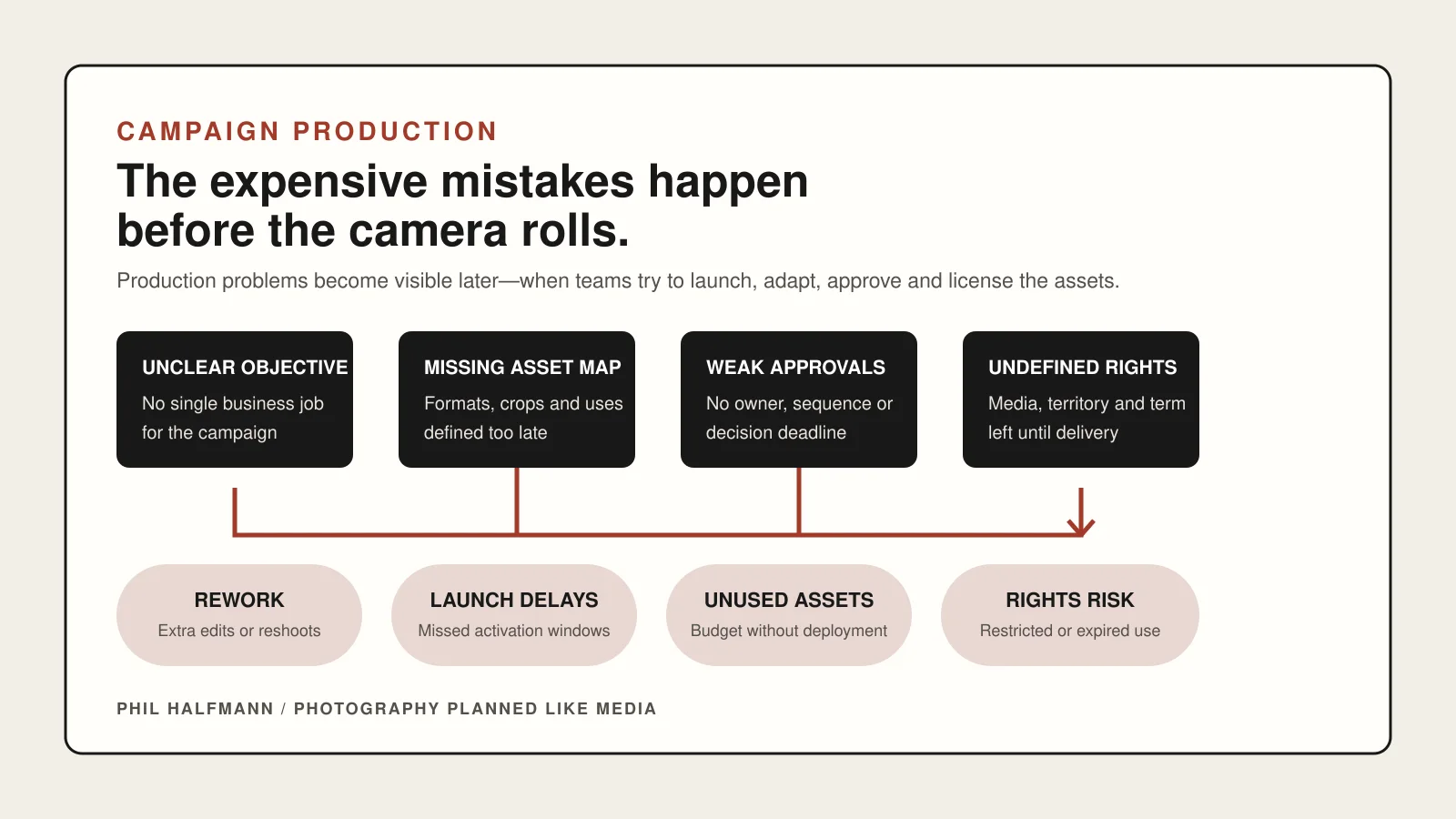
The short answer: 7 campaign production planning mistakes
- They approve a visual idea before defining the business outcome.
- They build a mood board without mapping the complete asset family.
- They plan hero images but overlook channel formats, product proof and copy-safe space.
- They invite feedback without establishing one final decision-maker.
- They schedule around shoot day instead of working backward from launch.
- They discuss licensing after talent, locations and creative choices are locked.
- They deliver files without a system for approval status, rights, retrieval and reuse.
These are not minor production details. They determine whether the campaign becomes usable marketing infrastructure or an expensive collection of attractive files.
Where campaign production costs actually leak
| Mistake | Visible symptom | Hidden cost | Preventive decision |
|---|---|---|---|
| No single objective | Competing creative directions | Time spent producing assets with no clear job | Name one primary business outcome |
| No asset map | Missing crops, formats or subjects | Extra editing, compromises or reshoots | Map every required asset to a channel |
| Uncontrolled approvals | Late or contradictory feedback | Delays, overtime and repeated retouching | Assign one final approver and stage gates |
| Rights defined late | Assets cannot run as planned | Renegotiation, replacement or legal exposure | Confirm media, territory and duration early |
| No library governance | Teams cannot find cleared files | Duplicate work and low asset utilization | Attach status, metadata and rights to delivery |
A useful cost model is broader than the production estimate:
Total campaign cost = production + rework + delay + unused assets + rights risk.
The last four terms are often missing from the budget conversation. That omission makes a cheaper production look efficient even when it creates more downstream expense.
1. Approving the concept before defining the outcome
A location, model or visual reference can make a project feel tangible. However, none of those choices explains what the campaign must accomplish. Is the priority to introduce a collection, make a product easier to understand, provide paid-media variations or strengthen long-term brand recognition?
When the objective remains broad—“create awareness,” for example—different stakeholders optimize for different outcomes. The creative director may prioritize distinctiveness, e-commerce may need product clarity and paid media may need testable variations. All three needs can be valid, but the production must rank them.
Define the decision the customer should make, the product or message that deserves priority, and the evidence that will indicate progress. Then write the brief. The fashion campaign brief example shows how to translate a commercial objective into usable creative direction.
2. Treating the mood board as the production plan
A mood board aligns taste. It does not specify deliverables. It cannot tell a team how many product-led images are required, which frames need negative space for copy, whether mobile and desktop banners need different compositions, or which paid placements require distinct aspect ratios.
Before finalizing the concept, create an asset map that connects each deliverable to:
- a business objective and audience stage;
- a product, message or story;
- a channel and placement;
- an orientation, crop and copy-safe requirement;
- an owner and activation date; and
- the necessary photography and talent rights.
Only then should the asset map become a detailed shot list. This keeps creative execution connected to marketing use instead of asking the team to improvise channel coverage after the shoot.
3. Producing hero images without an asset family
Hero imagery creates the campaign’s visual identity, but one strong frame cannot perform every job. A homepage banner, product page, email header, vertical story and paid-social test impose different compositional demands.
A complete asset family may include wide and vertical hero compositions, product-forward frames, details, clean copy space, lifestyle context, sequential images, short-form motion and meaningful variations in subject, message and crop. The goal is not indiscriminate volume. It is enough purposeful variation to support the customer journey and planned media.
For the broader planning sequence, use the guide to planning a fashion campaign shoot. It connects the brief, shot list, production schedule and final campaign use.
4. Allowing feedback without controlling decisions
More feedback does not automatically create a better campaign. When several stakeholders can reopen decisions without a defined sequence, the team loses time and accountability. A concept is approved, then challenged during casting. Casting is approved, then the product priority changes. Retouching begins before the final select list is stable.
A strong campaign approval workflow separates consultation from final authority. It names the approver, sets deadlines and creates stage gates for the brief, concept, casting, production plan, selects and retouching.
The practical rule is simple: gather specialist input early, but assign one accountable owner for the final decision.
5. Building the timeline around shoot day
Shoot day is only one dependency in a longer system. Products must be available, talent and locations must be cleared, selects must be approved, retouching must be completed, files must be adapted, rights must be documented and channel teams need time to build their campaigns.
Work backward from the first activation date, not forward from the date the photographer is available. Protect the critical path and include time for decisions—not only tasks. The detailed fashion campaign timeline guide explains the difference between production time and total campaign lead time.
6. Treating licensing as an administrative afterthought
Creative decisions can change the rights a campaign requires. Paid advertising, retailer use, influencer amplification, international territories, print, packaging, outdoor media and longer terms may affect photography, talent, music, location and third-party clearances.
If usage is discussed only after assets are delivered, the brand may discover that its preferred image is not cleared for the planned placement. Define media, territory, duration, exclusivity and partner use while the brief is being built. See the complete guide to photography licensing and usage rights before committing to talent or media assumptions.
7. Ending the production process at delivery
A campaign asset has little value if the team cannot find it, identify the approved version or confirm where it may be used. Delivery should include consistent filenames, clear version status, searchable metadata, usage information and an owner responsible for maintaining the library.
This is the point at which campaign production becomes an owned-media system. The guide to visual content library management explains how to preserve the commercial value of assets after delivery.
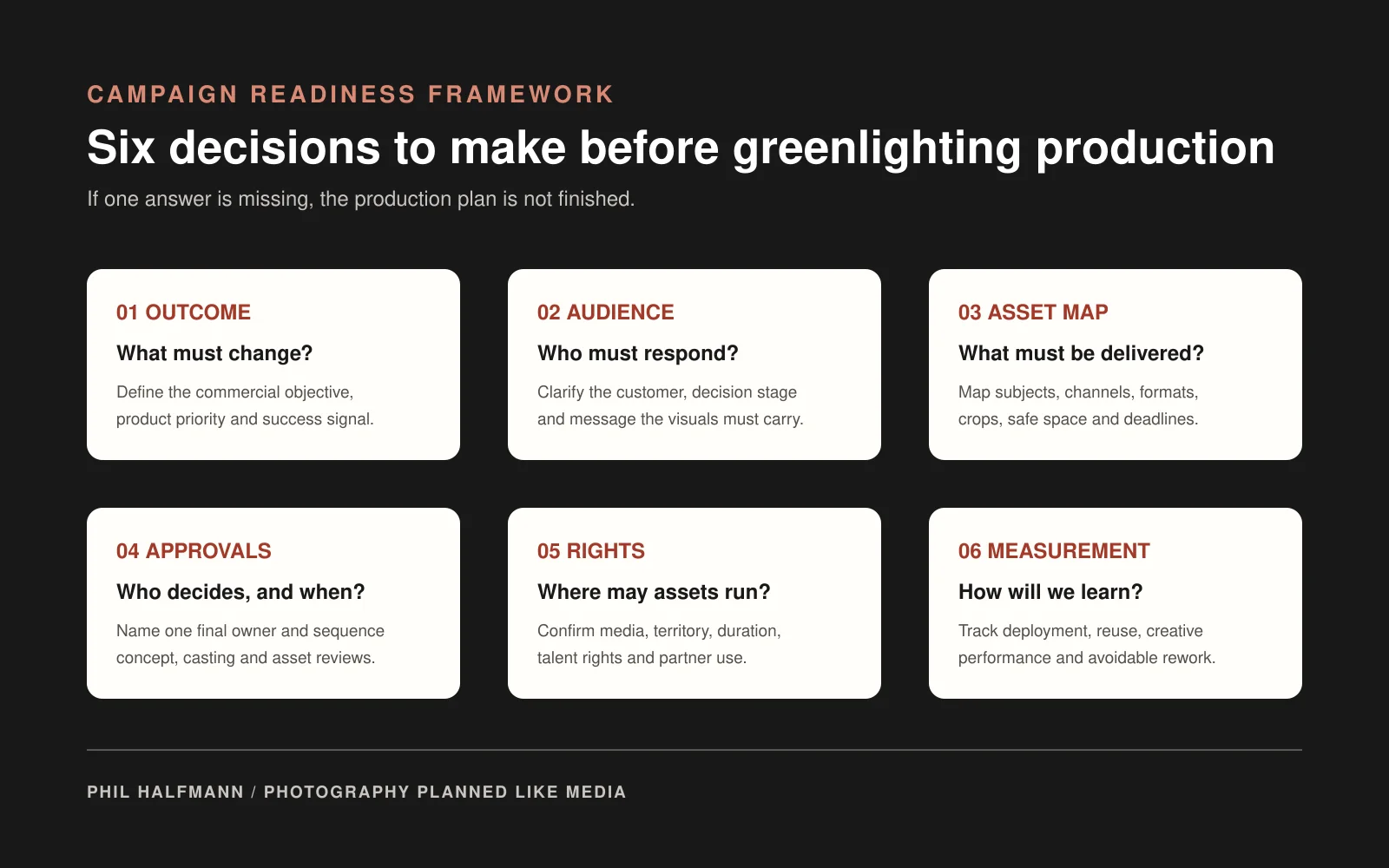
The campaign readiness test
Before greenlighting production, the brand should be able to answer six questions:
- Outcome: What must the campaign help the business achieve?
- Audience: Who must respond, and what do they need to understand or feel?
- Asset map: Which subjects, messages, formats and placements must be delivered?
- Approvals: Who provides input, who decides and when does each decision close?
- Rights: Where, for how long and by whom will the assets be used?
- Measurement: How will deployment, reuse, performance and avoidable rework be reviewed?
If one answer is missing, the production plan is not finished. That does not mean every creative detail must be rigid. It means the team has defined the constraints within which creative decisions can produce commercial value.
A practical example: one fashion launch, two outcomes
Imagine a fashion brand launching a new outerwear collection. In the first version, the team approves a strong editorial concept and captures twelve hero images. After delivery, paid media requests vertical variations, e-commerce asks for clearer construction details and email needs wide frames with copy space. The campaign is visually coherent, but the asset family is incomplete.
In the second version, the same creative concept is built around a channel map. The shot list pairs each hero setup with product detail, wide, vertical and copy-safe variations. The approval owner signs off the product hierarchy before production, and the usage schedule covers the planned paid and owned channels. The production may not look dramatically different on set. Its value becomes visible afterward because more of the marketing plan can activate without compromise.
Use the existing campaign planning toolkit
A separate download is not necessary for this article. Your existing campaign planning resources already solve the next problem and avoid creating another overlapping lead magnet.
Frequently asked questions
What is the most expensive campaign production mistake?
The most expensive mistake is approving production before the business objective and complete asset requirements are clear. That single gap can create missing deliverables, conflicting feedback, poor asset utilization and reshoots.
Why can a successful photoshoot still produce a weak campaign?
A shoot can run smoothly and create beautiful images while still failing to cover the formats, messages, products, usage rights or channel requirements the marketing plan needs. Shoot quality and campaign utility are related, but they are not the same measure.
How should a brand calculate campaign production ROI?
Track how many approved assets are actually deployed, how many channels and campaign phases they support, how often they are reused appropriately, and whether the production reduced avoidable rework or replacement. Performance metrics should then be evaluated by channel and objective rather than attributed to photography alone.
When should licensing be discussed?
Licensing should be discussed during briefing, before final creative, casting and location commitments. Planned media, territory, duration, partner use and exclusivity can affect both production decisions and third-party rights.
Who should have final approval on a campaign?
Relevant specialists should provide input, but one accountable stakeholder should hold final approval at each stage. Without a named owner, feedback can remain open-ended and previously approved decisions may be repeatedly reopened.
Fix the system before funding another shoot
If your last campaign produced strong images but still left content gaps, the next step is not automatically another production. First identify where the brief, asset map, approval process, rights or delivery system failed.
The Free Visual Audit is a focused working session for fashion, beauty and lifestyle brands that want to improve how campaign visuals support launches, paid media, e-commerce and long-term content needs.