
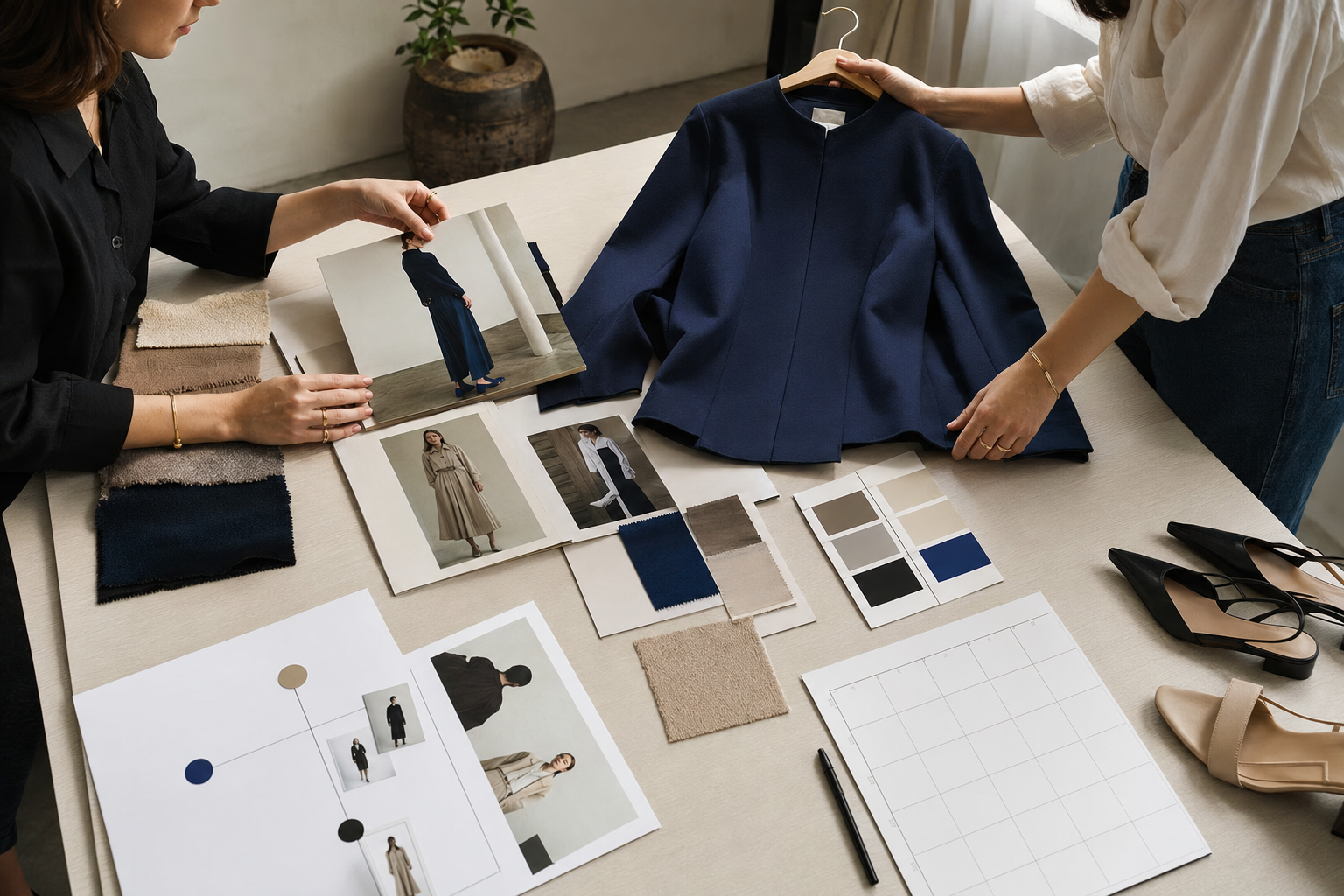
Many fashion brands still treat launch day as the main event. However, customers rarely move from silence to purchase because of one announcement. They need context before the release, clarity when the product becomes available, and reassurance after the first campaign impression. As a result, the real work is not creating a moment. It is designing a connected launch system.
This guide explains how to build that system. In particular, it connects a fashion product launch plan with fashion campaign planning, a practical launch content strategy, and a measurable fashion launch marketing strategy. It also shows where imagery, video, e-commerce assets, paid creative, email, PR, and post-launch optimization belong.
What Is a Fashion Product Launch Strategy?
A Fashion Product Launch Strategy is the coordinated plan used to introduce a new product, capsule, collection, collaboration, or category to the market. It defines who the launch is for, why the product matters, how demand will be built, which assets each channel needs, when every message will appear, and how performance will be evaluated.
Although launch strategy includes creative direction, it is not merely a creative concept. Likewise, although it includes a calendar, it is not simply a timeline. Instead, it is the operating architecture that aligns six essential elements:
- Commercial objective: the business result the launch must produce.
- Audience: the customer segment most likely to value the product.
- Positioning: the specific reason this product deserves attention now.
- Offer: the product, price, availability, experience, and incentive structure.
- Deployment: the sequence of owned, earned, retail, and paid touchpoints.
- Measurement: the signals used to improve the launch while it is active.
Consequently, campaign photography is one component of the strategy, not a substitute for it. Beautiful images can attract attention. Nevertheless, unless those images answer channel-specific and customer-specific questions, they may generate admiration without generating enough action.
Why Fashion Product Launches Underperform Before They Go Live
Weak launches often appear to fail in the market. In reality, many of them fail in planning. For example, a brand approves the collection, chooses a launch date, schedules a shoot, and only afterward asks what the marketing team needs. By then, the production has already limited the campaign.
The most common structural problems include:
- The target audience is defined too broadly.
- The product story describes features but not relevance.
- The campaign concept looks strong but does not support product understanding.
- The asset list is based on image quantity rather than channel use.
- Paid media, email, e-commerce, PR, and organic social are planned separately.
- Inventory, fulfillment, merchandising, and customer service are disconnected from promotion.
- The team measures revenue but ignores the earlier signals that explain it.
In addition, fashion teams sometimes confuse novelty with differentiation. A visually unusual concept may stop the scroll; however, it does not automatically explain why the product belongs in the customer’s wardrobe. Therefore, the campaign idea must dramatize the product’s value rather than compete with it.
Build the Fashion Product Launch Strategy From the Business Goal Backward
Before developing the creative, define what the launch is expected to change. Is the priority immediate sell-through, email-list growth, entry into a new category, acquisition of first-time buyers, reactivation of existing customers, retail traffic, or long-term brand positioning? These goals can support one another. However, one should lead because each requires a different launch design.
For example, a limited capsule designed for fast sell-through may emphasize scarcity, concentrated media, creator seeding, and a short conversion window. Conversely, a permanent core product may require education, search visibility, evergreen product imagery, testimonials, and repeated paid testing. Thus, the same launch calendar would not serve both products equally well.
A useful launch brief should answer:
- What business outcome must the launch create?
- Which product or category is being prioritized?
- Who is the primary customer for this release?
- What customer tension or desire does the product address?
- Why should that customer believe the claim?
- Which channels will create discovery, consideration, and conversion?
- Which operational constraint could weaken the campaign?
- Which metrics will determine whether the strategy worked?
If budget is still uncertain, use a structured campaign budget calculator before production assumptions harden. Likewise, review how fashion campaign shoot costs accumulate so that strategy, talent, production, licensing, and distribution are not treated as one undifferentiated expense.
Step 1: Define the Audience and Launch Positioning
The first stage of a fashion product launch plan is not choosing platforms. Instead, it is deciding whose attention matters and what the product should mean to that person. “Women aged 25–45 who like fashion” is not a useful strategic audience. It is too broad to guide casting, styling, messaging, media selection, or objections.
A stronger audience definition combines context, motivation, and friction. For instance, a brand might target design-aware professionals who want expressive tailoring but hesitate to buy statement pieces because versatility is unclear. That description immediately creates productive questions: Which styling combinations prove versatility? Which settings make the garment feel relevant? Which details justify the price? Which formats should demonstrate movement, fit, and repeat wear?
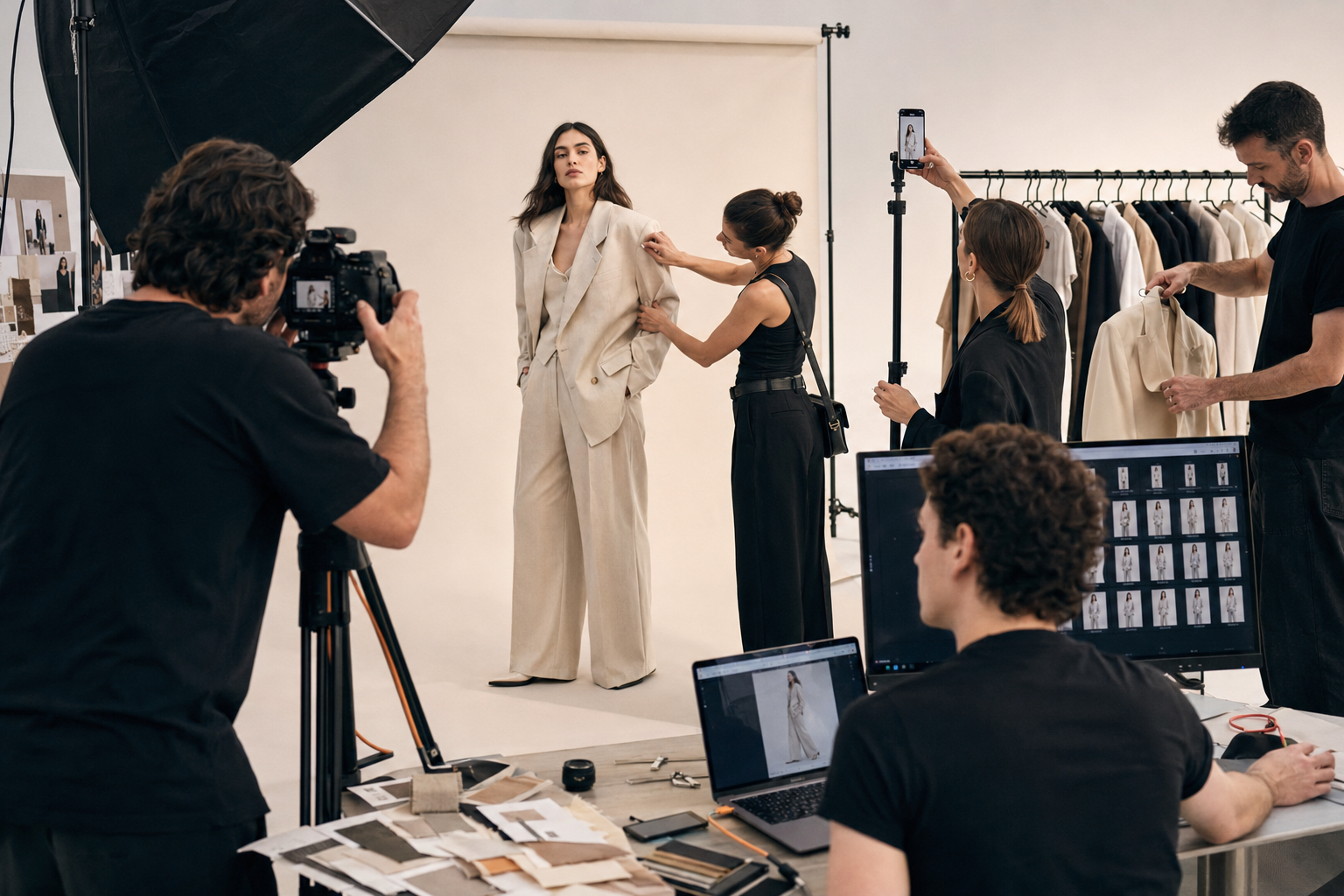
Next, translate that audience understanding into a positioning statement. Internally, use a simple structure: for a specific customer, this product is the relevant choice because it delivers a distinct outcome, supported by credible proof. Although this sentence may never appear in public, it should govern the fashion launch marketing strategy.
Most importantly, avoid building positioning from internal enthusiasm alone. The fact that a material is innovative, a silhouette took months to perfect, or a collaboration feels exciting to the team does not prove that the customer understands its value. Therefore, convert every internal feature into an external consequence.
Step 2: Design the Offer Before the Campaign
Marketing cannot permanently compensate for a weak offer. Consequently, the Fashion Product Launch Strategy must account for the product experience itself: price architecture, range depth, hero SKU, sizing, bundles, availability, delivery promise, return policy, and stock levels.
Choose a hero product or a small hero group. While the full collection still matters, equal emphasis across every SKU usually weakens memory. A lead product gives the launch a recognizable visual and narrative center. Meanwhile, supporting products can expand basket size and demonstrate a complete world.
Then, pressure-test the buying decision. Does the product page show scale, texture, construction, fit, movement, and styling options? Is sizing easy to understand? Is the price supported by evidence? Are delivery and returns visible? If these questions remain unanswered, adding more top-of-funnel impressions may simply send more people into an incomplete conversion experience.
Step 3: Turn Fashion Campaign Planning Into an Asset System
Once the objective, audience, positioning, and offer are clear, fashion campaign planning can begin. At this point, do not ask only, “What should the campaign look like?” Ask, “What must the audience see, understand, feel, and believe at each stage?”
That change produces an asset system rather than a collection of favorite images. A complete system may include:
- Brand assets: establish the campaign world and emotional promise.
- Hero campaign assets: create recognition and carry the launch idea.
- Product assets: show construction, fit, color, material, and key details.
- Consideration assets: demonstrate styling, movement, use cases, and versatility.
- Conversion assets: support product pages, email modules, retargeting, and offer clarity.
- Trust assets: include process, proof, reviews, press, talent, or founder context.
- Variation assets: provide multiple hooks, crops, sequences, and opening frames for testing.
Use a campaign asset planner to map each deliverable to a channel, format, launch phase, message, and owner. In addition, review brand photography for fashion brands when the launch must strengthen the visual identity beyond one season.
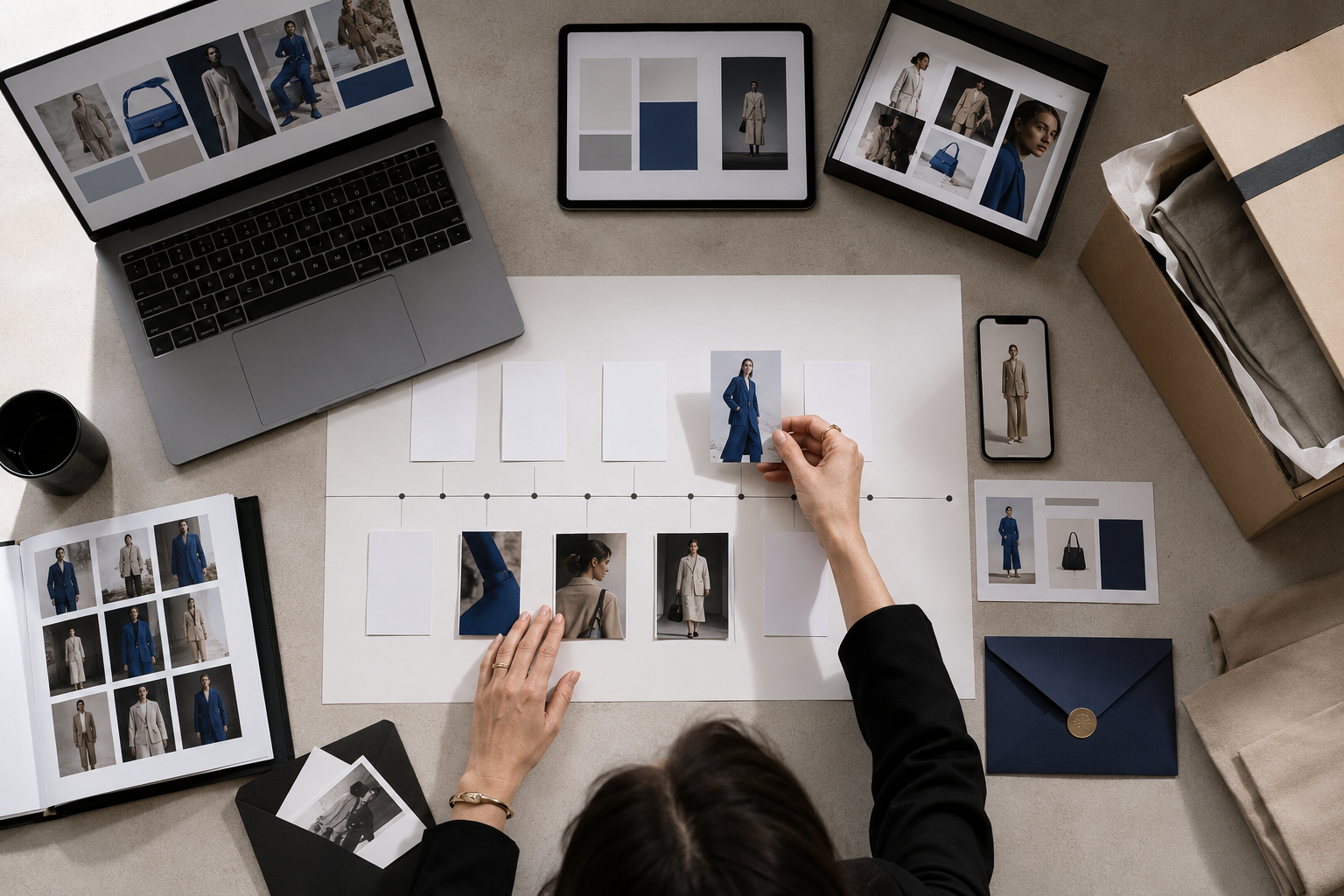
Crucially, define usage before the shoot. Cropping a horizontal hero image into a vertical ad afterward may preserve the subject, yet destroy the composition or remove vital product detail. Similarly, one polished campaign film cannot automatically become six effective short-form videos. Therefore, the shot list should include format-native compositions, sequences, openings, close-ups, transitions, and product demonstrations.
Step 4: Build a Launch Content Strategy Around Customer Decisions
A launch content strategy should not repeat the same announcement across every channel. Instead, each piece should perform a specific job within the buying journey. Although customers move unpredictably between touchpoints, the content system can still support four broad phases.
Pre-launch: Create recognition and qualified anticipation
Before availability, introduce the tension, point of view, process, or design idea that makes the product relevant. Teasers can be useful; however, pure mystery often produces shallow attention. Therefore, give the right audience enough substance to identify themselves with the release.
Pre-launch content may include an early-access landing page, founder perspective, material or construction details, campaign fragments, creator seeding, PR previews, behind-the-scenes context, and email-list segmentation. As a result, launch day begins with accumulated attention rather than a cold audience.
Launch: Make the product and action unmistakable
On launch day, clarity becomes more important than suspense. State what is available, why it matters, who it is for, what it costs, and what the customer should do. Moreover, ensure that the campaign world, product page, email, social profile, retail environment, and paid creative feel connected.
One contradiction is especially damaging: a premium campaign followed by a generic product page. Since the product page carries the purchase decision, it needs the same strategic attention as the hero visual. It should reduce uncertainty without flattening the brand.
Post-launch: Expand proof and address hesitation
After release, the campaign should evolve. Use customer questions, engagement patterns, search behavior, sales by SKU, creative performance, and return reasons to identify friction. Then publish content that answers it. For example, if customers engage with the jacket but hesitate at checkout, the next content may need to demonstrate fit, fabrication, styling range, or cost-per-wear rather than repeat the campaign film.
Finally, extend strong launch assets into evergreen content. The article what happens after a photoshoot explains how selection, organization, deployment, and repurposing determine whether a production becomes a long-term asset or a short-lived event.
Step 5: Sequence the Fashion Launch Marketing Strategy
A fashion launch marketing strategy becomes effective through sequence. If every channel publishes the same message at the same time, the brand creates repetition but not necessarily momentum. Instead, build a launch runway in which each touchpoint adds new information or proof.
A practical sequence may look like this:
- Foundation: finalize positioning, offer, landing pages, tracking, inventory logic, and customer-service preparation.
- Signal: introduce the campaign world and capture early interest.
- Reveal: show the product clearly and explain the central value.
- Release: coordinate site, email, social, PR, retail, creators, and paid distribution.
- Proof: add detail, styling, reviews, press, process, and customer response.
- Optimization: shift spend, creative, merchandising, and messaging based on evidence.
- Extension: repurpose successful ideas into evergreen acquisition and retention content.

Owned channels should generally form the operational center because the brand controls the customer experience and data. Earned and creator activity can then extend credibility and reach. Paid media can amplify what is already resonating, test messages, and re-engage interested visitors. Nevertheless, spending should not scale faster than the landing experience, stock position, and creative variation can support.
Step 6: Align Production, Inventory and Customer Experience
The unspoken truth of launch planning is that marketing success can expose operational weakness. If demand arrives but key sizes are unavailable, shipping promises are unclear, or service teams lack answers, attention converts into frustration. Therefore, the fashion product launch plan must include operations.
Before the launch, confirm:
- inventory by SKU, size, color, and market;
- product-page accuracy and mobile performance;
- tracking, attribution, and email capture;
- delivery windows and return procedures;
- customer-service scripts and escalation paths;
- contingency plans for delayed stock or unexpected demand;
- approval ownership for creative and commercial changes.
In other words, a Fashion Product Launch Strategy is cross-functional. Creative, marketing, e-commerce, merchandising, operations, PR, retail, and customer service should work from one source of truth. Otherwise, customers encounter a fragmented brand even when each department performs its own task well.
Step 7: Measure the Fashion Product Launch Strategy as a Funnel
Revenue and sell-through matter. However, they do not explain performance by themselves. A useful measurement framework separates leading indicators from commercial outcomes and diagnostic signals.
| Launch stage | Primary question | Example signals |
|---|---|---|
| Attention | Did the right audience notice? | Qualified reach, video retention, press pickup, direct traffic |
| Interest | Did the product create curiosity? | Landing-page visits, email sign-ups, saves, product views |
| Consideration | Did customers engage with the offer? | Size-guide use, repeat visits, add-to-cart rate, email clicks |
| Conversion | Did interest become revenue? | Conversion rate, units sold, revenue, customer acquisition cost |
| Product response | Which products and claims worked? | Sell-through by SKU, size curve, returns, review themes |
| Creative learning | Which content moved customers? | Hook performance, click-through rate, assisted conversion, fatigue |
For a more detailed framework, read how to measure campaign performance and optimize future campaigns. Additionally, use the content ROI calculator to evaluate whether assets create value across multiple channels and periods rather than judging them only by production cost.
A 12-Week Fashion Product Launch Plan
Timelines depend on product complexity, production scale, stock readiness, media commitments, and approval speed. Nevertheless, the following 12-week framework provides a practical starting point.
Weeks 12–10: Strategy and commercial alignment
Confirm the business objective, audience, positioning, hero products, offer, budget, launch markets, success metrics, and operational constraints. At the same time, map customer objections and channel requirements.
Weeks 9–7: Creative development and asset planning
Develop the campaign concept, messaging architecture, casting, styling, locations, production approach, licensing plan, and asset matrix. Furthermore, assign every planned asset to a purpose and format before approving the shot list.
Weeks 6–5: Production
Create campaign photography, video, product imagery, detail content, e-commerce assets, and channel-native variations. Meanwhile, build landing pages, email flows, media materials, creator briefs, and product-page structures.
Weeks 4–3: Post-production and launch assembly
Retouch, edit, crop, caption, organize, and approve assets. Then load content into the website, email platform, paid accounts, PR materials, and social schedule. Test tracking, mobile layouts, product data, links, checkout, and automated messages.
Weeks 2–1: Pre-launch activation
Begin the anticipation sequence, activate early-access acquisition, seed press and creators, and monitor audience response. If particular messages resonate, adjust launch-day emphasis before media spend accelerates.
Launch week: Coordinated release
Publish the hero story, open sales, activate email, social, PR, retail, and paid media, and monitor stock, site behavior, service questions, and creative response. Most importantly, keep decision-makers available so that emerging friction can be addressed quickly.
Weeks 1–4 after launch: Proof, optimization and extension
Publish product education, styling, press, testimonials, and objection-handling content. At the same time, reallocate media, update merchandising, test new creative, and document learning for the next release.
Common Fashion Product Launch Strategy Mistakes
Planning the photoshoot before the customer journey
When the visual concept comes first, the team often discovers missing formats and missing product proof after production. Therefore, define customer decisions and channel jobs before finalizing the creative treatment.
Using one hero image as the entire campaign
A hero image creates recognition, but it cannot show every detail, answer every objection, or support every platform. Consequently, plan a hierarchy of brand, product, proof, and conversion assets.
Making the pre-launch phase too mysterious
Mystery can create intrigue, yet it can also attract people who will never value the product. Instead, reveal enough of the perspective, problem, craft, or benefit to build qualified demand.
Stopping communication after launch day
Many customers do not see the first announcement, while others need multiple encounters before buying. Therefore, the post-launch phase should deepen understanding and respond to real behavior.
Optimizing only for short-term revenue
Immediate sales are important. Nevertheless, a launch can also build first-party audience, establish a category, create evergreen content, reveal customer insight, and improve future creative. A mature evaluation captures both direct and compounding value.
Fashion Product Launch Strategy Checklist
- Define one primary commercial objective.
- Select the priority audience and buying context.
- Write the positioning statement and proof points.
- Confirm the hero product, pricing, inventory, and offer.
- Map the journey from discovery through post-purchase.
- Assign a job to every channel.
- Build an asset matrix by phase, message, format, and owner.
- Plan usage and licensing before production.
- Create campaign, product, proof, conversion, and variation assets.
- Connect marketing with e-commerce, operations, retail, and service.
- Test tracking, pages, checkout, delivery claims, and automated flows.
- Prepare the post-launch content and optimization cadence.
- Review commercial, product, channel, and creative performance together.
- Document learning before planning the next launch.
Frequently Asked Questions About Fashion Product Launch Strategy
How early should a fashion brand plan a product launch?
Many launches benefit from at least 8–12 weeks of coordinated planning. However, larger productions, collaborations, retail activations, international releases, or major PR programs may need considerably more time. The correct schedule depends on the longest critical dependency, not merely the content calendar.
What content does a fashion product launch need?
Most launches need a mix of campaign, product, e-commerce, social, email, advertising, PR, and trust-building assets. Nevertheless, the exact mix should follow the audience, channels, price point, and buying objections. Asset quantity alone is not a strategy.
When should campaign photography be produced?
Photography should be produced after positioning, channel requirements, usage, formats, and the asset matrix are defined. At the same time, production must finish early enough for selection, retouching, editing, page creation, media delivery, testing, and approvals.
How do fashion brands create launch momentum?
Momentum comes from accumulated, coordinated attention. Therefore, brands should build recognition before availability, make the release clear on launch day, and add proof afterward. A sequence of distinct but connected messages is usually stronger than one repeated announcement.
How should a fashion launch be measured?
Measure attention, interest, consideration, conversion, product response, customer quality, and creative learning. Although revenue is the final commercial result, earlier indicators explain where the system is working or breaking.
Final Perspective: Treat the Launch as a System, Not a Date
A Fashion Product Launch Strategy is strongest when every decision supports the next one. The business objective shapes the audience. The audience shapes the positioning. The positioning shapes the offer and campaign. The campaign shapes the asset system. The asset system supports a sequenced launch. Finally, performance data improves both the active campaign and the next production.
Therefore, the central question is not, “How do we make launch day look bigger?” It is, “How do we make every customer touchpoint work together?” When fashion brands answer that question before production, they reduce waste, improve clarity, create more useful assets, and give strong creative work a better chance to produce commercial value.
https://philhalfmann.com/content-planning-for-fashion-brands-how-one-campaign-generated-6-months-of-marketing-assets/
Why Your Campaign Photos Stop Working After 30 Days (And What Brands Realize Too Late)