
Brand photography for fashion brands is not simply a collection of polished images but the visual operating system that helps customers recognize the brand, understand its position and experience it consistently across the website, campaigns, product pages, advertising, email, social media and PR.
The strongest system does more than make a fashion brand look cohesive. It defines repeatable creative rules, maps images to commercial uses and gives every production a clear role. That structure reduces reshoots, improves asset utilization and makes future campaigns easier to plan.
In brief: Effective brand photography combines five elements:
- clear brand positioning;
- a documented visual language;
- an asset plan tied to channels and customer journeys;
- a repeatable production and approval workflow; and
- governance for licensing, storage, reuse and measurement.

Watch: How Brand Photography Supports Scalable Growth
Prefer video? This companion guide explains how consistent brand photography can create a stronger foundation for campaigns, digital channels, product launches and long-term growth.
What Is Brand Photography for Fashion Brands?
Brand photography is the planned creation of images that express a brand’s identity and support its ongoing commercial communication. For a fashion business, that may include editorial identity images, lifestyle photography, founder and process imagery, selected product-led visuals, advertising variations and adaptable assets for web, email, social and retail use.
The defining feature is not a particular aesthetic but continuity. Lighting, color, casting, styling, composition, retouching and cropping follow an intentional logic, even when individual collections or campaign concepts change.
This makes brand photography different from two related disciplines:
| Photography type | Primary job | Typical lifespan | Examples |
|---|---|---|---|
| Brand photography | Build recognition and express long-term identity | Evergreen or semi-evergreen | Brand story, founder, lifestyle, signature visual assets |
| Campaign photography | Create attention for a defined launch or message | Time-bound | Seasonal campaign, collection launch, paid-media concept |
| Product photography | Help customers evaluate and buy a product | Usually tied to product availability | PDP images, details, fit, scale, construction |
Most fashion brands need all three. The important decision is to give each image a defined job. For a deeper campaign-specific framework, read the strategic guide to fashion campaign photography. For the performance relationship specifically, see how brand photography supports stronger campaign performance.
The Five Parts of a Scalable Brand Photography System
1. Brand Positioning Comes Before Visual References
A mood board can describe a look, but it cannot decide what the brand should mean. Before selecting references, clarify the audience, price position, point of difference, emotional promise and buying context. A premium minimalist label, an expressive streetwear brand and a performance-fashion company should not make identical choices simply because the same visual trend is popular.
Translate the positioning into observable creative principles. For example, “precise and quietly confident” is more useful when it becomes controlled lighting, deliberate negative space, restrained expressions, tactile detail and limited color contrast. This bridge between strategy and execution is the foundation of a fashion brand content strategy.
2. Document the Visual Language
A visual language gives different productions enough consistency to feel related without forcing every image to look identical. It should define a usable range rather than a single rigid formula.
- Lighting: softness, direction, contrast, shadow depth and treatment of skin and fabric
- Color: dominant tones, acceptable accents, background families and saturation limits
- Casting: presence, attitude, movement, expression and connection to the intended customer
- Styling: silhouette priorities, layering, accessories, grooming and treatment of hero products
- Composition: camera distance, negative space, horizon logic, symmetry, movement and crop tolerance
- Post-production: skin texture, garment color accuracy, contrast, grain and consistency across image sets
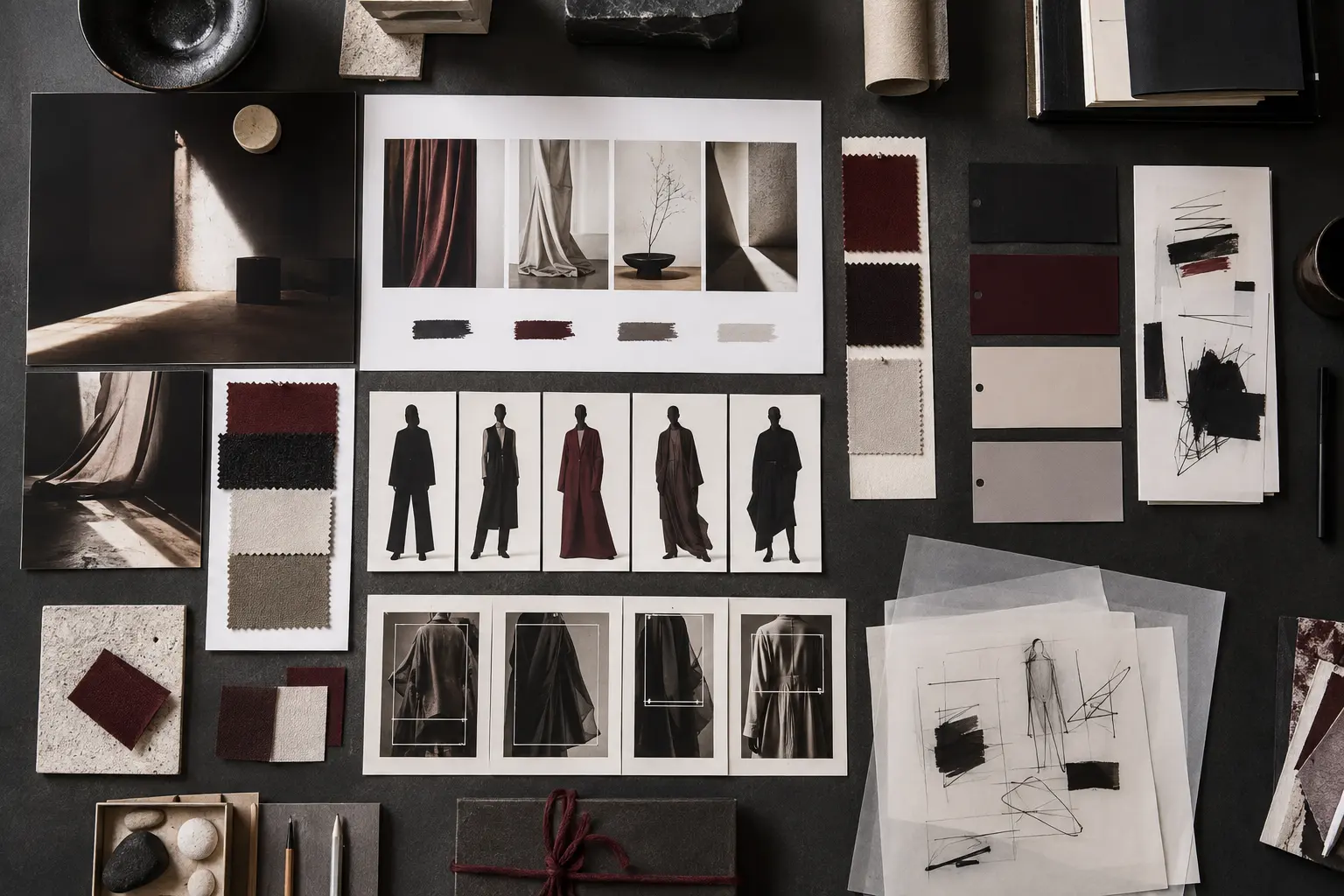
These decisions belong in a working visual-direction document. A well-built fashion mood board then becomes evidence of the system, not a substitute for it. The same rules should also guide creative direction for fashion campaigns.
3. Build an Asset Architecture, Not a Generic Shot List
A strong shot can still be the wrong asset. Before production, map every marketing need to a purpose, format, message and owner. That turns a creative wish list into an asset architecture.
| Use | Image job | Planning requirement | Common omission |
|---|---|---|---|
| Homepage | Position the brand and direct attention | Wide crops, controlled focal point, copy-safe space | No usable desktop/mobile crop pair |
| Product pages | Reduce uncertainty and support purchase | Fit, details, scale, construction and context | Editorial imagery without product clarity |
| Paid media | Stop attention and support creative testing | Multiple concepts, compositions, products and aspect ratios | One hero image forced into every placement |
| Email and organic social | Sustain attention between launches | Sequences, details, vertical frames and narrative variation | Too little variation for a full cadence |
| PR and wholesale | Give partners publication-ready context | Clean selects, credits, captions and usage clarity | Assets cannot be found or cleared quickly |
Platform requirements are operational constraints, not details to solve after the shoot. Google’s current guidance for responsive display ads, for example, calls for horizontal, square and vertical image options and permits multiple images per aspect ratio. That is a practical reason to design variation during capture rather than rely on aggressive crops later. See the official Google Ads image guidance.
For more specific planning, use the homepage banner planning guide, the product page image guide and the guide to images needed for paid advertising.
4. Connect the Brief, Shot List and Approval Workflow
The brief explains why the production exists. The shot list specifies what must be created. The approval workflow defines who can authorize the decisions. When these documents are disconnected, teams approve an attractive concept without confirming whether it covers the actual business requirements.
A reliable workflow links each required asset to:
- its business objective and audience
- the product, message or story it must communicate
- the required orientation, crop and safe space
- the named decision-maker
- the planned usage, territory and duration
- the final delivery deadline
Use the fashion campaign brief example to define the strategic inputs, then translate those inputs into a photography shot list. Before production begins, establish the campaign approval workflow so feedback does not arrive from multiple uncoordinated stakeholders.
5. Govern the Library After the Shoot
Delivery is not the end of the system. Assets lose value when the team cannot find them, understand their rights or identify the latest approved version. Brand photography needs an operating layer after production.
At minimum, define:
- a consistent folder and filename structure
- searchable metadata for product, collection, talent, channel, orientation and rights
- approval status and version control
- license dates, territories, channels and renewal responsibilities
- an archive policy for outdated or superseded assets
The detailed workflows are covered in the guides to campaign asset organization and marketing asset metadata. This layer is easy to overlook, but it determines whether a production becomes a reusable business asset or an expensive folder of files.

Download the Brand Photography System Planner
The editable Brand Photography System Planner turns this framework into a working document. Use it to define visual rules, map channel requirements, build the shot architecture, score current gaps and assign ownership before production.
Download the Brand Photography System Planner
The workbook includes a visual-system scorecard, visual direction rules, a channel asset map, a shot planner and a cadence-and-governance sheet.
How to Plan Brand Photography for Fashion Brands
Step 1: Audit the Current Customer Experience
Review the website, product pages, advertising, email, social channels, retailer materials and PR assets together. Look for conflicting color treatment, outdated campaigns, missing formats, inconsistent product representation and images that are repeatedly reused because no alternative exists.
Step 2: Separate Identity Needs From Campaign Needs
List the evergreen assets that should remain useful across several launches. Then identify the time-bound assets needed for the next collection or campaign. This prevents short-term creative ideas from replacing the brand’s permanent visual foundation.
Step 3: Map the Asset Family
For every channel, define the image’s job, primary audience, orientation, crop, message, product priority and planned lifespan. Include the variations required for creative testing. Do not use a total image count as a substitute for this map.
Step 4: Build the Production Around Coverage
Sequence the day around setups, talent, products and locations, but check the schedule against asset coverage. A production can run on time and still fail if essential homepage, product, ad or PR images never reach the shot list.
Step 5: Confirm Rights Before Capture
Usage changes the value and availability of photography, models, locations, music and other creative contributions. Define channels, territories, duration, paid-media use and exclusivity before booking the team. Start with licensing explained for brands and the separate guide to paid ads usage.
Step 6: Measure What the System Produces
Track whether the resulting library covers planned channels, launches on time and remains usable. The objective is not to prove that photography caused every sale but rather to learn whether the system gives marketing teams stronger, more adaptable inputs.
How Should Brand Photography ROI Be Measured?
Revenue matters, but last-click attribution rarely captures the full role of brand imagery. Use a balanced set of operational and performance indicators:
- Asset coverage: percentage of planned channel requirements delivered
- Utilization: percentage of delivered assets actually published or activated
- Reuse: number of approved uses per asset across channels or campaigns
- Useful lifespan: how long assets remain current and licensed
- Production efficiency: avoidable reshoots, rush requests and missing-format work
- Creative testing capacity: number of meaningfully different ad variations available
- Brand consistency: whether key visual rules survive across teams and touchpoints
- Channel performance: engagement, click-through, conversion or revenue when comparable creative variants are tested
A high delivery count with low utilization is not a successful system. Conversely, a smaller library that covers priority channels, supports testing and remains useful for months may create more value.
How Often Should Fashion Brands Update Their Photography?
There is no reliable universal rule such as “quarterly” or “every six months”. Update frequency should follow business events and evidence. A new collection, repositioning, major product expansion, new market, channel shift, creative fatigue or rights expiration can all trigger production.
Use three layers of cadence:
- Brand foundation: refresh when positioning, audience or core identity changes
- Campaign layer: produce around launches, seasons and strategic marketing moments
- Always-on layer: replenish when channel coverage or variation falls below the operating requirement
This approach is more defensible than tying production to the calendar alone. If the always-on requirement is persistent, a fashion content production retainer may be more efficient than repeated isolated projects.
A Practical Brand Photography Asset Map
Consider a contemporary fashion label preparing a six-week capsule launch. Instead of requesting “40 edited images”, the team defines the coverage it needs:
- two flexible homepage hero compositions with desktop and mobile crop options
- product-led lifestyle frames for six priority items
- fit, movement and detail images that complement the product-page sequence
- three distinct paid-media concepts, each with vertical, square and horizontal options
- an email sequence covering announcement, product focus and launch reminder
- editorial and behind-the-scenes frames for organic storytelling
- a small PR set with credits, captions and confirmed usage
The difference is structural. The production is judged against coverage and usability, not a raw quantity. It also becomes clear which images can serve several roles and which need to be purpose-built.
What Does Brand Photography Cost?
There is no meaningful standard price based only on image count. The budget depends on concept development, photographer and crew, casting, styling, location, set requirements, production days, post-production, deliverable complexity and licensing.
Two proposals can contain the same number of final images and represent very different commercial scope. One may cover a small owned-channel library with one model and a simple studio setup. Another may require multiple concepts, several talent agreements, paid advertising, video, broader territories and long-term usage.
For current planning factors and a more complete budget structure, use the dedicated guide to fashion campaign shoot costs. Keeping detailed price ranges there avoids turning this visual-system guide into a second competing pricing article.
Common Brand Photography Mistakes
- Starting with a trend: references are selected before positioning is clear
- Using image count as the scope: deliverables are not connected to channels or decisions
- Planning only the hero: the production lacks depth, detail and format variation
- Separating brand and performance creative: ads become visually disconnected from the wider customer experience
- Leaving usage until the contract stage: the intended distribution is not reflected in talent, location or production decisions
- Collecting too many approvers: feedback becomes contradictory and late
- Treating delivery as completion: assets arrive without metadata, rights information or a clear owner
- Repeating the system without reviewing it: consistency becomes stagnation instead of recognizable evolution
Project or Ongoing Partnership?
| Choose a focused project when | Choose an ongoing partnership when |
|---|---|
| The brand needs an initial visual foundation or a defined repositioning. | New products, campaigns and paid creative require frequent replenishment. |
| The next commercial milestone is clear and the asset lifespan is relatively long. | The team repeatedly experiences rush briefs, gaps and disconnected shoots. |
| Internal teams can govern, distribute and measure the delivered library. | Strategic alignment, production continuity and priority scheduling have ongoing value. |
The right model follows the operating need. A retainer is not automatically better; it only makes sense when the demand for planning and production is genuinely recurring.
Frequently Asked Questions
What should a fashion brand photography shoot include?
It should include the assets required by the agreed business objective and channel map. Common needs include brand-story imagery, website and homepage assets, product-led lifestyle images, paid-media variations, email and social sequences, PR selects and selected short-form video. The correct mix is determined before the shoot.
Is brand photography the same as campaign photography?
No. Brand photography establishes the long-term visual language and evergreen asset foundation. Campaign photography expresses that identity through a specific launch, season or message. They should connect, but they have different primary jobs.
How can a brand keep photography consistent without becoming repetitive?
Keep a stable set of identity rules, such as lighting logic, color boundaries, casting principles and post-production treatment, while varying concepts, environments, talent, movement and narrative. Recognition requires continuity, not duplication.
Should paid-ad assets be captured during the same production?
Often, yes, if paid media is part of the plan and the licensing covers it. However, the team must capture deliberate variations rather than assume one campaign hero can serve every ad placement. Performance assets may require different compositions, pacing and product emphasis.
Who should own the brand photography system?
One accountable brand or marketing lead should own the rules, priorities and final approvals. Creative direction, production and channel specialists contribute expertise, but unclear decision rights usually lead to inconsistent feedback and delayed delivery.
Build a Visual System Your Marketing Team Can Use
Brand photography for fashion brands creates more value when it is planned as connected infrastructure: a recognizable visual language, a complete asset map, a disciplined production workflow and a governed library. The result is not merely better-looking content but a more reliable way to support launches, customer journeys and long-term brand growth.
Start With a Free Visual Audit
I’ll review how your visuals work across campaigns and platforms, identify inconsistency and content gaps, and assess whether your shoots are designed for reuse and scale. It is a working session—not a generic sales call.