
If you feel like you’re constantly reshooting content every 2 months, you’re not imagining it.
One month your photos look “good enough”. Then suddenly your website feels outdated, your Instagram feed looks inconsistent, and your ads stop converting. So you book another shoot, spend more money and repeat the cycle all over again.
Most business owners assume the problem is the photographer, the camera, or the editing style. However, the real issue is usually much deeper.
You probably never built a visual content strategy that was designed to last.
As a buyer, that inconsistency is easy to notice. People don’t consciously think, “This company keeps reshooting content every 2 months” But they do feel that something is off. The brand feels disconnected, The visuals feel random and trust drops immediately.
That’s why businesses end up wasting thousands on branding photography mistakes while still struggling to create content that converts.
In this article, we’ll break down the situations that force companies into endless reshoots, the mistakes buyers instantly notice and what actually helps brands create visual systems that work long-term.
Take a look at Content Planning For Fashion Brands: How One Campaign Generated 6 Months Of Marketing Assets.
The Real Problem With Reshooting Content Every 2 Months

The biggest issue with reshooting content every 2 months is not the money. It’s the inconsistency.
Buyers notice when your homepage looks corporate, your Instagram looks casual, and your ads look like they belong to three completely different companies.
As a customer, that creates friction.
People start wondering:
- Which version of the company is real?
- Why does the branding keep changing?
- Can this business actually deliver consistently?
Even when your service is excellent, inconsistent visuals quietly damage trust.
That’s why a strong visual content strategy matters so much. Without one, every photoshoot becomes reactive instead of intentional.
And because there’s no long-term campaign content planning, businesses end up recreating the same content over and over again.
Take a look at Why Your Marketing Team Keeps Asking for More Content (And Why More Content Isn’t Fixing the Problem).
Situation #1: You Shot Content for Platforms Instead of Campaigns
One of the most common branding photography mistakes happens before the shoot even starts. Businesses plan content around platforms instead of campaigns.
So they ask for:
- Instagram content
- LinkedIn photos
- Website banners
- Reels
- Team portraits
However, none of it connects.
As a buyer, this feels chaotic. The website says one thing, the ads show another message, and social media tells a completely different story. That’s why the content expires quickly.
Without proper campaign content planning, visuals lose relevance fast because they were never connected to a bigger sales narrative. A better visual content strategy focuses on customer journeys first.
Instead of creating “Instagram photos,” strong brands create content that converts across multiple touchpoints.
That means one shoot can support:
- landing pages
- ads
- email campaigns
- social media
- PR
- sales presentations
- retargeting campaigns
When businesses skip this step, they usually end up reshooting content every 2 months because the original assets only solved one short-term problem.
Situation #2: Your Content Was Built Around Trends
Trend-based visuals age fast. As a buyer, you can spot outdated trends immediately. The problem is that businesses often confuse “current” with “effective”.
For example:
- Overused TikTok editing styles
- Generic startup poses
- Fake office moments
- Forced smiling team shots
- Viral reel formats
These trends might perform temporarily. However, they rarely create content that converts long-term. This is where many visual content strategy decisions go wrong.
Businesses chase trends because they want fast attention. Yet buyers usually respond better to clarity, consistency, and authenticity.
When visuals are trend-driven instead of brand-driven, companies start reshooting content every 2 months simply to keep up.
That cycle becomes exhausting. Worse, it becomes expensive.
Situation #3: Nobody Planned for Future Campaigns
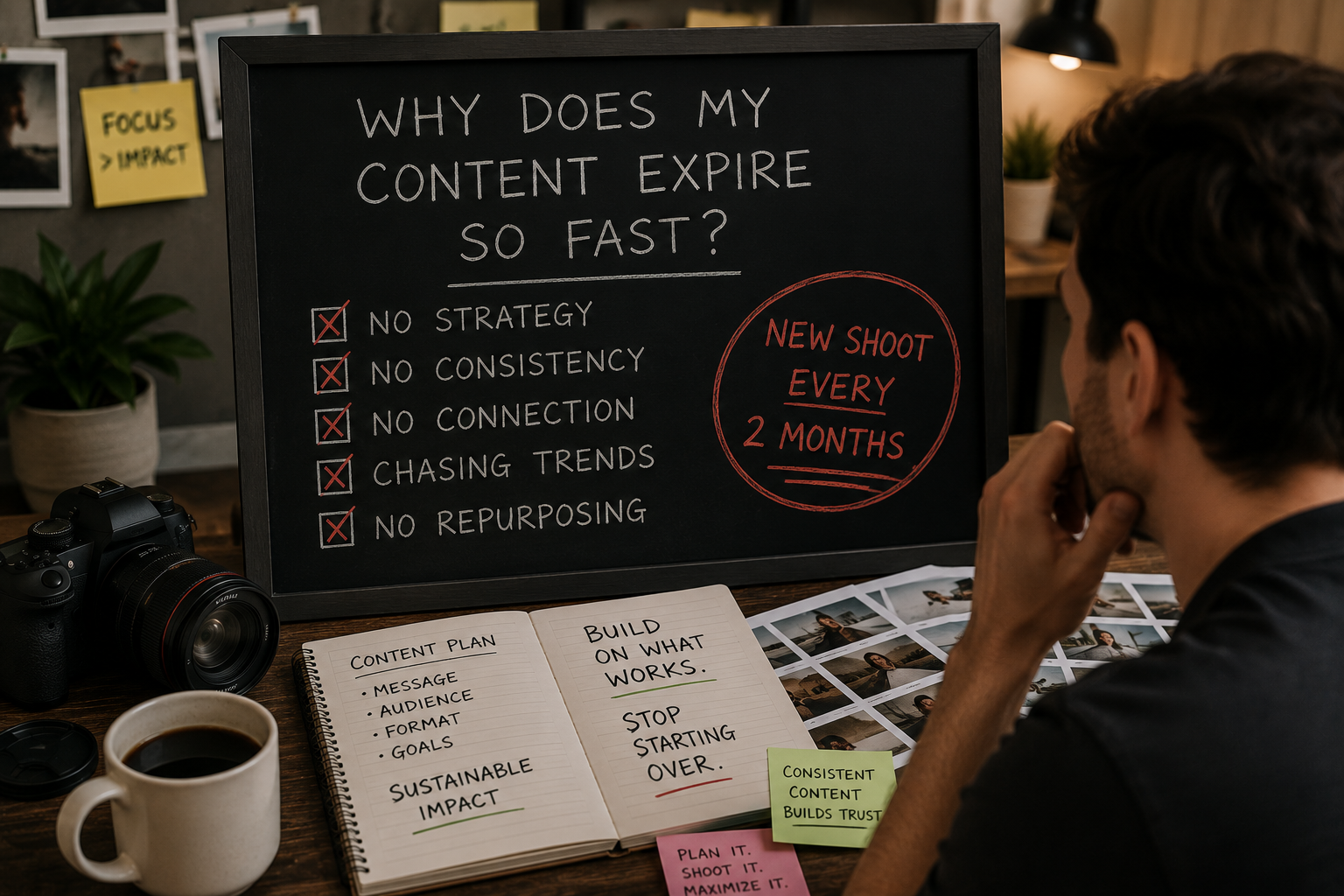
Another reason businesses keep reshooting content every 2 months is poor campaign content planning. Most shoots only cover immediate needs.
For example:
- A homepage redesign
- A product launch
- A seasonal promotion
- A social media refresh
However, nobody asks:
- What content will we need next quarter?
- What happens when we launch new offers?
- Will these visuals still match future campaigns?
- Can this content scale across multiple channels?
As a buyer, inconsistent future campaigns create confusion. One month the company looks premium. The next month it suddenly feels cheap. Then it becomes minimalistic. Then corporate again.
That inconsistency weakens trust even when customers cannot explain why. Strong campaign content planning prevents this.
Instead of producing disconnected visuals, businesses create systems. And systems create content that converts longer.
Situation #4: Your Team Chose “Nice Photos” Instead of Strategic Photos
This happens constantly. A team sees polished visuals and assumes the content is successful. However, buyers don’t care how “creative” the shoot was. They care whether the visuals help them trust the company.
That’s why many branding photography mistakes come from prioritizing aesthetics over clarity.
For example:
- Beautiful images with no context
- Cinematic footage that explains nothing
- Abstract visuals that don’t support offers
- Trendy edits that distract from the message
As a buyer, these visuals feel impressive for three seconds. Then they become forgettable. A strong visual content strategy focuses on usability.
The content should work:
- on websites
- in ads
- in emails
- on landing pages
- inside sales decks
- in remarketing campaigns
Otherwise, the assets become disposable and disposable assets lead to reshooting content every 2 months.
What Is A Visual Content Strategy?
A visual content strategy is a structured plan for creating, managing, and deploying visual assets that support business goals over an extended period of time.
Instead of producing content for a single campaign, social media post, or website update, a visual content strategy ensures that every image, video, and creative asset contributes to a larger marketing system.
The goal is not simply to create attractive visuals. The goal is to create visual assets that support customer acquisition, brand consistency, marketing performance, and long-term business growth.
Content Planning
Every successful visual content strategy begins with content planning. Before a photoshoot takes place, businesses identify:
- Marketing objectives
- Customer needs
- Campaign requirements
- Distribution channels
- Future content demands
Rather than asking: “What content should we create?”
Businesses ask: “What content will we need over the next three, six, or twelve months?”
This shift helps prevent content shortages and reduces the need for constant reshoots.
Campaign Planning
A visual content strategy also requires campaign planning. Many businesses create visuals for individual platforms without considering how assets will support larger marketing initiatives.
Strong campaign planning maps content to:
- Product launches
- Sales promotions
- Advertising campaigns
- Email marketing
- Website updates
- Seasonal initiatives
- Brand awareness campaigns
This ensures content remains relevant long after launch day. Instead of producing disconnected assets, businesses create content that supports multiple marketing objectives simultaneously.
Asset Creation
Asset creation is the process of producing visual content with multiple use cases in mind. A single production may generate:
- Hero campaign imagery
- Website banners
- Advertising creatives
- Social media content
- Email marketing assets
- Product photography
- Sales presentation visuals
- Public relations materials
The strongest visual content strategies focus on creating versatile assets rather than one-time content. This increases efficiency and improves return on investment.
Distribution
Creating content is only part of the process. A visual content strategy also defines where and how assets will be deployed.
Distribution channels may include:
- Websites
- Landing pages
- Paid advertising
- Social media
- Email marketing
- Retail marketing
- Sales materials
- PR outreach
Without a distribution strategy, even high-quality content often remains underutilized. The most effective brands plan distribution before production begins.
Repurposing
Repurposing is one of the most valuable components of a visual content strategy. Instead of using content once, businesses adapt assets for multiple channels and objectives.
For example, a single image may be used for:
- Website content
- Meta Ads
- Instagram posts
- Email marketing
- Sales presentations
- Product launch campaigns
Repurposing extends asset value, improves efficiency, and reduces production costs. The more ways an asset can be used, the greater its return on investment.
Content Lifespan
A visual content strategy also considers how long assets will remain useful. Different types of content have different lifespans.
For example:
- Campaign launch content may last several weeks.
- Paid advertising assets may remain effective for several months.
- Website imagery may remain useful for a year or longer.
- Evergreen brand content may support marketing efforts for multiple years.
By planning for content lifespan in advance, businesses can create refresh cycles, reduce creative fatigue, and avoid constantly replacing assets.
Why A Visual Content Strategy Matters
Without a visual content strategy, businesses often experience:
- Inconsistent branding
- Repeated content shortages
- Rising production costs
- Frequent reshoots
- Disconnected campaigns
- Lower content ROI
With a visual content strategy, every production contributes to a larger system that supports marketing, sales, customer acquisition, and long-term growth.
That is the difference between creating visuals and building a visual content strategy.
The strongest brands do not create content for the next post. They create content for the next six to twelve months of business growth.
The Hidden Cost of Reshooting Content Every 2 Months
Most businesses only calculate production costs. However, the real cost is much larger.
Every reshoot creates:
- lost consistency
- delayed campaigns
- wasted ad spend
- confused customers
- lower trust
- duplicated work
- fragmented branding
Additionally, teams lose momentum. Marketing departments constantly restart from zero. Designers rebuild assets. Ad creatives change direction. Websites become visually inconsistent.
As a buyer, this instability makes the business feel less reliable. That’s why visual content strategy should never be treated as a one-time creative project. It’s part of the customer experience and when the experience feels disconnected, content stops converting.
What Buyers Actually Want From Brand Content
Most customers are not looking for “cinematic storytelling.” They want clarity.
Buyers want to quickly understand:
- What the business does
- Who it helps
- Why it’s trustworthy
- What makes it different
- Whether the company feels consistent
That’s why strong visual content strategy matters more than trendy production. When businesses stop chasing random content ideas, they usually stop reshooting content every 2 months too.
Instead, they create:
- reusable assets
- scalable campaigns
- evergreen visuals
- flexible ad creatives
- consistent branding systems
And that consistency creates content that converts much more effectively.
How to Stop Reshooting Content Every 2 Months
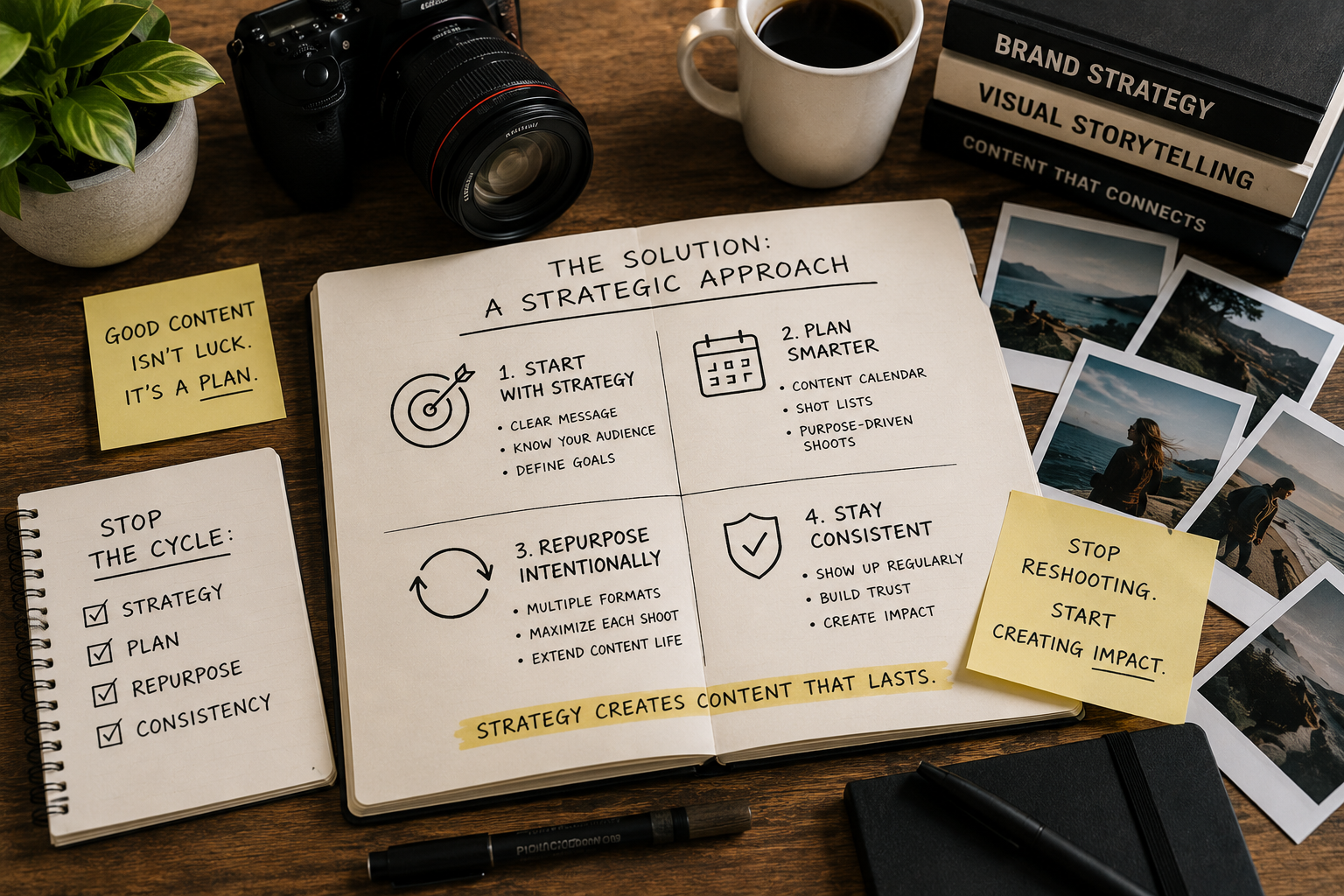
If your business constantly replaces visuals, the solution is usually not “better photos”. The solution is better planning. Here’s what helps:
Build a Long-Term Visual Content Strategy
Instead of planning content month-by-month, build systems that support multiple campaigns.
A proper visual content strategy creates alignment between:
- website visuals
- ad campaigns
- social media
- sales content
- future launches
That alignment reduces unnecessary reshoots dramatically.
Audit Your Existing Visual Assets
Most companies already have usable content. They simply don’t organize it correctly.
A visual audit helps identify:
- missing content gaps
- inconsistent visuals
- outdated assets
- conversion bottlenecks
- unnecessary duplication
Plan Campaigns Before Production
Strong campaign content planning starts before cameras come out.
Businesses should map:
- campaign goals
- customer journeys
- content formats
- future distribution
- long-term asset usage
Create Evergreen Content That Converts
The best-performing visuals are usually the simplest. Not the trendiest. Not the most cinematic. Just clear, trustworthy, and consistent. That’s what buyers actually respond to and that’s what creates content that converts over time.
The Content Lifespan Framework
One of the biggest mistakes businesses make is assuming all content should last the same amount of time.
In reality, different types of visual assets serve different purposes and naturally have different lifespans. Understanding these lifespans helps businesses plan production more effectively, improve content ROI, and avoid unnecessary reshoots.
The goal is not to make every image last forever. The goal is to create a balanced content library containing both short-term and long-term assets.
Read more about Asset Lifespan Extended From Weeks to Months.
Tier 1: Launch Content
Typical Lifespan: 2 – 8 Weeks
Launch content is designed to create immediate awareness around a specific event, offer, or campaign.
Examples include:
- Product launches
- Collection releases
- Seasonal promotions
- Limited-time offers
- New service announcements
Launch content is highly relevant in the short term but often loses effectiveness once the campaign ends.
Because of its limited lifespan, businesses should avoid building their entire content strategy around launch assets.
Primary Purpose
- Generate attention
- Create urgency
- Drive initial traffic
- Support campaign launches
Tier 2: Campaign Content
Typical Lifespan: 2 – 6 Months
Campaign content supports ongoing marketing initiatives and customer acquisition efforts.
Examples include:
- Paid advertising assets
- Landing page imagery
- Promotional content
- Product-focused marketing visuals
- Retargeting creatives
Campaign content often goes through multiple phases:
- Launch
- Testing
- Scaling
- Refresh
The strongest campaigns include enough creative variety to support each phase without requiring immediate reshoots.
Primary Purpose
- Customer acquisition
- Lead generation
- Advertising performance
- Conversion support
Tier 3: Website Content
Typical Lifespan: 6 – 18 Months
Website assets generally remain useful longer than campaign content because they communicate the core identity of the business rather than a temporary promotion.
Examples include:
- Homepage imagery
- About page photography
- Team portraits
- Service visuals
- Process photography
- Brand storytelling assets
While these assets may require occasional updates, they are not usually replaced every few months.
Primary Purpose
- Build trust
- Communicate credibility
- Explain offerings
- Support conversions
Tier 4: Evergreen Brand Content
Typical Lifespan: 12 – 36+ Months
Evergreen content is designed to remain relevant regardless of specific campaigns or promotions.
Examples include:
- Founder photography
- Brand story content
- Company culture imagery
- Customer experience visuals
- Lifestyle photography
- Educational content
These assets form the foundation of long-term brand consistency and often generate the highest overall return on investment.
Primary Purpose
- Brand recognition
- Customer trust
- Consistency
- Long-term marketing support
Tier 5: Strategic Content Assets
Typical Lifespan: 24 – 60+ Months
Strategic content assets are visual resources that continue supporting the business across multiple campaigns, launches, and marketing initiatives.
Examples include:
- Signature brand imagery
- Core visual identity assets
- Brand guidelines photography
- Hero lifestyle imagery
- Foundational marketing visuals
These assets become part of the company’s visual infrastructure and are often reused repeatedly over several years.
Primary Purpose
- Visual consistency
- Brand positioning
- Marketing efficiency
- Long-term scalability
Why Most Businesses Reshoot Too Often
Many businesses unintentionally build their entire content strategy around Tier 1 assets.
As a result:
- Content expires quickly
- Marketing teams run out of creative
- Campaigns require constant updates
- Production costs increase
Because there are few evergreen assets in the content library, the company becomes dependent on frequent reshoots.
This is one of the primary reasons businesses feel trapped in a cycle of replacing content every few months.
The Ideal Content Mix
A healthy content library contains assets from every tier.
For example:
| Content Type | Percentage Of Library |
|---|---|
| Launch Content | 10–15% |
| Campaign Content | 25–30% |
| Website Content | 20–25% |
| Evergreen Brand Content | 20–25% |
| Strategic Content Assets | 10–15% |
This balance helps businesses support both short-term marketing objectives and long-term brand growth.
The Goal Is Not Longer Content. It Is Smarter Content.
The strongest brands do not measure success by how often they create content.
They measure success by how long their content continues generating value.
When businesses understand content lifespan and build assets across multiple tiers, they reduce unnecessary reshoots, improve content ROI, strengthen brand consistency, and create marketing systems that support growth long after production ends.
Visual Content Checklist
If you want to stop reshooting content every 2 months, start by fixing the planning stage.
Download the free Visual Content Checklist to identify:
- missing assets
- weak campaign visuals
- branding inconsistencies
- content gaps hurting conversions
Final Thoughts on Reshooting Content Every 2 Months
Most businesses think they have a production problem. In reality, they usually have a planning problem. Without a strong visual content strategy, content expires quickly.
Without campaign content planning, visuals become disconnected. And without understanding what buyers actually need, companies keep repeating the same branding photography mistakes.
That’s why businesses get trapped reshooting content every 2 months. The goal is not to constantly create more visuals. The goal is to create content that converts for longer.
Frequently Asked Questions About Reshooting Content Every 2 Months
Why Do Businesses Keep Reshooting Content Every 2 Months?
Most businesses do not keep reshooting content because they lack photography. They keep reshooting content because they lack a visual content strategy.
Without long-term planning, content is often created to solve immediate marketing needs rather than support future campaigns, customer journeys, and business growth. As a result, content runs out quickly and new productions become necessary.
Is Reshooting Content Every 2 Months Normal?
For most businesses, no.
While active brands may require new campaign content regularly, constantly replacing all visual assets every two months is usually a sign of poor planning rather than a genuine content requirement.
Strong content systems are designed to support marketing efforts for several months and often much longer.
Why Does Content Feel Outdated So Quickly?
Content often feels outdated because it was created around trends, platforms, or short-term campaigns.
Common causes include:
- Trend-driven visuals
- Seasonal-only content
- Limited asset variety
- No content refresh plan
- Inconsistent branding
When content lacks long-term strategic value, businesses frequently feel pressured to replace it sooner than necessary.
Why Do My Ads Stop Working After A Few Months?
Advertising assets naturally experience creative fatigue.
As audiences repeatedly see the same images, engagement and conversion rates often decline.
This does not necessarily mean the content was ineffective. It usually means the audience has become overly familiar with the creative.
Strong campaign planning includes multiple asset variations and future refresh content to address this challenge.
How Long Should Marketing Content Last?
Content lifespan varies depending on the asset type.
Typical ranges include:
- Launch content: 2–8 weeks
- Campaign content: 2–6 months
- Advertising assets: 1–6 months
- Website content: 6–18 months
- Evergreen brand content: 12–36+ months
The strongest content libraries contain a mix of short-term and long-term assets.
What Is A Visual Content Strategy?
A visual content strategy is a structured plan for creating, distributing, repurposing, and managing visual assets over time.
Rather than creating content for individual platforms or campaigns, businesses develop assets that can support:
- Websites
- Advertising
- Social media
- Email marketing
- Sales materials
- Future campaigns
This approach improves consistency and reduces the need for constant reshoots.
Why Does My Brand Feel Inconsistent?
Brand inconsistency often occurs when content is created without a unified strategy.
For example:
- Website visuals communicate one message
- Social media communicates another
- Advertising uses different imagery
- New campaigns introduce entirely different styles
Customers may not consciously identify these inconsistencies, but they often notice that the brand feels disconnected.
What Are The Biggest Branding Photography Mistakes?
Common mistakes include:
- Planning content around platforms instead of campaigns
- Chasing trends instead of building brand consistency
- Creating too few usable assets
- Failing to plan future campaigns
- Prioritizing aesthetics over marketing objectives
- Ignoring content distribution and repurposing
These mistakes often shorten content lifespan and increase production costs.
How Can Businesses Reduce The Need For Reshoots?
Businesses can reduce unnecessary reshoots by:
- Building a visual content strategy
- Planning campaigns before production
- Creating evergreen assets
- Producing multiple content variations
- Mapping content across channels
- Establishing refresh cycles
- Repurposing existing assets
The goal is to create content systems rather than isolated photoshoots.
What Is Evergreen Content?
Evergreen content is content that remains relevant regardless of specific promotions, launches, or trends.
Examples include:
- Founder photography
- Team portraits
- Brand story visuals
- Customer experience imagery
- Lifestyle content
- Educational content
These assets often provide the highest long-term return on investment.
Why Does Campaign Content Expire Faster Than Brand Content?
Campaign content is typically tied to specific products, launches, promotions, or offers.
Once the campaign ends, the content often loses much of its relevance.
Brand content, on the other hand, focuses on identity, trust, positioning, and customer experience, making it useful across multiple campaigns and marketing initiatives.
How Often Should Businesses Update Brand Photography?
Most businesses should review their visual assets annually and update them as needed.
However, a complete reshoot every two months is rarely necessary unless the company has:
- Frequent product launches
- High advertising volume
- Rapid growth
- Seasonal business cycles
Well-planned visual systems significantly extend the lifespan of marketing assets.
What Is The Hidden Cost Of Constant Reshoots?
The cost extends far beyond photography budgets.
Frequent reshoots often create:
- Inconsistent branding
- Content gaps
- Delayed campaigns
- Lower marketing efficiency
- Increased production costs
- Reduced customer trust
These hidden costs frequently outweigh the actual expense of the photoshoot itself.
What Is The Best Way To Stop Reshooting Content Every 2 Months?
The most effective solution is to shift from creating content to building a content system.
This means:
- Planning future campaigns
- Creating reusable assets
- Building evergreen content
- Managing content lifespan
- Developing a long-term visual strategy
The strongest brands do not solve content shortages by constantly producing more content.
They solve them by creating content that remains valuable for longer.
Next Recommended Reads
How Visual Consistency In Branding Drives Brand Recall And Conversion
Why Your Campaign Visuals Aren’t Converting (And What Brands Usually Get Wrong)