
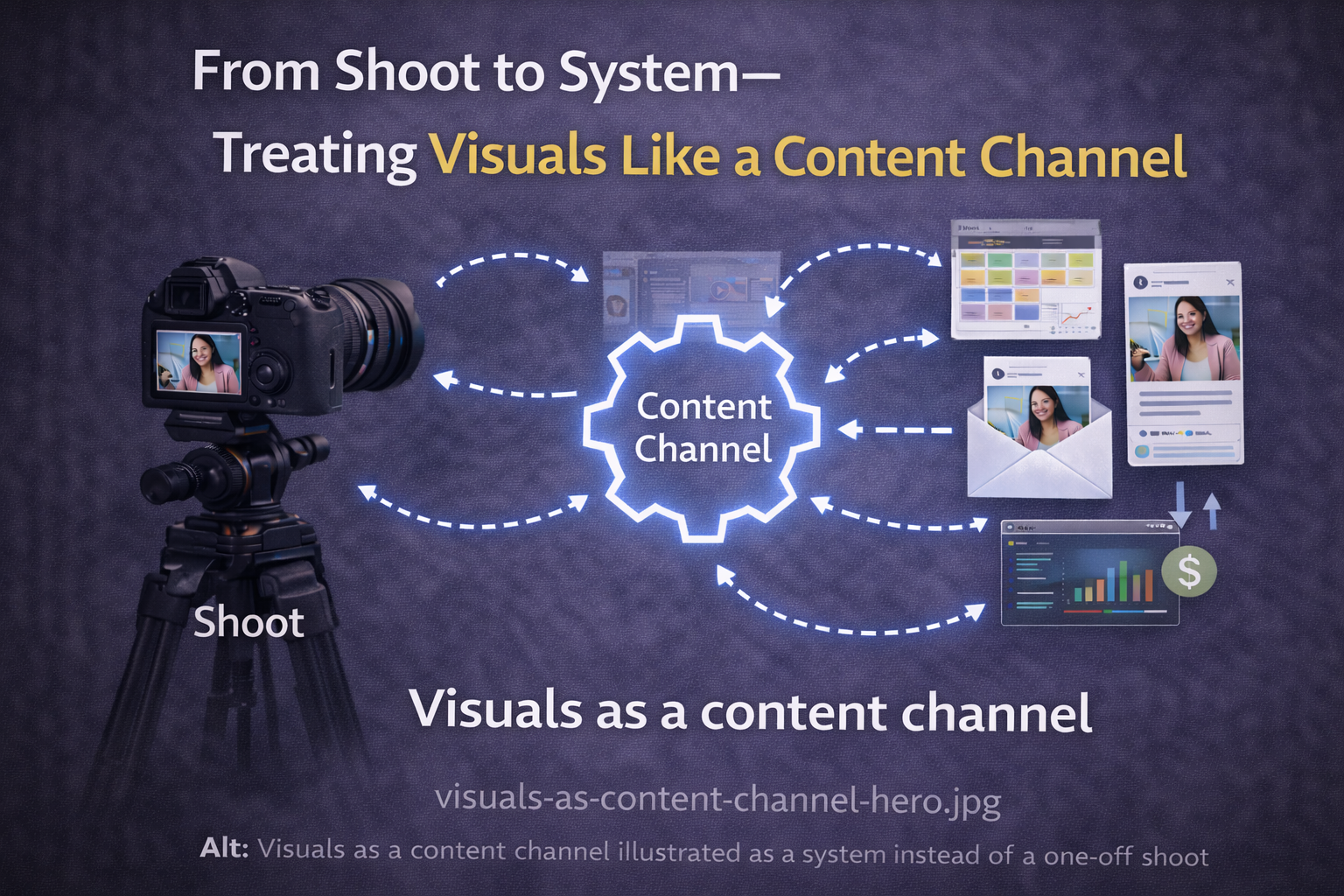
Most brands still approach photography as a one-time production event. However, when you start treating visuals as a content channel, the entire value equation changes. Instead of isolated assets, visuals become part of a repeatable, scalable system that supports long-term growth and measurable content creation ROI.
In other words, the shift from shoot to system is not creative—it’s strategic.
Why Visuals Should Be Treated as a Content Channel

Every photo your brand publishes lives across websites, email campaigns, social platforms, and landing pages. Therefore, visuals already function like media. Yet, without intention, they rarely operate like a channel.
By reframing visuals as a content channel, brands align photography with their broader owned media strategy instead of treating it as a supporting asset.
The Problem With Shoot-Based Thinking
Shoot-based workflows prioritize output over longevity. As a result, teams often create strong visuals that lack a clear lifecycle or distribution plan.
Consequently, content creation ROI suffers. Assets are underused, campaigns demand new shoots, and budgets quietly inflate.
From Shoot to System: What Actually Changes

When brands adopt a system mindset, campaign photography planning starts with where visuals will live, how often they’ll be used, and how they’ll evolve.
As a result, photography is designed for reuse, sequencing, and adaptation—core principles of any effective visual content strategy.
Read: Why content production costs keep rising →
Visual Content Strategy Is the Missing Layer
A strong visual content strategy connects photography to campaigns, channels, and timelines. Instead of isolated deliverables, teams build libraries of modular assets.
Therefore, visuals compound in value rather than expiring after a single launch.
How Treating Visuals as a Content Channel Improves ROI

Once visuals as a content channel are planned like owned media, efficiency increases immediately. Teams produce fewer shoots, extract more value, and extend asset lifespans.
As a result, content creation ROI improves without increasing production volume.
Campaign Photography Planning Becomes Predictable
With a system in place, campaign photography planning becomes proactive instead of reactive. Visual needs are anticipated alongside editorial and media calendars.
Moreover, photography integrates naturally into your owned media strategy, supporting consistency across channels.
Read: How to build a scalable content strategy →
Final Thoughts
Photography doesn’t fail because of creativity—it fails because of structure. When brands move from shoot-based thinking to systems thinking, everything changes.
By treating visuals as a content channel, brands unlock scalability, alignment, and sustained content creation ROI across their entire marketing ecosystem.