
Most brands don’t run out of content because they aren’t producing enough. They run out of content because they planned a photoshoot instead of planning a marketing system.
When content starts disappearing after a few weeks, the usual response is simple: Book another shoot.
The problem is that more shoots rarely solve the underlying issue.
They increase production costs, consume marketing budgets, create operational complexity, and often produce another round of assets that expire just as quickly.
The better question isn’t: “What should we shoot?”
It’s: “What content will marketing actually need over the next six months?”
That question changes everything.
See how campaign assets can be planned for use beyond the original shoot.
🎥 Prefer to Watch Instead?
If you’d rather watch than read, this video covers the key ideas discussed in this article. Then continue below for the complete guide, practical examples and additional resources.
Here is how one production can support multiple content applications.
What Is Content Planning For Fashion Brands?
Content planning for fashion brands is the process of identifying, organizing, and creating the visual assets needed to support marketing activities before a photoshoot takes place.
Rather than starting with creative concepts, locations, or moodboards, content planning begins with business objectives. Fashion brands first determine how content will be used across websites, product launches, paid advertising, email marketing, social media, retail partnerships, and public relations. Production is then designed around those requirements.
This approach helps ensure that every asset created during a shoot has a clear purpose and supports specific marketing goals.
For example, a fashion brand preparing to launch a new collection may require content for:
- Website banners
- Collection landing pages
- Product pages
- Email campaigns
- Meta Ads
- TikTok advertising
- Instagram content
- Retail marketing materials
- Press and PR outreach
Find out more about homepage banner strategy and how one production can generate assets for multiple marketing needs.
Without content planning, brands often produce visually strong imagery that cannot fully support all of these channels. As a result, marketing teams frequently run out of usable content and are forced to organize additional productions sooner than expected.
Effective content planning helps fashion brands create assets that can be distributed, repurposed, and reused across multiple marketing activities over an extended period of time. Instead of treating each photoshoot as a standalone project, brands create a content system that supports ongoing growth.
See how Prestige Artists transformed disconnected productions into a more structured content system in this campaign case study.
The goal is not simply to create more content but to create the right content for the right channels at the right time while maximizing the value of every production investment.
The Traditional Approach
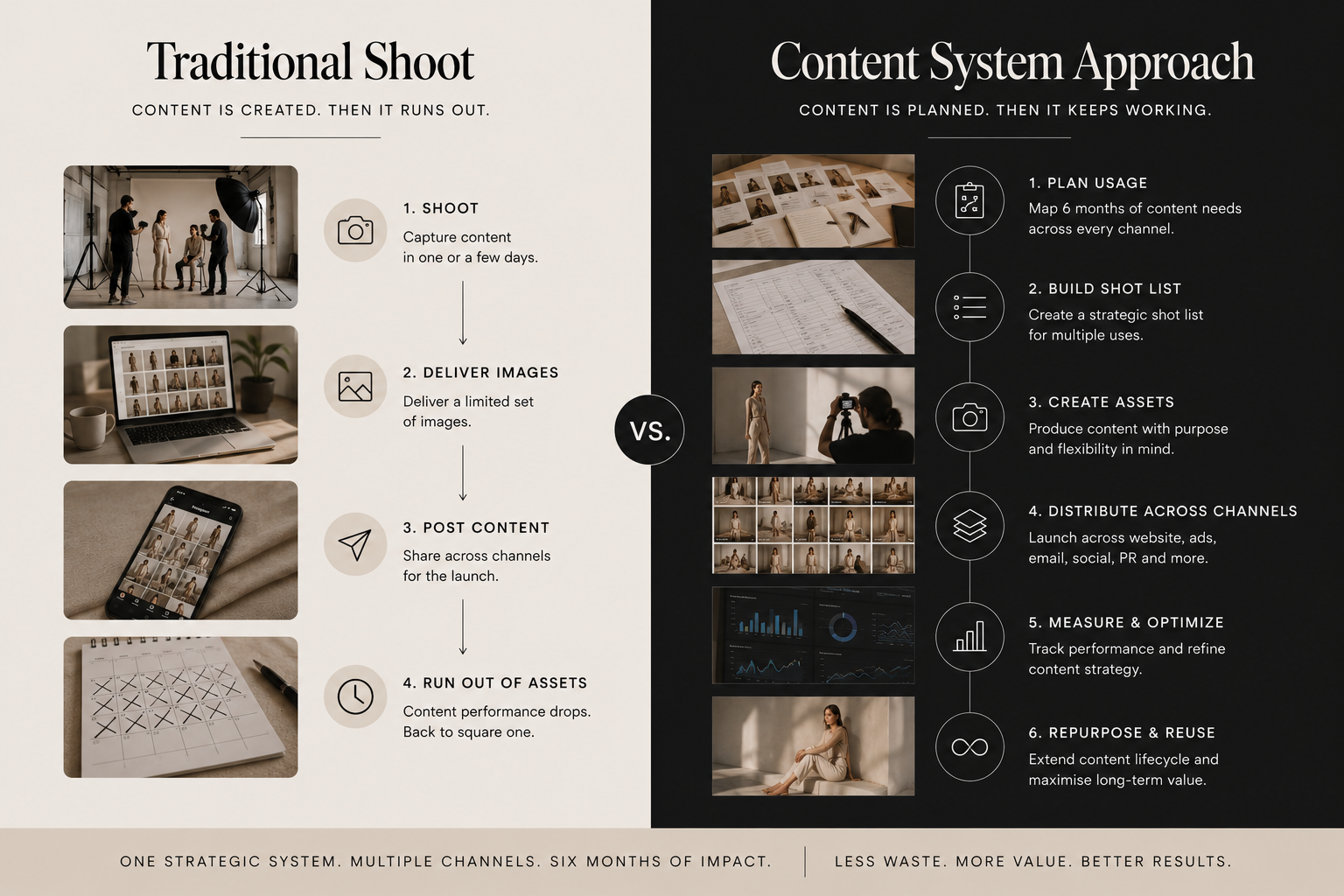
Most productions start with creative concepts.
Teams discuss:
- Moodboards
- Locations
- Styling
- Models
- Shot ideas
Those things matter. However, they are often discussed before anyone defines how the content will actually be used.
As a result, brands end up with beautiful imagery but insufficient assets for paid advertising, email marketing, product launches, website updates, retail communications, and ongoing social media content.
The production succeeds creatively but underperforms operationally.
Planning Marketing Before Planning Production
Before any creative concepts were developed, we mapped every channel that required content.
The brand needed assets for:
- Website banners
- Collection launch pages
- Product pages
- Email marketing
- Paid social campaigns
- Organic social content
- PR and editorial outreach
- Retail partner communications
Instead of building a shoot around aesthetics, we built a production around marketing requirements. The objective wasn’t to create content. The objective was to create a system.
Read more about We Use The Content Planning Framework Before Every Shoot.
Mapping Six Months Of Content Needs
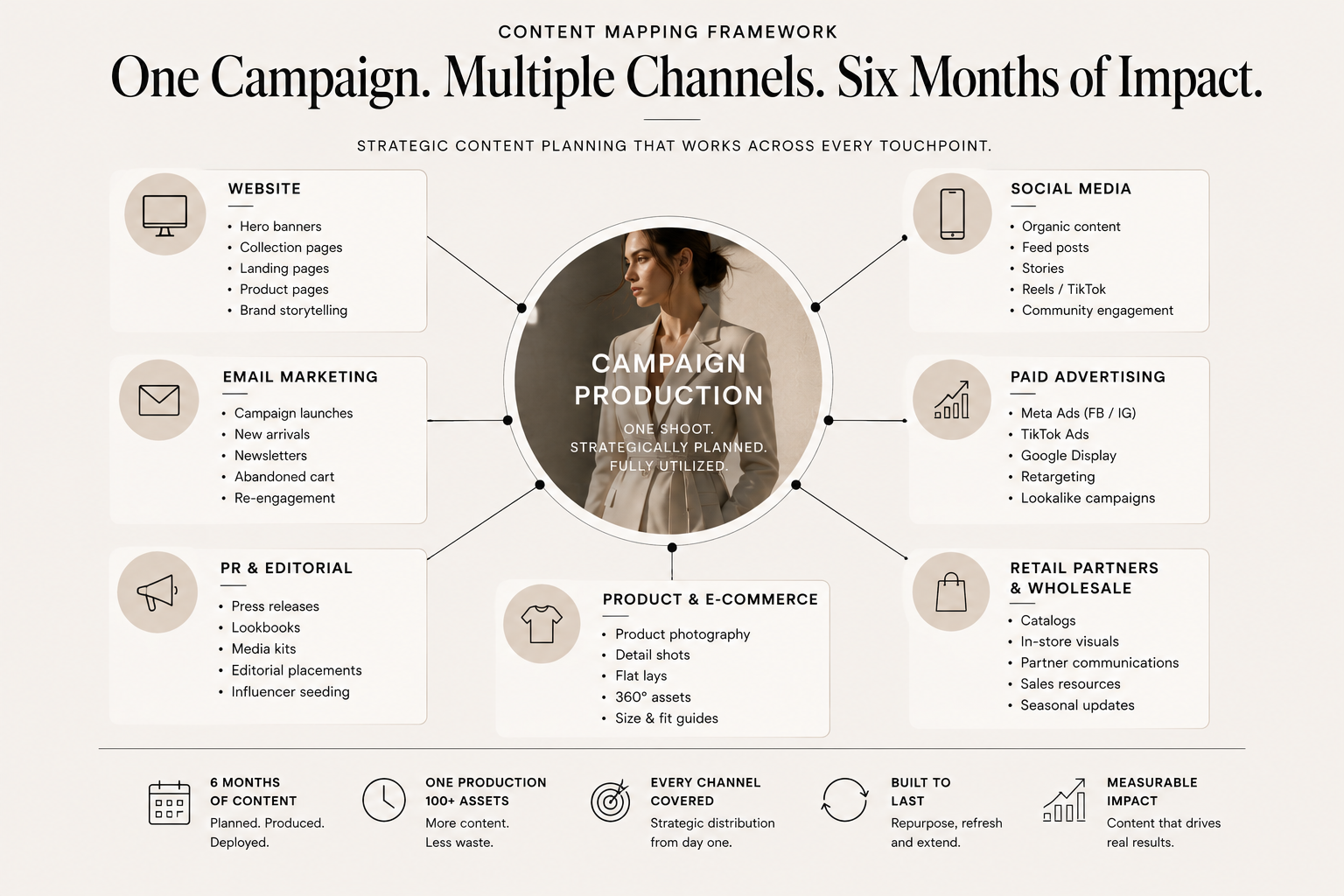
Once distribution channels were identified, we organized content into four categories.
Launch Content
Used during the initial collection release.
Required assets included:
- Hero campaign imagery
- Launch announcements
- Collection landing pages
- Press materials
Growth Content
Designed to support ongoing customer acquisition.
Required assets included:
- Paid social advertisements
- Product-focused creative
- Retargeting campaigns
- Conversion-focused website content
Always-On Content
Content needed continuously throughout the year.
Required assets included:
- Organic social media
- Email newsletters
- Website updates
- Brand storytelling
Evergreen Brand Assets
Long-term content designed to remain valuable beyond a single campaign.
Required assets included:
- Lifestyle imagery
- Founder stories
- Brand positioning visuals
- General marketing materials
Every asset category had a purpose before production began.
Watch: Why Brands Need Content Infrastructure, Not More Shoots
Expanding The Six-Month Content Plan
Many fashion brands evaluate a production based on what happens during launch week. However, the strongest brands evaluate a production based on how long the content continues generating value.
Before production begins, every asset should be mapped to specific marketing activities. This ensures content remains useful long after the initial campaign has ended.
Take a look at How Much Content Does A Fashion Brand Need?
Month 1: Collection Launch
The first month focuses on creating awareness and introducing the collection to the market.
Content priorities typically include:
- Hero campaign imagery
- Collection landing pages
- Launch announcements
- Email launch campaigns
- Press materials
- Retail partner communications
- Social media launch content
The objective is to generate excitement, establish the visual identity of the collection, and create a strong first impression across every customer touchpoint.
Take a look at Why Brand Photography for Fashion Brands Is the Key to Stronger Campaign Performance.
Month 2: Customer Acquisition & Paid Advertising
Once the collection is live, the focus shifts toward acquiring new customers.
Content priorities often include:
- Meta advertising campaigns
- TikTok advertising creatives
- Product-focused advertising assets
- Retargeting campaigns
- Conversion-focused landing pages
- Creative testing variations
At this stage, content is optimized for performance rather than awareness. Different creative variations help marketing teams identify which messages, products, and visuals generate the strongest results.
Read also: What Images Do I Need For Ads?
Month 3: Email Marketing & Product Education
Many brands underutilize content during the weeks following launch. However, this period presents significant opportunities to deepen customer engagement.
Content priorities may include:
- Product feature highlights
- Styling guides
- Collection spotlights
- Customer education campaigns
- Newsletter content
- Product recommendation emails
These assets help extend the lifespan of launch content while providing additional value to existing subscribers and customers.
Watch: The Difference Between Creating Content and Building a Content System
Month 4: Website Refresh & Content Updates
By the fourth month, many brands begin to experience visual fatigue if the same content remains visible across all channels.
Content priorities often include:
- Homepage refreshes
- Collection page updates
- Seasonal website banners
- New landing page imagery
- Product category updates
- Editorial-style website content
Because these assets were planned from the beginning, the website can be refreshed without requiring another production.
Long-term planning becomes easier when teams maintain a searchable visual content library of existing and upcoming assets.
Month 5: Brand Storytelling & Community Building
As the initial launch cycle concludes, attention can shift toward strengthening brand affinity.
Content priorities typically include:
- Lifestyle imagery
- Founder stories
- Behind-the-scenes content
- Brand values communication
- Community engagement campaigns
- Customer-focused storytelling
This content helps fashion brands build deeper relationships with their audience while maintaining consistent visibility between major launches.
Month 6: Retargeting & Evergreen Marketing
The final phase focuses on maximizing the remaining value of the content library.
Content priorities may include:
- Retargeting campaigns
- Evergreen advertising assets
- Website optimization
- Brand awareness campaigns
- Retail support materials
- PR and media outreach
At this stage, content created months earlier continues generating value because it was designed for long-term usability rather than a single campaign.
Why The Six-Month Plan Matters
Most brands create content for a launch. The strongest brands create content for an entire marketing cycle.
When assets are mapped across six months of activity, brands benefit from:
- Longer content lifespan
- Improved content ROI
- Fewer emergency productions
- Better campaign consistency
- More efficient marketing execution
- Stronger return on production investment
The goal is not simply to create more content. The goal is to create content that continues supporting growth long after launch day. That is the difference between a photoshoot and a content system.
Why Fashion Brands Run Out Of Content
Many fashion brands believe they have a content production problem. In reality, they often have a content planning problem.
The issue is rarely a lack of photoshoots. Instead, it is a lack of strategic planning before production begins. As a result, brands frequently invest in new content only to find themselves facing the same shortage a few weeks or months later.
Planning Shoots Instead Of Systems
One of the biggest mistakes fashion brands make is planning individual photoshoots rather than building content systems.
Most productions are organized around:
- Creative concepts
- Moodboards
- Locations
- Styling
- Models
While these elements are important, they do not guarantee that the resulting content will support long-term marketing needs.
As a result, brands launch a campaign, publish a few social media posts, update their website, and quickly discover they need more content.
The strongest brands take a different approach. They view every production as part of a larger content ecosystem designed to support multiple campaigns, channels, and marketing objectives over time.
No Channel Mapping
Many brands begin production without identifying where the content will actually be used.
Content may be needed for:
- Website banners
- Collection launch pages
- Product pages
- Email marketing
- Meta Ads
- TikTok Ads
- Instagram content
- Retail partner communications
- PR and editorial outreach
Without channel mapping, productions often generate content for one or two platforms while leaving significant gaps elsewhere.
The result is predictable: marketing teams need additional content shortly after launch because important channels were never considered during planning.
No Asset Planning
Another common mistake is focusing on image quantity instead of asset requirements.
Brands often ask: “How many images will we receive?”
A more valuable question is: “What assets do we need to support our marketing objectives?”
Different channels require different asset types.
For example:
- Hero campaign imagery
- Product-focused content
- Lifestyle photography
- Website banners
- Vertical advertising assets
- Email marketing visuals
- Brand storytelling content
Without asset planning, brands may receive hundreds of images but still lack the specific content required to execute campaigns effectively.
Planning should extend through production and into the final delivery and handoff of campaign assets.
No Repurposing Strategy
Many fashion brands use content once and then move on to the next production. However, high-performing brands maximize the value of every asset by repurposing content across multiple channels and campaigns.
A single campaign image can often support:
- Website content
- Paid advertising
- Social media
- Email marketing
- PR opportunities
- Retail marketing
The more ways an asset can be used, the greater its return on investment. Without a repurposing strategy, content lifespans become unnecessarily short and production costs increase.
No Usage Plan
Perhaps the most overlooked issue is the absence of a content usage plan. Many brands know what they want to create but have no plan for how assets will be distributed over time.
As a result:
- Campaign assets are used too quickly
- Content libraries become depleted
- Marketing teams run out of creative options
- New productions are scheduled sooner than necessary
The strongest brands map content usage before production begins.
They identify how assets will support:
- Collection launches
- Paid advertising
- Website updates
- Email marketing
- Social storytelling
- Retargeting campaigns
over several months rather than several weeks.
The Real Problem Is Not Production
Most fashion brands do not run out of content because they create too little. They run out of content because they create content without a long-term system.
When brands shift from planning photoshoots to planning marketing systems, content becomes more versatile, more efficient, and significantly more valuable. Instead of constantly chasing the next production, they build content libraries that support growth long after the shoot is complete.
Building The Shot List
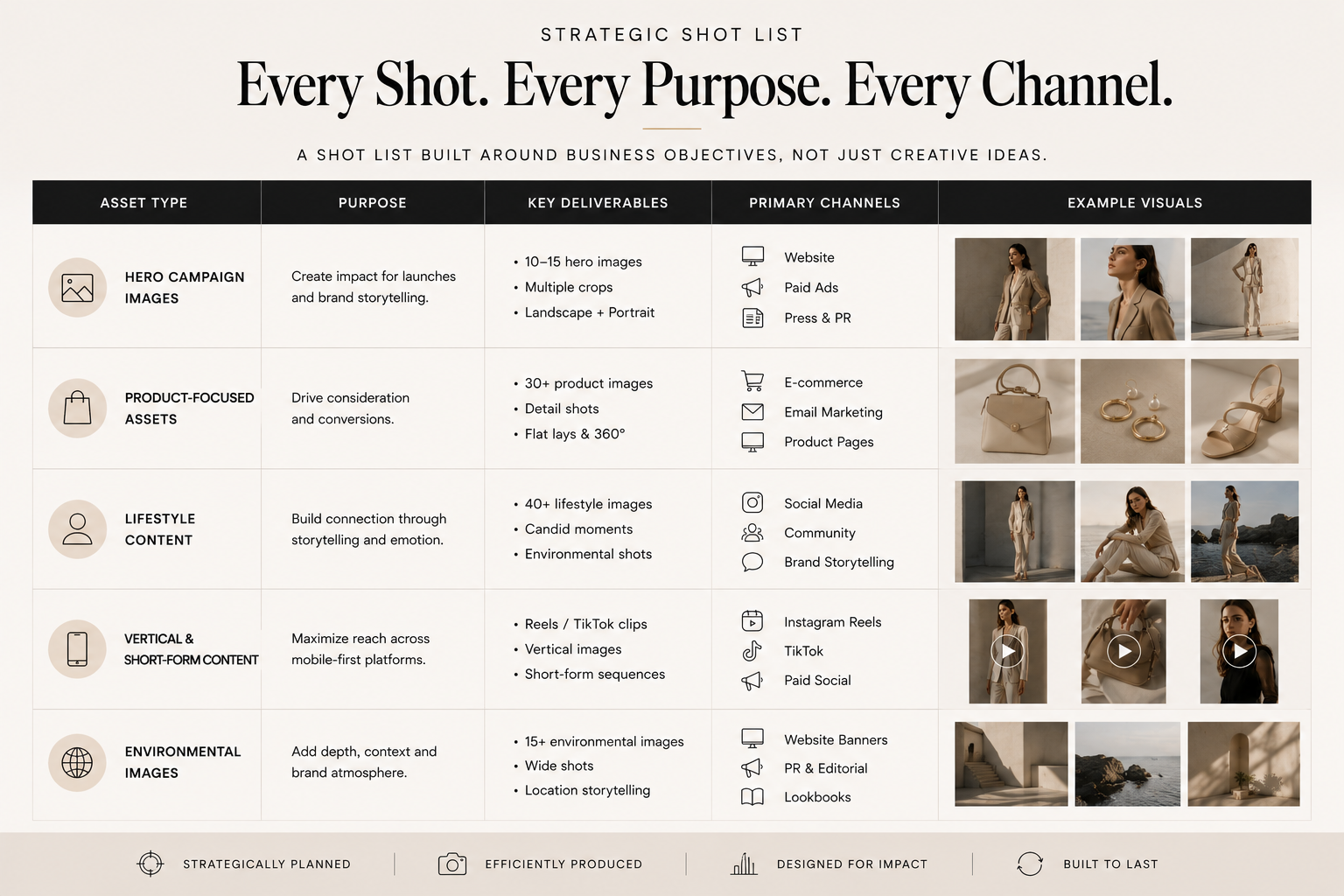
Most shot lists are organized around creative ideas. Ours was organized around business objectives.
Hero Campaign Imagery
Purpose:
- Website banners
- Launch campaigns
- Paid advertising
Deliverables: 10–15 campaign hero images
Product-Focused Assets
Purpose:
- Product pages
- E-commerce
- Email marketing
Deliverables: 30+ product-focused images
Lifestyle Content
Purpose:
- Social media
- Brand storytelling
- Community engagement
Deliverables: 40+ lifestyle assets
Vertical Content
Purpose:
- Instagram Reels
- TikTok
- Paid social campaigns
Deliverables: Multiple short-form video clips & vertical image formats
Environmental Content
Purpose:
- Website headers
- Editorial placements
- PR opportunities
Deliverables: 15+ environmental assets
Every shot had a job.
The Deliverables
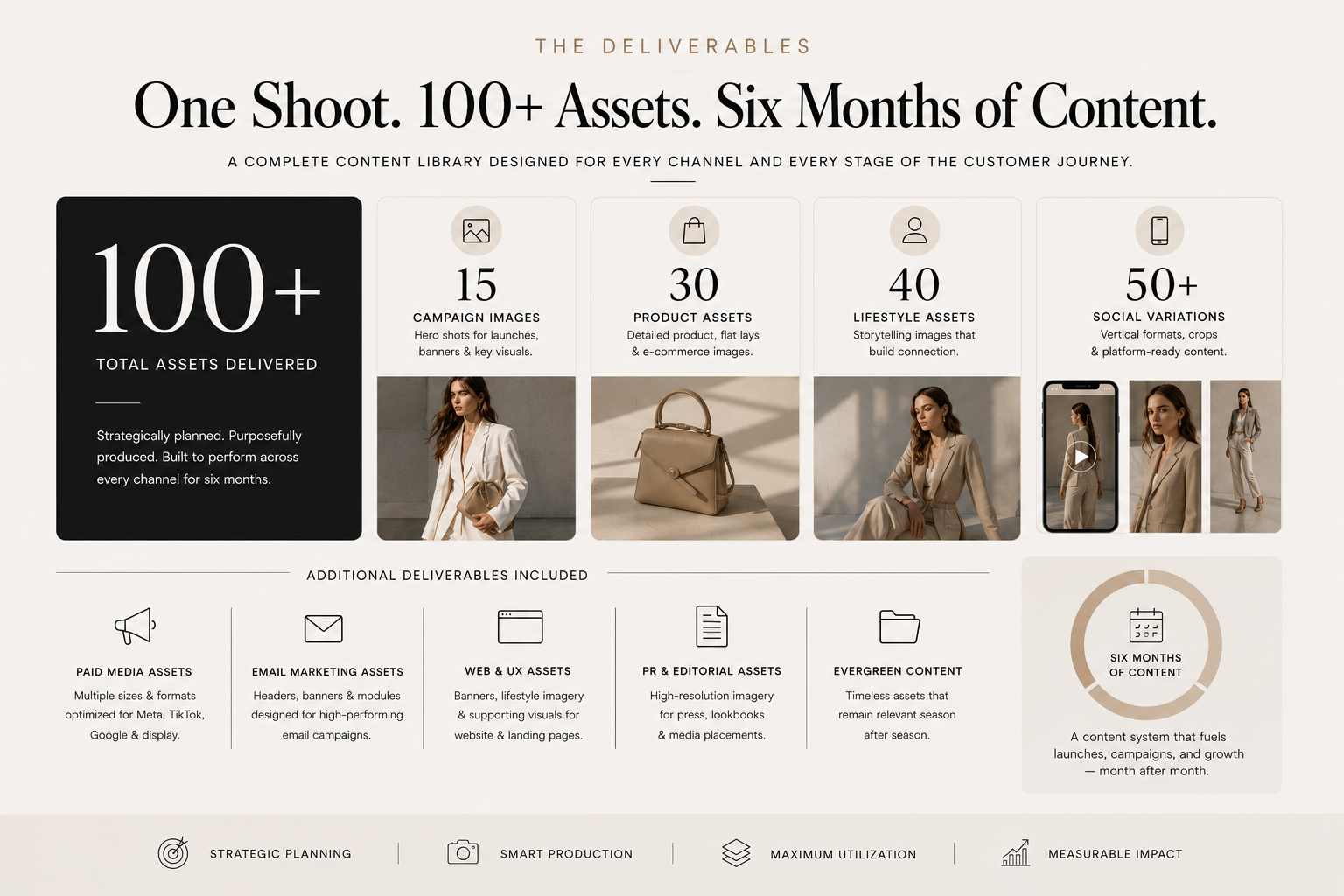
The production generated more than photographs. It generated a content library.
Final outputs included:
Campaign Assets: 15 images
Product Assets: 30 images
Lifestyle Assets: 40 images
Social Variations: 50+ formatted assets
Paid Media Assets: Multiple crops and formats optimized for advertising platforms
Email Marketing Assets: Content designed specifically for newsletters and campaign communications
In total, the production created more than 100 usable assets.
How Strategic Content Planning Reduces Marketing Costs
Many fashion brands assume that reducing marketing costs means reducing production budgets. However, the most effective way to improve efficiency is often improving how content is planned before production begins.
Strategic content planning helps brands create assets that remain valuable for longer, support more marketing activities, and reduce the need for constant content creation. As a result, marketing investments work harder and generate greater long-term returns.
Fewer Emergency Shoots
One of the most expensive habits in fashion marketing is reactive content production.
The cycle is familiar:
- A campaign launches
- Assets are used quickly
- Content runs out
- Marketing teams need new creative
- Another shoot is scheduled
These emergency productions often happen under tight deadlines, which can increase costs and reduce efficiency.
Additional expenses may include:
- Rush production fees
- Last-minute location bookings
- Model availability challenges
- Additional creative development
- Increased project management time
Strategic content planning helps prevent these situations by identifying future content needs before production begins. Instead of constantly reacting to content shortages, brands create content libraries that support multiple campaigns and marketing activities over an extended period.
As a result, content production becomes more predictable, more efficient, and significantly less expensive.
Less Production Waste
Many productions generate far more content than brands actually use.
Without clear planning, teams often create imagery that:
- Does not align with marketing objectives
- Has no defined distribution channel
- Supports only a single use case
- Quickly becomes obsolete
While the images may be visually strong, they provide little long-term business value.
Strategic content planning reduces waste by assigning a purpose to every asset before production begins.
For example, content may be planned specifically for:
- Website updates
- Paid advertising
- Product launches
- Email marketing
- Retail partnerships
- Public relations
When every asset has a defined role, brands maximize the value of production resources and reduce the amount of unused content sitting in storage.
Lower Cost Per Asset
Many brands evaluate a production based on the total cost of the shoot. However, a more useful metric is cost per usable asset.
Consider two productions:
Production A
- Investment: €8,000
- Creates 40 usable assets
Cost per asset: €200
Production B
- Investment: €8,000
- Creates 120 usable assets
Cost per asset: €67
The production cost is identical, but the business value is dramatically different.
Strategic planning increases asset output by intentionally creating:
- Hero campaign imagery
- Product photography
- Lifestyle content
- Advertising creatives
- Email marketing visuals
- Website assets
- Vertical content formats
- Content variations
The more usable assets generated from a single production, the lower the effective cost of each asset and the greater the return on investment.
Longer Content Lifespan
One of the largest hidden costs in marketing is content expiration.
Many brands create assets that are only useful for a single campaign or launch. Once the campaign ends, the content loses much of its value.
Strategic content planning focuses on creating assets with multiple lifespans.
For example:
Short-Term Assets
- Launch announcements
- Promotional campaigns
- Seasonal marketing
Medium-Term Assets
- Paid advertising
- Email marketing
- Social media content
Long-Term Assets
- Website imagery
- Brand storytelling content
- Founder photography
- Lifestyle content
- Evergreen marketing materials
When content remains useful for six months or longer, brands require fewer productions while maintaining a consistent marketing presence.
The longer an asset continues supporting growth, the lower its true cost becomes.
Better Planning Creates Better Economics
The strongest fashion brands rarely reduce costs by producing less content. Instead, they improve efficiency by planning content more strategically.
Strategic content planning reduces marketing costs by:
- Preventing emergency shoots
- Eliminating production waste
- Lowering cost per asset
- Extending content lifespan
As a result, every production supports more marketing objectives, generates more usable assets, and delivers greater long-term value.
The goal is not simply to spend less. The goal is to extract more value from every production investment. That is where strategic content planning becomes a competitive advantage.
Content Planning for Fashion Brands: The Usage Plan
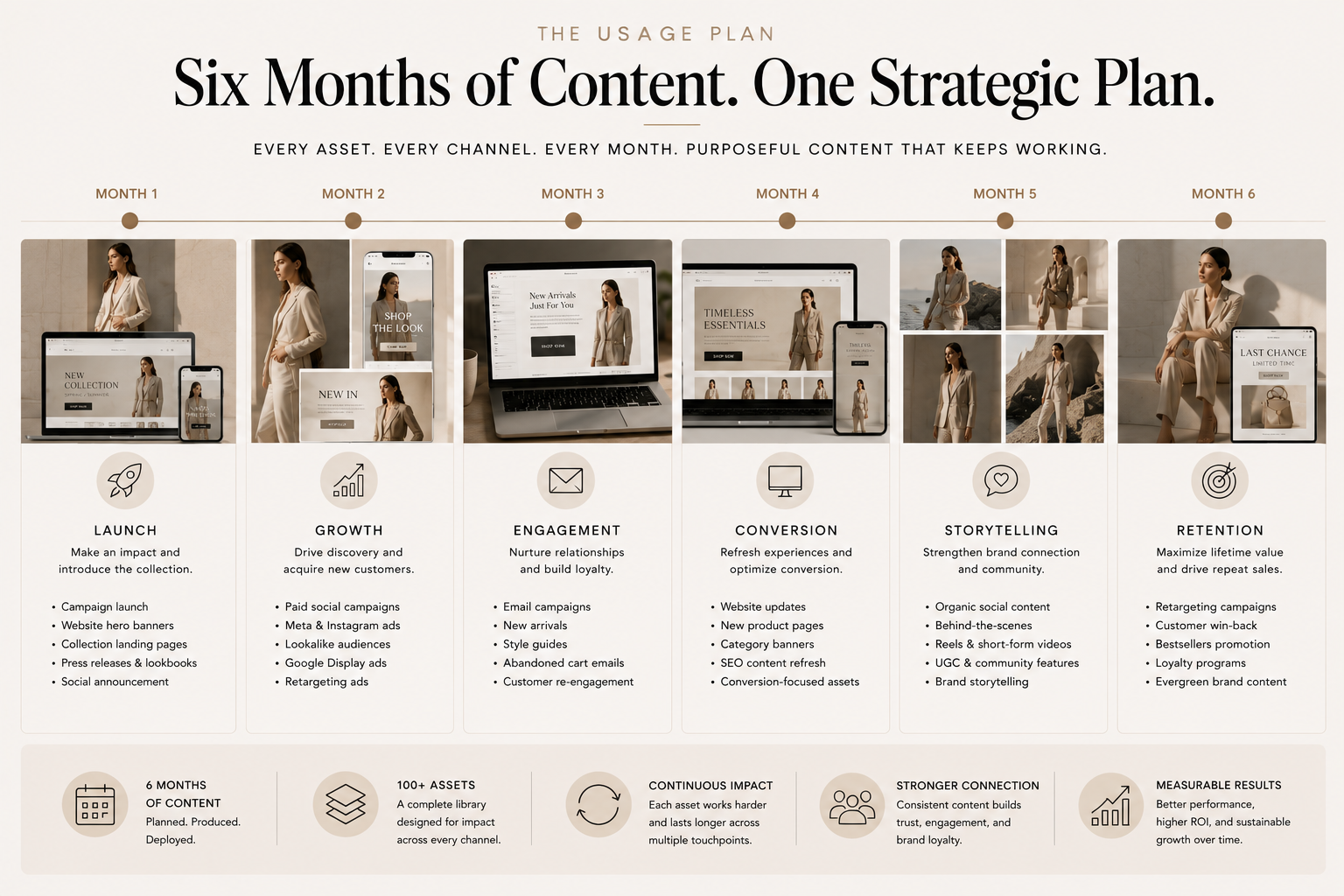
Most brands measure a production by how it looks. We measure it by how long it remains useful. The content was mapped across six months.
1. month: Collection launch
2. month: Paid advertising campaigns
3. month: Email marketing initiatives
4. month: Website updates and refreshes
5. month: Social storytelling campaigns
6. month: Retargeting and evergreen brand content
The production was never intended to support one launch. It was designed to support six months of marketing activity.
Read more about Why We Treat Photography As An Owned Channel.
Free Download: Fashion Content Planning Template
The Difference Between A Shoot And A Content System
A photoshoot creates content. A content system creates assets that continue generating value long after production ends.
The brands achieving the highest return on content investment aren’t necessarily producing more content than everyone else. They’re planning differently.
Instead of asking what should be photographed, they ask how content will be used, distributed, and repurposed across every marketing channel.
The result is less waste, greater efficiency, and content that continues supporting growth long after launch day.
| Traditional Shoot | Content System |
|---|---|
| Creates images | Creates assets |
| Launch-focused | Growth-focused |
| Short lifespan | Long lifespan |
| Reactive | Strategic |
| One channel | Multi-channel |
Also read: Content Systems vs Random Shoots
Final Thought
Most brands don’t have a content production problem. They have a content planning problem.
The more strategically content is planned before production begins, the longer every asset remains valuable and that’s where content starts becoming a system rather than a series of isolated shoots.
Frequently Asked Questions About Content Planning For Fashion Brands
What Is Content Planning For Fashion Brands?
Content planning for fashion brands is the process of identifying the assets required to support marketing activities before a photoshoot takes place. Rather than focusing only on creative concepts, brands determine how content will be used across websites, advertising, social media, email marketing, product launches, retail partnerships, and public relations. This approach helps maximize content lifespan, improve efficiency, and increase return on investment.
Why Do Fashion Brands Run Out Of Content So Quickly?
Many brands run out of content because they plan individual photoshoots instead of building content systems. Without channel mapping, asset planning, repurposing strategies, and long-term usage plans, content is often exhausted within weeks. Strategic content planning helps create assets that can support multiple campaigns and channels over several months.
How Far Ahead Should Fashion Brands Plan Content?
Most fashion brands should plan content at least three to six months in advance. This allows teams to align content production with collection launches, advertising campaigns, seasonal promotions, email marketing initiatives, and website updates. Brands with frequent product releases or active advertising programs may benefit from quarterly or ongoing content planning.
How Much Content Should A Fashion Campaign Produce?
The answer depends on the marketing objectives and distribution channels involved. However, a successful fashion campaign should typically generate assets for:
- Website content
- Paid advertising
- Social media
- Email marketing
- Product launches
- Retail partnerships
- Public relations
The strongest productions often create more than 100 usable assets across multiple formats and channels.
What Is The Difference Between A Photoshoot And A Content System?
A photoshoot creates content for a specific project or campaign. A content system creates assets that support multiple marketing activities over an extended period of time.
A photoshoot focuses on production.
A content system focuses on planning, distribution, repurposing, and long-term asset utilization.
The goal is not simply to create content but to create content that continues generating value long after production ends.
How Often Should Fashion Brands Schedule Photoshoots?
The ideal frequency depends on product launches, advertising activity, and content requirements.
As a general guideline:
- Startup brands: Every 6–12 months
- Emerging brands: Every 3–6 months
- Growth-stage brands: Quarterly
- Established brands: Monthly or ongoing production
The more active a brand’s marketing strategy, the more frequently new content may be required.
How Can Fashion Brands Improve Content ROI?
Fashion brands can improve content ROI by:
- Planning content before production
- Mapping all marketing channels
- Creating assets for multiple use cases
- Producing content variations
- Repurposing existing assets
- Building organized content libraries
- Tracking content performance
The goal is to ensure that every asset supports as many marketing objectives as possible.
What Are The Biggest Content Planning Mistakes Fashion Brands Make?
Common mistakes include:
- Planning shoots instead of systems
- Creating content without a marketing strategy
- Ignoring paid advertising requirements
- Producing too few content variations
- Focusing only on social media
- Failing to plan multiple formats
- Not tracking content performance
- Underestimating future content needs
These mistakes often lead to content shortages, inefficient productions, and unnecessary marketing costs.
How Long Should Marketing Assets Remain Useful?
A well-planned production should generate assets that remain valuable for several months and, in some cases, years.
For example:
- Launch content may be used for several weeks
- Advertising assets may support campaigns for months
- Website imagery may remain useful for a year or longer
- Brand storytelling content may provide value across multiple campaigns
The longer an asset remains relevant, the greater its return on investment.
Why Is Strategic Content Planning Important For Fashion Brands?
Strategic content planning helps fashion brands create more effective marketing assets while reducing production waste and improving efficiency.
Instead of constantly organizing new photoshoots, brands can build content systems that support:
- Product launches
- Advertising campaigns
- Website updates
- Social media
- Email marketing
- Retail partnerships
- Long-term brand growth
As a result, content becomes a scalable business asset rather than a recurring operational challenge.
Recommended Next Reads
How Visual Consistency In Branding Drives Brand Recall And Conversion
What Images Do I Need for Ads? The Mistakes Brands Make Before Their Campaign Even Launches