
How Do You Choose Models for a Fashion Campaign?
Choose models by evaluating how well they support the brand position, target audience, product, campaign concept and required deliverables. Then test their expression, movement, direction response and ensemble chemistry before confirming availability, fees and usage rights.

What Is Fashion Campaign Casting?
Fashion campaign casting is the process of identifying, evaluating and booking models or other talent whose presence and performance support a campaign’s commercial and creative objectives. It connects the target audience, brand positioning, product, visual direction, deliverables and media plan to the people appearing in the final work.
This makes campaign casting different from choosing talent for a runway show, a fit session, an editorial story or an e-commerce production. Each format places different demands on a model. A runway model must deliver movement and consistency in a live environment. An e-commerce model may need to repeat precise poses across a large product volume. Editorial casting may prioritize conceptual tension. Campaign talent must often combine brand presence, product credibility, emotional range and multi-format performance.
Casting also sits within a larger production system. The fashion campaign brief establishes the objective and audience. Creative direction for fashion campaigns defines the visual language. Casting then gives that strategy a human presence. When these stages are disconnected, the model may look compelling in isolation while communicating the wrong brand.
Why Casting Affects Brand Performance
People read faces, posture, movement, age, styling and social cues almost instantly. Therefore, talent shapes the viewer’s first interpretation of a campaign. Before a customer studies the product, they may already have decided whether the brand feels relevant, aspirational, accessible, progressive, exclusive or familiar.
The casting decision influences at least five outcomes:
- Positioning: The model helps signal the brand’s cultural and market context
- Audience recognition: Customers can see themselves, an attainable future self or a credible world they want to enter
- Product perception: Proportion, movement and attitude change how a garment or accessory is understood
- Asset performance: Expressive range and camera awareness affect the number of usable campaign, social, e-commerce and advertising variations
- Commercial flexibility: Usage terms, availability and category conflicts determine where and for how long the content can run
The uncomfortable truth is that a visually exciting model can still be a weak commercial choice. If they cannot deliver the required movement, do not fit the samples, conflict with the intended positioning or cannot be licensed for priority media, the production inherits a problem that styling and retouching cannot solve.
Define the Casting Strategy Before Reviewing Models
Do not begin with agency boards. First, write a casting direction that explains what the talent must communicate and do. Otherwise, recognizable faces and personal taste will anchor the discussion before the team has agreed on the job to be done.
A useful casting direction should answer these questions:
- Who is the campaign designed to influence?
- What should that audience feel about the brand?
- Is the model a reflection of the customer, an aspiration or a character within a story?
- Which product categories and sample sizes must the talent carry?
- What movement, expression, acting or interaction will the concept require?
- Which still, video, social, e-commerce, retail or paid-media deliverables are planned?
- Will one model lead the narrative, or must several people work as an ensemble?
- Which markets, media, durations and exclusivity terms must be cleared?
Write the answer as a short strategic statement rather than a list of physical traits. For example: “The campaign needs a confident, contemporary lead who can make technical tailoring feel expressive rather than corporate, perform controlled movement for stills and short-form video, and connect credibly with style-conscious professionals aged 28–45”. That gives agencies and casting directors something meaningful to solve.

Eight Fashion Campaign Casting Criteria
1. Brand positioning
Ask what the model’s presence communicates before styling is added. Premium does not have one face, and neither do youth, authority or innovation. However, every person brings visual and cultural associations. The goal is not to stereotype talent; it is to consider whether the full presentation supports the brand world being built.
2. Audience relationship
Decide whether the campaign relies on identification, aspiration, expertise, desire or community. A customer does not always need to look like the model. Nevertheless, the relationship should feel intentional. If the audience cannot understand why this person belongs in the campaign, the imagery may create distance without creating desire.
3. Product compatibility
Check current measurements, proportions, shoe size and any product-specific requirements against the actual samples. Then go further. Consider how the model’s posture and movement affect silhouette, fabric, construction and scale. For accessories or beauty, hands, ears, skin, hair and facial movement may also be central production considerations.
4. Emotional and narrative range
A portfolio shows selected successes, not necessarily the range required by your concept. Define the emotional register: restrained, playful, intimate, defiant, energetic or serene. Then request material that demonstrates it. If the campaign includes interactions, assess listening and responsiveness as well as individual presence.
5. Movement and repeatability
Some models create excellent isolated frames but struggle to repeat movement, hold continuity or adapt across formats. Campaign production often requires a model to perform a gesture for stills, repeat it for video and adjust it for horizontal and vertical compositions. Repeatability protects the schedule while variation protects the asset library.
6. Multi-format performance
Review the photography shot list before approving talent. A close beauty portrait, a full-length garment image, a six-second vertical video and a group scene demand different skills. Casting should support the hardest priority deliverable, not merely the hero image on the moodboard.
7. Professional reliability
Good campaign talent arrives prepared, understands direction, communicates clearly and sustains performance across the scheduled day. Agencies, casting directors, producers and previous collaborators can provide useful context. Reliability should not outweigh creative fit, but ignoring it can turn an ambitious shot list into an expensive compromise.
8. Commercial availability
Confirm dates, travel, usage, territory, duration, exclusivity and competitive conflicts before treating anyone as the preferred choice. A model who is available for the shoot but unavailable for the campaign’s intended media is not truly available.
Build a Casting Scorecard
A scorecard makes the decision more transparent without pretending that casting is purely mathematical. Weight the factors according to the campaign, score each candidate using the same evidence and add written notes for important nuances.
| Criterion | Suggested Weight | Evidence to Review |
|---|---|---|
| Brand and concept alignment | 25% | Portfolio, digitals, casting brief response |
| Product and sample compatibility | 15% | Measurements, fitting, movement test |
| Expression and narrative range | 15% | Self-tape, live casting, previous work |
| Movement and repeatability | 15% | Walk, turn and action sequences on video |
| Multi-format suitability | 10% | Close-up, full-length, horizontal and vertical tests |
| Ensemble chemistry | 10% | Pair or group callback |
| Reliability and production fit | 5% | Agency information and production history |
| Rights, availability and budget | 5% | Confirmed quote, dates and usage terms |
These weights are not universal. A movement-led sportswear campaign may assign 30% to physical performance. A beauty close-up may weight skin, expression and camera intimacy more heavily. A campaign built around several characters should increase the importance of ensemble chemistry.
Scorecards also expose disagreement. If the marketing lead favors one candidate and the creative director favors another, the team can identify whether they disagree about the evidence or about the campaign priorities. That is more useful than debating who has better taste.
| Candidate | Brand fit | Performance | Product fit | Rights | Decision |
|---|---|---|---|---|---|
| Model A | 9/10 | 6/10 | 9/10 | 10/10 | Strong backup |
| Model B | 8/10 | 9/10 | 8/10 | 8/10 | Preferred |
| Model C | 10/10 | 7/10 | 6/10 | 5/10 | Creative fit, high commercial risk |
Download the Fashion Campaign Casting Scorecard
Turn the framework above into a consistent, reviewable casting decision.
The Fashion Campaign Casting Scorecard helps your team compare up to 12 candidates using weighted criteria rather than appearance, familiarity or personal preference alone. You can adjust the weights to match the campaign, score each model from 1–10 and automatically calculate rankings and decision statuses.
The downloadable Excel template includes:
- Eight editable casting criteria and campaign-specific weights
- Automatic weighted scores and candidate rankings
- Essential checks for availability, sample fit, usage rights, budget and competitive conflicts
- Space to document evidence, reservations and production risks
- Primary-candidate, backup and final-approval fields
A high score cannot override a failed essential requirement. This keeps visually strong candidates from advancing when the booking cannot support the product, production or planned media.
Download the Fashion Campaign Casting Scorecard
Review Portfolios and Casting Materials Properly
Start with current digitals, measurements, location, availability and agency representation. Then review portfolio work for relevant evidence. Do not confuse an exceptional photographer, styling team or retouch with the model’s repeatable capability. Look for consistency across different clients and production conditions.
Request a focused self-tape when the existing material does not answer the brief. Give every candidate the same simple instructions: framing, wardrobe, light, introduction, required expressions and movement sequence. The goal is not to recreate the campaign without a crew. It is to compare response to direction under reasonably consistent conditions.
Social reach may matter if the agreement includes creator distribution. Otherwise, it should not quietly become a substitute for campaign suitability. A large following has little value when the model’s audience, content style or contractual participation does not support the media plan.
Test Models Before Booking
For higher-value or performance-sensitive campaigns, hold a live casting, virtual callback, fitting or camera test. Test the requirements that carry the most production risk:
- neutral and directed expressions
- full-length movement and garment behavior
- hand interaction with products or accessories
- spoken delivery when video includes dialogue
- chemistry between paired or grouped talent
- response to concise creative direction
- repeatability across several takes
- appearance under lighting similar to the planned production

A fitting is not only a sizing check. It can reveal whether tailoring holds its intended line, whether movement exposes product issues and whether time-consuming alterations are realistic. Document approved looks and unresolved risks, then feed those decisions into the fashion campaign approval workflow.
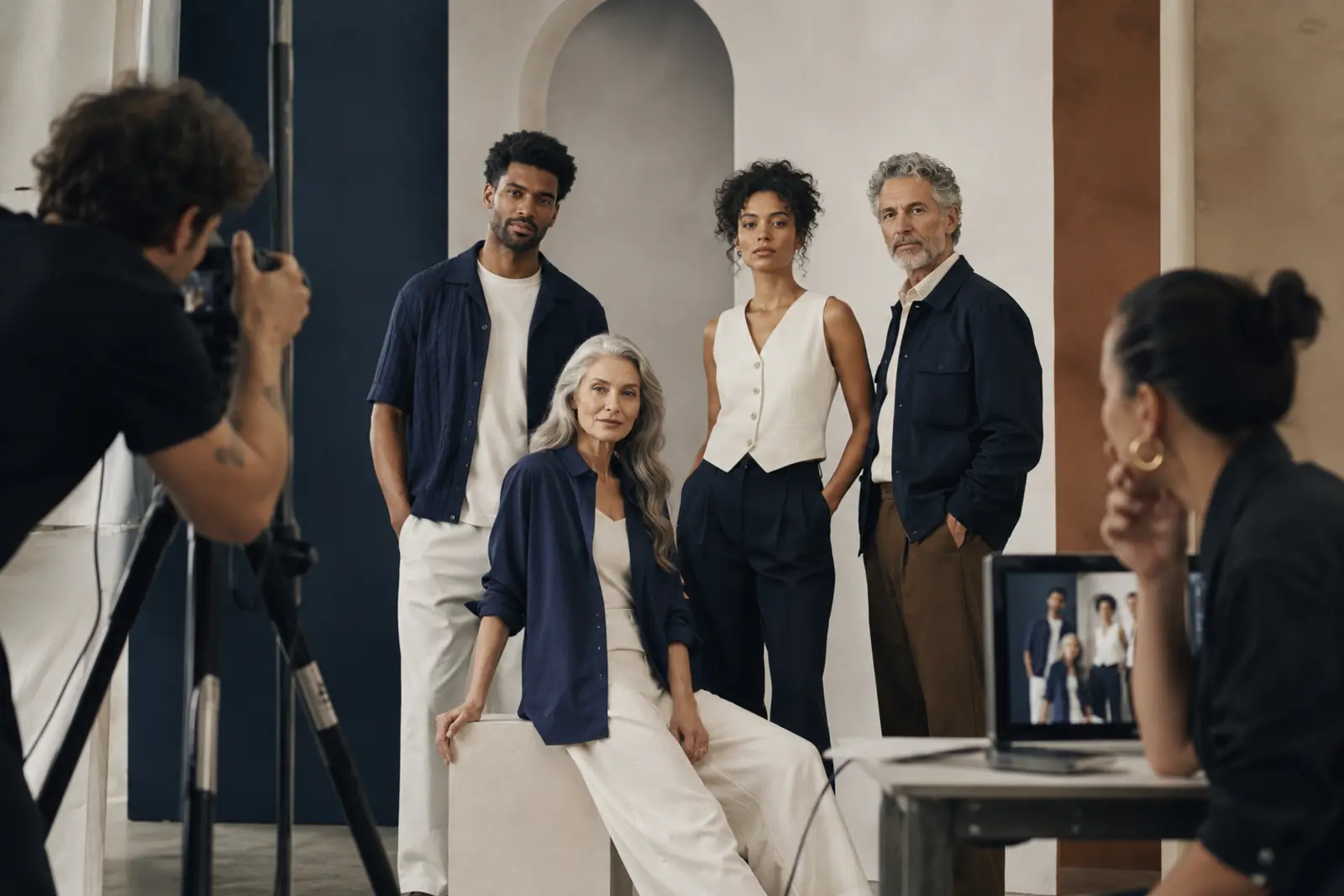
Cast an Ensemble, Not Separate Individuals
When a campaign includes several models, do not select each person independently and assume the group will work. An ensemble creates its own hierarchy, rhythm and story. Similar heights may create unity, while contrast can create energy. Neither is automatically better.
Review the shortlist as contact sheets and test likely pairings. Consider:
- who visually leads and whether that hierarchy serves the concept
- whether styling can create cohesion without making everyone look interchangeable
- how height, scale and movement affect planned compositions
- whether the models listen and respond to one another
- whether individual identities remain visible within the group
- how many useful pairings and subgroups the cast can generate
This matters commercially because ensemble flexibility increases coverage. A well-planned group can create a hero composition, several pairs, individual portraits, product stories and short-form interactions without making the campaign feel fragmented.
Plan Representation Without Tokenism
Inclusive casting should begin with the audience, brand values and campaign world, not with a last-minute request to make the shortlist “more diverse”. Tokenistic casting treats difference as decoration while leaving the story, styling, decision-makers and distribution strategy unchanged.
Instead, ask whether the complete campaign represents people with dignity, specificity and meaningful presence. Consider age, race, ethnicity, disability, gender expression, body diversity and other forms of lived experience where relevant. Then check whether styling, hair and makeup expertise, set access, scheduling and product samples support the people being cast.
Representation is not solved by maximizing visible difference in every frame. It is strengthened by consistency between what the brand claims, whom it serves, how talent is treated and where the final content appears. The Zalando Beauty scalable photoshoot case study shows how inclusive creative intent can become a coherent asset system rather than an isolated visual gesture.
Check Usage Rights, Budget and Logistics Before Approval
Talent fees are shaped by more than shoot hours. Paid advertising, print, out-of-home, point of sale, e-commerce, organic social, territory, duration, exclusivity and renewal options can affect the quote. Confirm the intended use before requesting final estimates so candidates can be compared on equivalent terms.
The casting budget should include:
- agency and casting fees
- session or shoot fees
- usage and buyout terms
- travel, accommodation and local transport
- fittings, rehearsal or test days
- overtime, weather holds and cancellation terms
- exclusivity or competitive-category restrictions
- renewal options and potential extension costs
Use the campaign budget calculator to place talent costs within the complete production rather than treating them as an isolated line item. After delivery, attach model releases and usage data to the relevant assets. The guide to digital asset management for fashion brands explains why rights information must remain connected to the files.
A cheap booking can become expensive if limited rights force an early reshoot. Conversely, paying for an unrestricted global buyout when the campaign will run for three months in one market wastes budget. The correct agreement matches the real distribution plan and provides clearly priced options for plausible growth.
A Practical Fashion Campaign Casting Workflow
- Approve the campaign brief. Fix the objective, audience, message, product priority and launch requirements
- Translate strategy into a casting direction. Describe the role, energy, performance and relationship to the audience
- Confirm operational constraints. Record samples, sizes, dates, location, media, territory, duration and budget
- Issue one consistent brief. Give agencies or casting partners the same criteria and deadline
- Create a longlist. Remove candidates who fail essential availability, rights or product requirements
- Build a scored shortlist. Evaluate current materials against weighted criteria and document uncertainties
- Run callbacks or tests. Test the performance requirements with the highest creative or financial risk
- Review ensembles and backups. Compare combinations and keep at least one approved alternative for each essential role
- Secure stakeholder approval. Present evidence, scores, fees, usage terms and risks, not only headshots
- Book and document. Confirm agreements, releases, travel, fittings, call times and approval status
- Brief the full team. Share casting decisions with styling, hair and makeup, photography, video and production
- Archive rights data. Store agreements, expiry dates and restrictions with the final campaign assets
This process also clarifies ownership. The article on fashion campaign production roles explains how brand, agency, producer, casting director, creative director, photographer and talent responsibilities should work together.
Common Fashion Campaign Casting Mistakes
Casting from appearance alone
A still image cannot prove movement, range, chemistry or response to direction. Use the portfolio to begin the evaluation, not to end it.
Using vague language such as “cool” or “aspirational”
These words hide disagreement. Define what the audience should perceive and which observable qualities support that response.
Choosing social reach without a distribution agreement
A following is not campaign media unless the model is contracted to publish appropriate content and the audience is relevant.
Ignoring the hardest deliverable
A model chosen for a static hero may struggle with dialogue, product demonstration, group interaction or fast e-commerce coverage. Test the most demanding priority output.
Checking measurements too late
Outdated information and untested samples can create emergency alterations, styling compromises and delays. Confirm measurements and arrange fittings early.
Treating inclusion as an add-on
Representation without suitable samples, specialist hair and makeup, accessible production or meaningful narrative presence is cosmetic rather than structural.
Approving talent before confirming usage
Dates and creative fit do not complete the booking. Rights, territory, exclusivity, duration and renewals must match the campaign plan.
Failing to approve backups
Availability can change. A strategically acceptable backup protects the concept and timeline from avoidable last-minute decisions.
Fashion Campaign Casting Checklist
- Campaign objective and target audience are approved
- Talent’s role in the narrative is clearly defined
- Brand-fit criteria are written in observable language
- Required expressions, movement and interactions are listed
- Priority still and video formats are identified
- Current measurements and sample compatibility are confirmed
- Longlist and shortlist use consistent evaluation criteria
- High-risk performance requirements have been tested
- Ensemble chemistry and visual hierarchy have been reviewed
- Representation is supported throughout the production
- Dates, travel and fitting availability are confirmed
- Media, territory, duration and exclusivity are documented
- Fees, options, overtime and cancellation terms are clear
- Decision-makers have approved primary and backup talent
- Agreements and rights metadata have an archive owner
Frequently Asked Questions
What is fashion campaign casting?
Fashion campaign casting is the strategic process of selecting and booking models or talent who support a campaign’s brand positioning, audience, product, creative concept, production needs and media plan.
When should casting begin for a fashion campaign?
Casting should begin after the brief and core creative direction are approved but early enough to complete shortlisting, tests, fittings, negotiations and backup approvals. For many campaigns, this means several weeks before production. Use a complete fashion campaign timeline to schedule dependencies.
Who chooses models for a fashion campaign?
The final authority depends on the production. The brand may approve the decision, while a casting director or producer manages sourcing and negotiations. The creative director and photographer usually assess concept, ensemble and on-camera performance. Roles should be defined before shortlisting.
Should a fashion brand cast models who look like its customers?
Sometimes, but not automatically. A campaign may use identification, aspiration, expertise, fantasy or character. The important question is whether the audience understands and believes the model’s relationship to the brand.
Are model followers important when casting a campaign?
Only when creator reach is an intentional, contracted part of the distribution plan. Otherwise, audience size should not outweigh product fit, brand alignment, performance, reliability or usable rights.
What should a fashion campaign casting brief include?
Include the campaign objective, audience, concept, role description, desired energy, required skills, product and sample information, dates, location, deliverables, media, territory, duration, exclusivity, fee structure and submission instructions.
How do you evaluate models fairly?
Give candidates consistent instructions, assess them against job-related criteria, document the evidence and separate essential requirements from subjective preferences. A weighted scorecard can structure the discussion, but informed creative judgment remains necessary.
Final Perspective: Cast the Brand Strategy
The strongest fashion campaign casting decisions do not start with “Who looks best?” They start with “What must this campaign communicate, and what must the talent be able to deliver?” That shift makes the process more creative and more commercially responsible.
When the brief, creative direction, product, audience, performance tests and usage plan point toward the same choice, casting becomes part of the brand system. The result is not only a stronger hero image. It is a more coherent, flexible and valuable campaign library.
Plan the People and Assets as One Campaign System
If your next production needs to align casting, creative direction and multi-channel deliverables, a Visual Audit can identify the gaps before the budget is committed.