
Photography as owned media is hiding in plain sight. Brands invest heavily in photoshoots, yet most treat photography as a creative deliverable instead of a media channel. However, when photography is planned like owned media, it becomes one of the most powerful and cost-effective assets in the marketing mix.
In short, photography already functions as media, brands just don’t manage it that way.
What You Will Learn About Photography As Owned Media?
- What we mean by photography as owned media
- Why most brands don’t treat photography as owned media
- Photography as owned media and planning photography like media buys
- Why fashion brands benefit from photography as owned media
- Photography as owned media creates compounding ROI
What We Mean By Photography As Owned Media
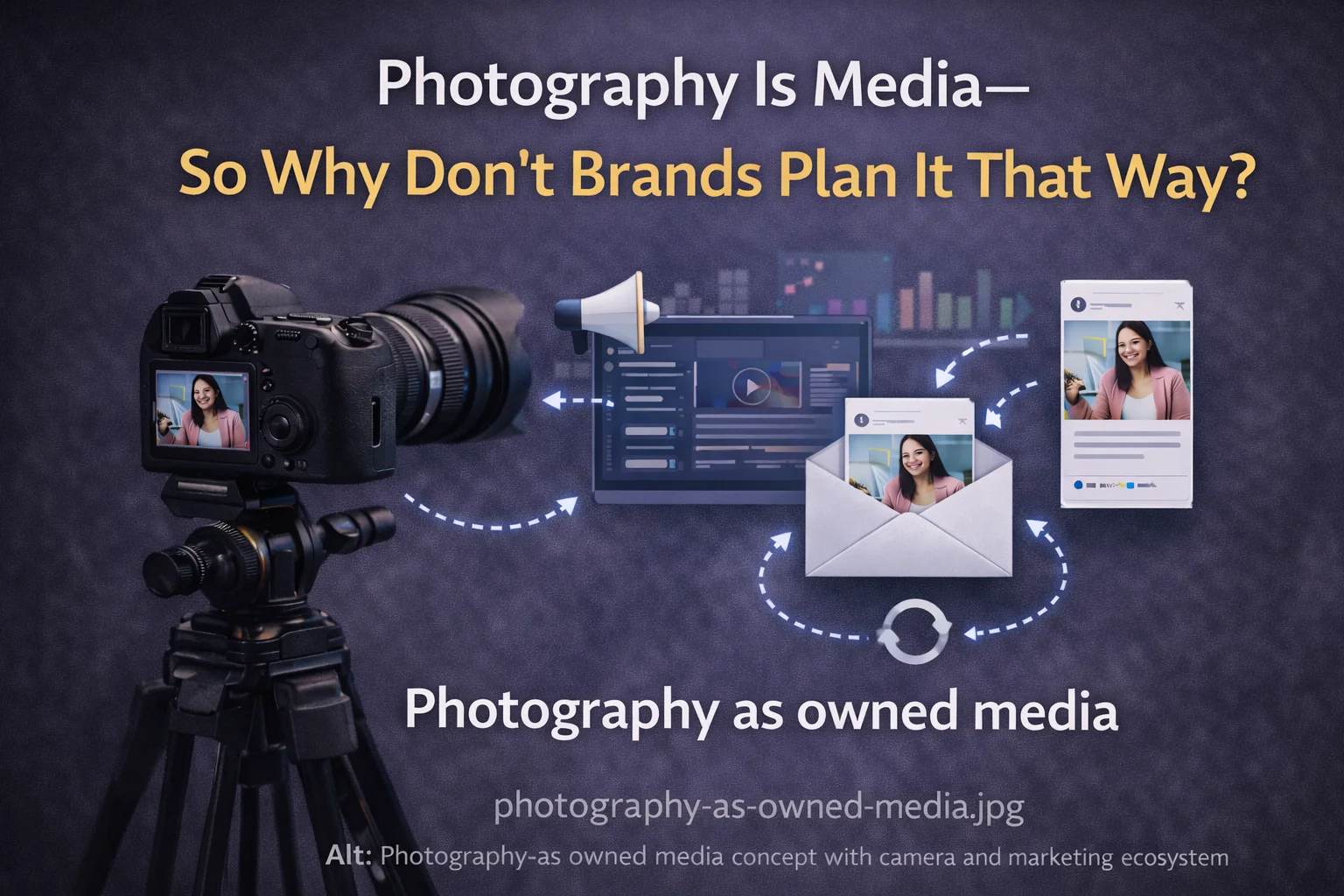
Most brands think about photography as a creative service. A campaign needs images, a collection is launching, a photoshoot is commissioned, the content is delivered and the campaign runs. Then the process starts again.
While this approach is common, it often limits the long-term value photography can create. We believe brands should think differently. We believe in photography as owned media.
Rather than treating photography as a one-time deliverable, we treat it as a business asset that continuously supports marketing, customer acquisition, brand visibility, and long-term growth.
The goal is not simply to create images but to build a library of visual assets that continues generating value long after production is complete. This shift fundamentally changes how photography is planned, produced, and deployed across the business.
Photography As Owned Media Definition
At its core, photography as owned media means treating photography as a long-term marketing asset rather than a short-term production expense.
Instead of viewing photography as content created for a single campaign, brands view photography as media that they own, control, and continuously utilize.
Much like a website, an email list, or a content library, photography becomes part of the company’s marketing infrastructure. The images are not created solely for immediate use.
They are created to support future campaigns, future launches, future marketing initiatives, and future customer acquisition efforts.
Every asset becomes part of a growing visual ecosystem that strengthens the brand over time. This is the foundation of photography as owned media.
Photography As Owned Media vs Rented Media
Understanding photography as owned media becomes easier when compared with rented media. Owned media refers to assets and channels a brand controls. Examples include:
- Websites
- Email Lists
- Content Libraries
- Brand-Owned Platforms
These assets remain under the brand’s control regardless of platform changes or advertising costs. Rented media, by contrast, depends on platforms controlled by others.
Examples include:
- Social Media Platforms
- Paid Advertising Platforms
- Third-Party Marketplaces
- External Distribution Channels
Brands can benefit from rented media, but they do not control it. Algorithms change, advertising costs increase, reach fluctuates and platform rules evolve. Photography assets, however, remain owned by the brand.
Once created and licensed appropriately, those assets can support marketing efforts across multiple channels for years. This is why we believe photography should be viewed as owned media rather than simply campaign content.
Photography As Owned Media Creates Marketing Assets
One of the most important principles behind photography as owned media is asset creation. Every production should generate assets that continue supporting the business long after the shoot has ended.
Examples include:
- Campaign Photography
- Advertising Creative
- Website Imagery
- E-Commerce Photography
- Email Marketing Content
- Social Media Content
- Public Relations Assets
These are not simply deliverables, they are marketing assets and can be reused, repurposed, extended, and redeployed across multiple initiatives.
The more frequently they are used, the greater the return generated from the original production investment. This asset-first mindset is central to photography as owned media.
Read more about Our Approach To Media-First Campaign Photography.
Photography As Owned Media Supports Content Infrastructure
Strong brands rarely operate campaign by campaign. They build systems, processes and infrastructure. Photography as owned media plays a critical role within that infrastructure.
Photography supports:
- Campaign Planning
- Content Libraries
- Advertising Systems
- Customer Acquisition
- Product Launches
- Brand Visibility
Instead of constantly creating content from scratch, brands build a growing collection of assets that can support future marketing activities.
This creates a more efficient and scalable marketing operation. Content shortages decrease, campaign execution improves and marketing teams gain access to a larger pool of usable assets.
Over time, photography becomes part of the company’s content infrastructure rather than a recurring production problem.
Photography As Owned Media Creates Long-Term Value
The biggest difference between traditional photography and photography as owned media is long-term value creation. Traditional photography is often measured by the success of a single campaign.
Once the campaign concludes, the perceived value of the assets declines. Photography as owned media takes a different view. Assets are designed to remain useful over extended periods of time.
A single production may support:
- Current Campaigns
- Future Campaigns
- Advertising Variations
- Website Updates
- Email Marketing
- Product Launches
- Retail Marketing
Each additional use increases the value generated by the original investment. Instead of depreciating after launch, the assets continue producing marketing value.
This is one of the primary reasons brands embracing photography as owned media often achieve significantly stronger ROI from content production.
Read more about Why We Treat Photography As An Owned Channel.
Photography As Owned Media Changes How Brands Think About Content
Most brands think about creating content. Brands that embrace photography as owned media think about building assets. This difference may seem subtle, but it has significant implications.
Content is often temporary. Assets are designed to create long-term value. Content gets consumed, assets continue working, content solves immediate needs and assets support future growth.
This shift encourages brands to plan production more strategically and maximize the value of every shoot.
Why We Believe In Photography As Owned Media
The purpose of photography as owned media is not simply to create better photography but to create a stronger marketing asset. Strong photography as owned media creates:
- Long-Term Marketing Assets
- Greater Asset Utilization
- Stronger Content Infrastructure
- Better Marketing Efficiency
- Higher Long-Term ROI
Ultimately, photography should do more than support a single campaign. It should become part of the brand’s marketing ecosystem.
When planned strategically, photography evolves from a creative expense into a valuable owned media asset that continues supporting customer acquisition, brand visibility, and growth for years to come.
Why Most Brands Don’t Treat Photography As Owned Media
Despite the critical role visual content plays in modern marketing, most brands still do not view photography as owned media. Photography is often treated as a creative service.
A campaign needs content, a collection is launching, a photoshoot is scheduled, ahe assets are delivered and the campaign runs. Then the process starts all over again.
While this approach may solve immediate content needs, it often prevents brands from maximizing the long-term value of their photography investments.
The issue is rarely the quality of the imagery but how photography is planned, utilized, and valued within the business. Most brands continue operating with a project mindset rather than an asset mindset.
As a result, photography remains a production expense instead of becoming a strategic marketing asset.
Project-Based Thinking Prevents Photography From Becoming Owned Media
One of the biggest reasons brands struggle to embrace photography as owned media is project-based thinking. Photography is often connected to a specific initiative.
Examples include:
- A Product Launch
- A Seasonal Campaign
- A Website Refresh
- A Collection Release
- An Advertising Campaign
The production is planned around that single objective. Success is measured by whether the images are delivered and the campaign launches successfully.
Once the project ends, the perceived value of the photography often ends with it. This approach limits long-term asset value.
Instead of creating photography that supports years of marketing activity, brands create photography that supports a single moment.
Brands that understand photography as owned media take a different approach. They create assets that can support multiple campaigns, multiple channels, and future marketing initiatives.
One-Off Shoots Create A Cycle Of Content Shortages
Many brands operate through a cycle of one-off productions. The process often looks like this:
- Need Content
- Book A Shoot
- Create Assets
- Launch Campaign
- Run Out Of Content
- Book Another Shoot
This cycle repeats throughout the year. While it solves short-term content requirements, it rarely creates a scalable content system.
Every campaign requires a new production, every launch requires new photography and every content shortage requires another shoot.
Brands become dependent on constant production rather than maximizing the value of assets they already own. Photography as owned media breaks this cycle by encouraging brands to build asset libraries that continuously support future marketing activities.
Campaign-Only Production Reduces Asset Lifespans
Another major reason brands fail to embrace photography as owned media is campaign-only production. Many shoots are planned exclusively around immediate campaign needs. Photography is created for a single:
- Launch
- Collection
- Promotion
- Advertising Initiative
Because the assets are designed for a specific moment, future usage opportunities are often ignored. Potential applications such as:
- Advertising Variations
- Email Marketing
- Website Updates
- Social Media Content
- Future Campaign Extensions
are rarely considered during planning. This dramatically shortens asset lifespans. Photography that could have remained valuable for months or years often becomes obsolete within weeks.
Brands lose significant value because production is focused on immediate deliverables rather than long-term asset creation.
Creative-First Planning Often Overshadows Marketing Needs
Most productions begin with creative discussions. Teams focus on:
- Mood Boards
- Visual Concepts
- Locations
- Styling
- Creative Direction
While creativity remains essential, problems emerge when marketing requirements become secondary. Questions such as:
- How Will These Assets Support Advertising?
- How Will They Support Customer Acquisition?
- How Will They Be Used Across Channels?
- How Long Will They Remain Valuable?
are often discussed too late or not at all. This is one of the biggest obstacles preventing brands from adopting photography as owned media.
The focus remains on producing images rather than building assets. The result is often beautiful content that delivers less business value than it could have.
Asset Underutilization Is The Biggest Hidden Cost
Perhaps the most significant reason brands fail to treat photography as owned media is asset underutilization. Many companies invest substantial budgets into photography but use only a small percentage of what is produced.
Images appear briefly on:
- Social Media
- Websites
- Advertising Campaigns
Then they disappear.
Large portions of the production remain unused, assets sit in folders, content libraries remain underdeveloped and new productions are commissioned while valuable assets remain untouched.
This creates a significant gap between production investment and actual business value. Brands embracing photography as owned media approach assets differently.
The goal becomes maximizing deployment across:
- Advertising
- Email Marketing
- E-Commerce
- Social Media
- Public Relations
- Future Campaigns
The more frequently assets are utilized, the more valuable they become.
Most Brands Think About Shoots. Few Think About Assets.
This is often the fundamental difference. Most brands focus on planning productions. They organize shoots, coordinate logistics and execute campaigns. Brands that embrace photography as owned media focus on building assets.
They ask:
- How Can These Assets Support Future Campaigns?
- How Can They Support Additional Channels?
- How Can We Extend Asset Lifespans?
- How Can We Increase Asset Utilization?
This shift from production thinking to asset thinking dramatically increases the value of every shoot.
Why Most Brands Don’t Treat Photography As Owned Media
The challenge is not that brands fail to invest in photography but that many brands still view photography through a short-term lens. Common obstacles include:
- Project-Based Thinking
- One-Off Shoots
- Campaign-Only Production
- Creative-First Planning
- Asset Underutilization
Together, these habits prevent photography from functioning as a long-term marketing asset. Photography as owned media offers a different perspective.
Instead of creating content for a single campaign, brands create assets designed to support years of marketing activity. Ultimately, the brands that generate the greatest return from photography are not necessarily the brands producing the most content.
They are the brands extracting the most value from the assets they already own.
Photography As Owned Media And Planning Photography Like Media Buys

Two concepts form the foundation of our approach to content production: Photography as owned media and planning photography like media buys.
While they are closely connected, they address different parts of the same challenge. Photography as owned media focuses on the long-term value of photography assets.
Planning photography like media buys focuses on how those assets are planned before production begins. Together, these approaches transform photography from a creative deliverable into a strategic marketing asset.
Instead of creating content for a single campaign, brands build assets that support customer acquisition, campaign execution, and long-term business growth.
For a deeper exploration of this concept, see What Happens When You Are Planning Photography Like Media Buys?.
Photography As Owned Media Requires Media-First Thinking
Most photoshoots begin with creative discussions. The focus is often placed on:
- Mood Boards
- Visual Concepts
- Locations
- Styling
- Creative Direction
While these elements are important, they do not necessarily determine whether the content will support business objectives. Photography as owned media requires a different starting point.
It requires media-first thinking. Media-first thinking asks questions such as:
- What Marketing Goals Must This Content Support?
- What Campaigns Need Assets?
- What Customer Segments Are Being Targeted?
- What Channels Require Content?
- How Will Success Be Measured?
These questions shift the focus away from simply creating imagery and toward creating assets that generate business value. This is one of the most important principles connecting photography as owned media with media-buy planning.
Photography As Owned Media Depends On Asset Mapping
Media buyers rarely purchase advertising without knowing exactly where the media will appear. They identify placements, define audiences, allocate budgets and map deployment strategies.
The same principle applies to photography. When brands embrace photography as owned media, asset mapping becomes a critical planning activity.
Before production begins, teams identify:
- Website Assets
- Advertising Assets
- Email Marketing Assets
- Social Media Assets
- E-Commerce Assets
- PR Assets
This process ensures photography is created with clear deployment opportunities already defined. Rather than creating content and later searching for ways to use it, brands create assets with specific marketing applications already in mind.
The result is significantly greater asset utilization.
Photography As Owned Media Strengthens Campaign Planning
Campaigns rarely succeed because of a single image. They succeed because the right assets are available throughout the customer journey.
Brands that adopt photography as owned media plan production around campaign requirements rather than individual deliverables.
Instead of asking: What Images Do We Need For Launch Day?
they ask: What Assets Will Support The Entire Campaign Lifecycle?
This broader perspective allows photography to support:
- Awareness Campaigns
- Consideration Campaigns
- Conversion Campaigns
- Retention Campaigns
- Future Campaign Extensions
Assets become more valuable because they support marketing activity long after the initial launch. This dramatically increases ROI while reducing the need for constant production.
Photography As Owned Media Aligns With Marketing Objectives
One of the biggest differences between traditional production and media-first planning is the role of marketing objectives. Traditional productions often prioritize creative outcomes.
Media-first productions prioritize business outcomes. When brands embrace photography as owned media, every production begins by identifying marketing objectives.
Examples include:
- Customer Acquisition
- Brand Awareness
- Product Launches
- E-Commerce Growth
- Advertising Performance
- Customer Retention
These objectives help guide creative decisions throughout the planning process. Every image is created with a defined purpose and every asset contributes to a larger marketing goal.
This alignment helps ensure photography functions as a strategic business asset rather than simply a creative deliverable.
Planning Photography Like Media Buys Improves Asset Value
The true power of combining photography as owned media with media-buy planning lies in asset value. Most photography depreciates quickly because it is planned for a single use. Media-first planning changes this.
Assets are created with multiple deployment opportunities already identified. This allows content to support:
- Current Campaigns
- Future Campaigns
- Advertising Variations
- Website Updates
- Email Marketing
- Product Launches
Every additional use increases the return generated from the original production investment. Rather than becoming obsolete after launch, assets continue creating value over time.
This is one of the strongest advantages of treating photography as owned media.
Creative-First Planning vs Media-First Planning
| Creative-First Planning | Media-First Planning |
|---|---|
| Visual Concept First | Business Objectives First |
| Deliverables Focused | Asset Focused |
| Campaign Specific | Marketing System Focused |
| Short-Term Usage | Long-Term Asset Value |
| Creative Success Metrics | Marketing Success Metrics |
| Limited Deployment | Multi-Channel Deployment |
| Production Thinking | Media Thinking |
Why Photography As Owned Media And Media-Buy Planning Work Together
Photography as owned media and planning photography like media buys are ultimately two parts of the same strategy. One determines how assets are planned.
The other determines how those assets continue generating value after production. Together, they help brands create:
- Better Marketing Assets
- Stronger Campaign Support
- Greater Asset Utilization
- Better Content Infrastructure
- Higher Long-Term ROI
Ultimately, photography becomes much more than content.
It becomes owned media that supports marketing objectives, customer acquisition, and business growth across multiple campaigns and multiple channels.
That is why we believe the strongest brands do not simply create photography. They plan photography the same way they plan media investments.
Why Fashion Brands Benefit From Photography As Owned Media

Fashion brands depend on visual communication more than almost any other industry. Customers often experience the brand through imagery long before they experience the product itself.
Photography influences perception. It shapes desirability, communicates quality and reinforces positioning. Yet many fashion brands still treat photography as a campaign expense rather than a long-term marketing asset.
This approach often leads to content shortages, repeated production costs, and underutilized assets. Photography as owned media offers a different model.
Rather than creating content solely for immediate campaigns, brands build visual assets that continue supporting marketing, customer acquisition, and growth over time.
For a deeper look at the role photography plays in brand performance, see Fashion Campaign Photography: The Foundation Of High-Performing Fashion Brands.
Photography As Owned Media Supports Collection Launches
Collection launches are often among the most important marketing events in a fashion brand’s calendar. They require coordinated communication across multiple channels and customer touchpoints.
Most launches require:
- Campaign Imagery
- Website Assets
- Email Marketing Content
- Social Media Content
- Advertising Creative
- Public Relations Assets
Brands that embrace photography as owned media plan these requirements before production begins.
Instead of creating assets solely for launch day, they build content libraries capable of supporting the collection throughout its entire lifecycle.
This allows the same production investment to generate value long after the initial launch has ended.
Photography As Owned Media Strengthens Seasonal Campaigns
Fashion marketing operates around seasonal cycles.
- Spring
- Summer
- Fall
- Holiday
Each season creates new opportunities to engage customers and drive revenue. Without a strategic content system, however, seasonal marketing can become reactive.
Brands often find themselves rushing to create content as deadlines approach. Photography as owned media helps solve this challenge by creating assets that remain valuable across multiple seasons and future campaigns.
Content libraries allow brands to:
- Launch Faster
- Maintain Consistency
- Support Multiple Campaigns
- Reduce Production Pressure
- Improve Marketing Efficiency
Instead of constantly starting from scratch, brands build a growing foundation of assets that support ongoing seasonal marketing activity.
Photography As Owned Media Supports E-Commerce Growth
E-commerce success depends heavily on visual presentation. Customers cannot physically touch products before purchasing.
Photography becomes one of the primary drivers of perception and purchase decisions. Fashion brands require a wide range of visual assets to support online sales.
Examples include:
- Product Photography
- Collection Photography
- Lifestyle Imagery
- Category Page Assets
- Homepage Content
- Lookbook Assets
Photography as owned media ensures these assets continue supporting e-commerce performance long after production concludes.
Rather than viewing photography as a campaign cost, brands view it as an investment in their digital sales infrastructure. This improves product presentation while creating more opportunities for conversion and revenue growth.
Photography As Owned Media Improves Advertising Performance
Advertising is one of the largest consumers of photography assets. Successful campaigns rarely rely on a single image. Advertising teams require:
- Creative Variations
- Audience-Specific Assets
- Format Variations
- Testing Creative
- Retargeting Assets
Brands that embrace photography as owned media create asset libraries capable of supporting advertising for extended periods of time.
Instead of constantly producing new content, they maximize the value of existing assets. This allows brands to:
- Reduce Creative Fatigue
- Support Campaign Extensions
- Improve Asset Utilization
- Increase Advertising Efficiency
Every asset works harder because it supports multiple advertising initiatives over its lifespan.
Photography As Owned Media Supports Retail Marketing
Retail marketing depends heavily on strong visual communication. Whether customers are shopping online, in-store, or through retail partners, photography influences perception at every stage.
Retail marketing often requires:
- Collection Graphics
- Retail Displays
- Point-Of-Sale Materials
- Launch Assets
- Lookbooks
- Wholesale Marketing Materials
Brands that treat photography as owned media ensure these requirements are considered during production planning. The same assets supporting advertising and e-commerce can also support retail environments.
This creates a more consistent brand experience while maximizing the value of every production investment.
Photography As Owned Media Creates A More Scalable Fashion Marketing System
The strongest fashion brands rarely think about photography as content created for a single campaign. They think about how photography supports the entire business.
Photography as owned media creates a scalable system that supports:
- Collection Launches
- Seasonal Campaigns
- E-Commerce Growth
- Advertising Performance
- Retail Marketing
Every asset contributes to multiple marketing objectives, every production generates value across multiple channels and every campaign benefits from stronger content availability.
This significantly increases the return on content production investments.
Why Fashion Brands Benefit From Photography As Owned Media
The purpose of photography as owned media is not simply to create more content. It is to create assets that continuously support growth.
Fashion brands benefit from:
- Stronger Collection Launches
- Better Seasonal Campaign Support
- Improved E-Commerce Performance
- More Effective Advertising
- Better Retail Marketing Alignment
Together, these advantages create a more efficient and scalable marketing operation. Ultimately, fashion brands do not grow because they produce more photography.
They grow because they create photography assets that continue generating value long after production has ended. That is the true advantage of treating photography as owned media.
The Hidden Cost Of Not Planning Photography Strategically
Without a defined system, content creation ROI drops. Teams often spend heavily on production but deploy only a small percentage of usable images.
Moreover, because campaign photography planning is often disconnected from channel needs, brands repeatedly commission new shoots instead of extending the value of existing assets.
Visual Content Strategy Makes Photography Work Harder
A strong visual content strategy ensures photography supports multiple campaigns, formats, and timelines. Instead of one-off usage, images are designed for reuse, adaptation, and sequencing.
As a result, photography compounds in value rather than expiring after a single launch.
Campaign Photography Planning Should Start With Distribution
Effective campaign photography planning begins by mapping where images will live: homepage, email, paid social, organic social, and beyond.
When photography is planned alongside channels, content creation ROI improves because every image has a defined purpose.

Photography As Owned Media Creates Compounding ROI
Most brands evaluate photography based on the performance of a single campaign. The shoot is completed, the assets are delivered, the campaign launches and results are measured. Then attention shifts to the next production.
This approach overlooks one of the most powerful advantages of photography as owned media. The value of photography does not need to end when a campaign ends.
When assets are planned strategically and utilized effectively, they continue generating value across multiple campaigns, multiple channels, and multiple customer interactions.
This creates compounding ROI. Every campaign benefits from previous investments, every asset contributes to future marketing performance and every customer interaction strengthens future customer interactions.
Over time, the value of the photography investment grows rather than declines.
Photography As Owned Media Strengthens Recognition
Recognition is one of the first benefits that compounds. Every time customers encounter a brand’s photography, they become more familiar with its visual identity.
They begin recognizing the:
- Photography Style
- Creative Direction
- Product Presentation
- Campaign Aesthetic
- Brand Personality
When brands consistently deploy assets across multiple channels, recognition grows with every interaction. Photography as owned media allows brands to build a recognizable visual language that customers associate directly with the company.
Over time, customers no longer need to see the logo to identify the brand. The visual style itself becomes recognizable.
This recognition makes future marketing efforts more effective because familiarity already exists.
Builds Trust Over Time
Trust is rarely created through a single campaign. It develops through repeated positive experiences. Customers trust brands that appear consistent, professional, and reliable.
Photography plays a major role in creating those perceptions. When customers repeatedly encounter strong visual assets across:
- Advertising
- Websites
- Email Marketing
- Social Media
- E-Commerce Experiences
their confidence in the brand increases.
Photography as owned media helps strengthen trust because assets remain active long after the original production has ended.
Every exposure reinforces the same visual standards and every campaign contributes to a consistent brand experience. As trust accumulates, customers become more likely to engage, purchase, and remain loyal.
Photography As Owned Media Maximizes Content Reuse
One of the most significant drivers of compounding ROI is content reuse. Many brands create photography for a single campaign and then move on to the next production.
This limits the value of the assets. Photography as owned media takes a different approach. Assets are created with future deployment opportunities already in mind.
A single production may support:
- Advertising Campaigns
- Website Updates
- Email Marketing
- Social Media Content
- E-Commerce Assets
- Public Relations
- Future Product Launches
Every additional use increases the value extracted from the original production investment. Instead of generating value once, photography continues producing value over months or even years.
This is one of the strongest arguments for treating photography as owned media.
Photography As Owned Media Improves Marketing Efficiency
Marketing teams constantly need content. Advertising requires fresh creative, email campaigns require visuals, social media requires ongoing assets and product launches require support materials.
Without a strong asset library, content shortages become inevitable. Photography as owned media improves marketing efficiency by creating a growing library of reusable assets.
Rather than solving the same content problem repeatedly, teams gain access to assets that already exist.
This improves:
- Campaign Execution
- Content Availability
- Asset Utilization
- Operational Efficiency
- Marketing Performance
As efficiency improves, future marketing initiatives require fewer resources to execute successfully. The result is a compounding return from the original photography investment.
Photography As Owned Media Supports Long-Term Growth
The greatest advantage of compounding ROI is its impact on long-term growth. Every asset contributes to future business performance, recognition supports future campaigns, trust supports future conversions, content libraries support future launches and marketing efficiency supports future scaling.
Photography as owned media creates a system where every production contributes to future success. Instead of starting from zero with every campaign, brands build upon previous investments.
This creates:
- Greater Market Visibility
- Stronger Brand Equity
- More Efficient Customer Acquisition
- Higher Marketing Performance
- Sustainable Growth
The longer the system operates, the more valuable it becomes. Over time, photography evolves from a content expense into a long-term growth asset.
Traditional Photography vs Photography As Owned Media
| Traditional Photography | Photography As Owned Media |
|---|---|
| Campaign-Specific Value | Long-Term Asset Value |
| Limited Content Reuse | Continuous Content Reuse |
| Short Asset Lifespans | Extended Asset Lifespans |
| Single Campaign Support | Multi-Campaign Support |
| Temporary Visibility | Compounding Recognition |
| One-Time Impact | Compounding Trust |
| Higher Production Dependency | Greater Asset Utilization |
| Linear ROI | Compounding ROI |
Why Photography As Owned Media Creates Compounding ROI
The value of photography as owned media extends far beyond a single campaign. It creates:
- Stronger Recognition
- Greater Trust
- Continuous Content Reuse
- Improved Marketing Efficiency
- Long-Term Growth
Together, these advantages compound over time.
Every asset continues supporting future marketing efforts, every campaign benefits from accumulated recognition and trust and every production investment becomes more valuable with continued use.
Ultimately, photography as owned media is not simply about creating content. It is about creating assets that continue generating value long after production ends.
That is why we believe photography should be viewed as owned media rather than a one-time production expense.
Final Thoughts
Photography isn’t just creative — it’s media. When brands stop treating it as an afterthought and start planning it like an owned channel, everything changes.
Photography as owned media delivers stronger alignment, better reuse, and measurable content creation ROI. The only real question is why more brands haven’t made the shift yet.
Recommended Next Reads
From Shoot to System – Treating Visuals As A Content Channel