
Most brands still approach photography as a one-time production event. However, when you start treating visuals as a content channel, the entire value equation changes. Instead of isolated assets, visuals become part of a repeatable, scalable system that supports long-term growth and measurable content creation ROI.
In other words, the shift from shoot to system is not creative — it’s strategic.
What You Will Learn About Visuals As A Content Channel?
- What we mean by visuals as a content channel
- Why most brands don’t treat visuals as a content channel
- Visuals as a content channel and photography as an owned channel
- Why we treat visuals as a content channel
What We Mean By Visuals As A Content Channel
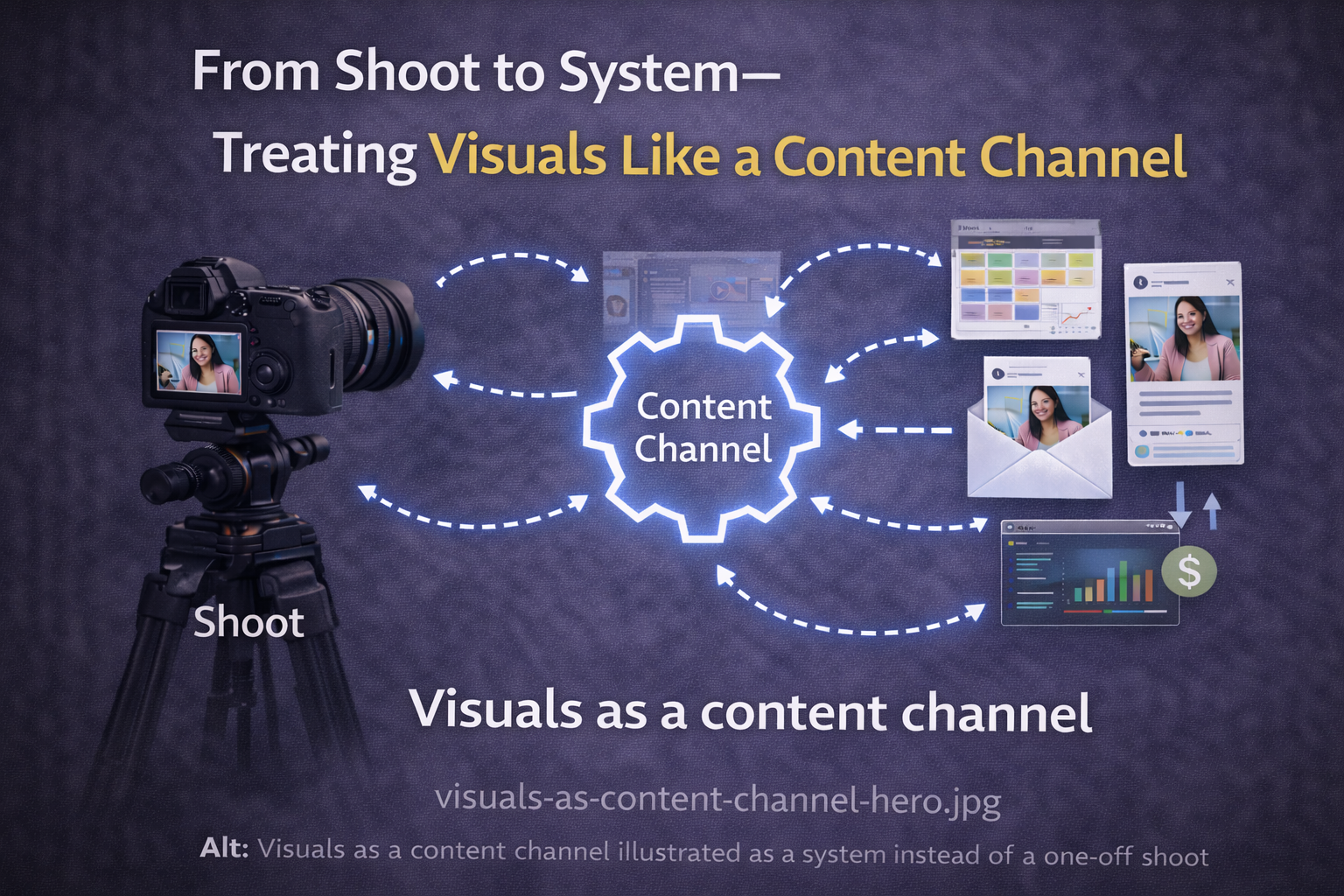
Most brands think about visual content in terms of individual projects.
- A photoshoot is commissioned
- A campaign launches
- Assets are delivered
- The content is used
- Then the process starts over again
While this approach is common, it often limits the long-term value visual content can create.
We believe brands should think differently. We believe in treating visuals as a content channel.
Rather than viewing photography, video, and creative assets as isolated deliverables, we view them as a continuous channel that supports marketing, customer acquisition, brand visibility, and business growth.
This shift changes how content is planned, produced, distributed, and measured. The objective is no longer to create content for a single campaign but to build a visual ecosystem that continuously supports the brand.
Visuals As A Content Channel Definition
At its core, visuals as a content channel means treating visual content the same way brands treat other marketing channels.
Most companies already invest in channels such as:
- Email Marketing
- Paid Advertising
- Social Media
- Public Relations
- Content Marketing
These channels are managed strategically because they directly support marketing objectives. Visual content should be approached in the same way.
Instead of being viewed as a collection of individual images, visuals become a channel that continuously communicates with customers.
Every image contributes to the overall brand experience, every asset reinforces brand recognition and every campaign builds upon previous visual communication. This is the foundation of visuals as a content channel.
Visuals As A Content Channel Changes How Brands Think About Content Channels
Traditional content channels are designed to create ongoing communication with audiences. Brands consistently invest in:
- Email Campaigns
- Advertising Campaigns
- Social Media Publishing
- Website Content
The purpose is not to communicate once but to communicate continuously. When brands embrace visuals as a content channel, they apply the same logic to photography and visual assets.
Visual content becomes an ongoing communication system rather than a series of isolated productions. The visual language evolves into a channel that supports awareness, consideration, conversion, and retention across the customer journey.
This creates a much stronger relationship between content production and business performance.
Visuals As A Content Channel Create Marketing Assets
One of the most important shifts that occurs when treating visuals as a content channel is moving from deliverables to assets. Traditional production often focuses on delivering content for a specific campaign.
Once the campaign ends, the perceived value of the assets declines. A content channel approach views visual content differently. Every production creates marketing assets capable of supporting future activity.
Examples include:
- Campaign Photography
- Advertising Creative
- Website Assets
- Email Marketing Content
- Social Media Content
- E-Commerce Assets
- Public Relations Assets
These assets remain valuable because they can be reused, repurposed, and redeployed across multiple campaigns and multiple channels.
The more frequently they are used, the greater the return generated from the original production investment.
Visuals As A Content Channel Support Content Infrastructure
Successful marketing rarely depends on individual campaigns alone. It depends on infrastructure. Strong brands build systems that support ongoing execution.
Visuals as a content channel contribute directly to that infrastructure. Visual assets support:
- Campaign Planning
- Content Libraries
- Advertising Systems
- Customer Acquisition
- Product Launches
- Brand Visibility
Instead of constantly creating content from scratch, brands develop a growing collection of assets that can support future marketing activities.
This creates greater efficiency while reducing content shortages and production pressure. Over time, visual content becomes part of the brand’s operational infrastructure.
Create Long-Term Value
The most significant advantage of treating visuals as a content channel is long-term value creation. Most campaigns have limited lifespans, Most launches eventually end and most promotions are temporary.
However, visual assets can continue creating value long after those initiatives conclude. A single production may support:
- Current Campaigns
- Future Campaigns
- Advertising Variations
- Website Updates
- Email Marketing
- E-Commerce Growth
- Retail Marketing
Each additional use increases the value generated from the original investment. Rather than becoming obsolete after launch, the assets continue supporting business objectives.
This creates a compounding return that becomes increasingly valuable over time.
Shift The Focus From Production To Value Creation
Many brands focus heavily on production. They think about the:
- Shoot
- Creative Concept
- Deliverables
- Launch
These elements matter.
However, they represent only part of the picture. Visuals as a content channel shift the focus toward long-term value creation. The key questions become:
- How Will These Assets Be Used?
- How Long Will They Remain Valuable?
- How Many Channels Can They Support?
- How Much Marketing Activity Can They Enable?
This perspective encourages smarter planning and significantly improves asset utilization.
Why We Believe In Visuals As A Content Channel
The purpose of treating visuals as a content channel is not simply to create more content. The purpose is to create more value. Strong visual systems create:
- Better Marketing Assets
- Stronger Content Infrastructure
- Greater Asset Utilization
- Improved Marketing Efficiency
- Higher Long-Term ROI
Ultimately, visual content should do more than support a single campaign.
It should function as an ongoing marketing channel that continuously supports visibility, customer acquisition, brand growth, and business performance.
That is what we mean when we talk about visuals as a content channel. It is not simply a different production strategy, it is a different way of thinking about the role visual content plays in modern marketing.
Why Visuals Should Be Treated As A Content Channel

Every photo your brand publishes lives across websites, email campaigns, social platforms, and landing pages. Therefore, visuals already function like media. Yet, without intention, they rarely operate like a channel.
By reframing visuals as a content channel, brands align photography with their broader owned media strategy instead of treating it as a supporting asset.
The Problem With Shoot-Based Thinking
Shoot-based workflows prioritize output over longevity. As a result, teams often create strong visuals that lack a clear lifecycle or distribution plan.
Consequently, content creation ROI suffers. Assets are underused, campaigns demand new shoots, and budgets quietly inflate.
Why Most Brands Don’t Treat Visuals As A Content Channel
Most brands understand the importance of visual content. They invest in photography, produce campaigns, create social media content and launch new collections.
Yet despite these investments, many brands still do not treat visuals as a content channel. Instead, visual content is often viewed as a series of isolated projects designed to solve immediate marketing needs.
The result is a cycle of repeated production, underutilized assets, and missed opportunities for long-term growth. Rather than building a visual content system, brands continually rebuild the same assets from scratch.
For a deeper look at this challenge, see Photography As Owned Media — So Why Don’t Brands Plan It That Way?.
Project-Based Thinking Prevents Visuals As A Content Channel
One of the biggest obstacles to treating visuals as a content channel is project-based thinking. Many brands approach content production through individual initiatives. Examples include:
- A Product Launch
- A Seasonal Campaign
- A Collection Release
- A Website Refresh
- An Advertising Campaign
The production is planned around the immediate project. Once the project ends, attention shifts to the next campaign. This mindset limits the long-term value of visual assets.
Photography and content are viewed as temporary deliverables rather than strategic resources. Brands that embrace visuals as a content channel think differently.
They create assets that can support future campaigns, future launches, and future marketing objectives. The focus shifts from completing projects to building content infrastructure.
One-Off Shoots Create A Reactive Content Cycle
Many brands operate through a continuous cycle of one-off productions. The process often looks like this:
- Need Content
- Book A Shoot
- Create Assets
- Launch Campaign
- Run Out Of Content
- Book Another Shoot
This approach may solve short-term content shortages, but it rarely creates a scalable system.
Every campaign requires new production, every launch requires new photography and every content shortage creates additional pressure. Because there is no long-term strategy, brands remain dependent on continuous production.
Visuals as a content channel break this cycle by encouraging brands to build reusable asset libraries that support ongoing marketing activities.
The goal becomes creating assets that continue generating value instead of content that expires after a single use.
Campaign-Only Production Limits Asset Value
Another reason brands struggle to adopt visuals as a content channel is campaign-only production. Many shoots are designed to support a specific campaign and nothing more. Assets are created for a single:
- Launch
- Promotion
- Collection
- Advertising Initiative
Future uses are rarely considered during planning.
As a result, asset lifespans remain short. Photography that could support months of marketing activity often becomes irrelevant after only a few weeks.
Brands then invest in additional production while valuable assets remain underutilized. When brands begin treating visuals as a content channel, they create assets with future deployment opportunities already in mind.
This significantly extends the value of every production investment.
Creative-First Planning Often Overshadows Marketing Requirements
Most productions begin with creative discussions. Teams focus on:
- Mood Boards
- Visual Concepts
- Locations
- Styling
- Creative Direction
While creativity remains essential, problems arise when marketing objectives become secondary. Questions such as:
- How Will These Assets Be Used?
- How Will They Support Customer Acquisition?
- How Will They Support Advertising?
- How Long Should They Remain Valuable?
are often addressed too late in the planning process.
This creative-first approach frequently results in content that looks impressive but delivers less business value than it could. Visuals as a content channel require marketing objectives to be considered from the beginning.
The focus shifts from producing images to creating assets that support measurable outcomes.
Asset Waste Is The Hidden Cost
Perhaps the biggest consequence of failing to embrace visuals as a content channel is asset waste. Many brands produce significantly more content than they actually use. Assets appear briefly across:
- Social Media
- Websites
- Advertising Campaigns
Then they disappear.
Large portions of production remain unused, content libraries stay underdeveloped and new shoots are commissioned while existing assets continue sitting idle.
This creates a significant gap between production investment and actual business value. Brands treating visuals as a content channel focus on maximizing asset utilization.
Assets are intentionally deployed across:
- Advertising
- Email Marketing
- E-Commerce
- Social Media
- Public Relations
- Future Campaigns
The more frequently assets are used, the greater the return generated from the original production investment.
Most Brands Plan Shoots. Few Brands Build Content Channels.
This is often the fundamental difference. Most brands focus on producing content. They plan photoshoots, launch campaigns and create deliverables. Brands that embrace visuals as a content channel focus on building systems.
They ask:
- How Can These Assets Support Future Campaigns?
- How Can We Extend Asset Lifespans?
- How Can We Improve Asset Utilization?
- How Can Visual Content Support Long-Term Growth?
This shift dramatically increases the value of every production investment.
Why Most Brands Don’t Treat Visuals As A Content Channel
The challenge is not that brands fail to invest in content but how that content is viewed. Most brands remain limited by:
- Project-Based Thinking
- One-Off Shoots
- Campaign-Only Production
- Creative-First Planning
- Asset Waste
Together, these habits prevent visual content from functioning as a true marketing channel. Visuals as a content channel offer a different approach.
Instead of creating content for a single campaign, brands build assets that support continuous marketing activity. Ultimately, the brands that generate the greatest return from content production are rarely the brands producing the most content.
They are the brands building the strongest content systems.
From Shoot to System: What Actually Changes

When brands adopt a system mindset, campaign photography planning starts with where visuals will live, how often they’ll be used, and how they’ll evolve.
As a result, photography is designed for reuse, sequencing, and adaptation—core principles of any effective visual content strategy.
Visuals As A Content Channel And Photography As An Owned Channel
Two ideas sit at the center of how we think about content production: Visuals as a content channel and photography as an owned channel.
While these concepts are closely related, they address different aspects of the same challenge. Visuals as a content channel focuses on how visual content supports ongoing communication with customers.
Photography as an owned channel focuses on ownership, control, and long-term asset value. Together, they transform photography from a creative deliverable into a strategic marketing resource.
Instead of producing content for isolated campaigns, brands build visual systems that continuously support marketing, customer acquisition, and business growth.
For a deeper look at this philosophy, see Why We Treat Photography As An Owned Channel.
Visuals As A Content Channel Depend On Owned Channels
Most brands are familiar with the concept of marketing channels. Examples include:
- Email Marketing
- Social Media
- Paid Advertising
- Search Marketing
- Public Relations
Each channel helps the brand communicate with customers.
However, not all channels offer the same level of control. Many channels are rented. Brands rely on third-party platforms, changing algorithms, and rising advertising costs to reach audiences.
This is where visuals as a content channel become particularly valuable. When combined with photography as an owned channel, brands gain access to a communication asset they control.
The photography belongs to the brand, the assets remain available and the content can be deployed whenever and wherever it is needed.
Unlike rented platforms, owned visual assets continue creating value regardless of algorithm changes or advertising costs.
Visuals As A Content Channel Create Owned Assets
One of the biggest mindset shifts occurs when brands stop thinking about photography as content and start thinking about photography as assets.
Traditional production often focuses on deliverables. The goal is to complete a campaign, the assets are delivered, the project ends.
Brands embracing visuals as a content channel focus instead on creating owned assets.
Examples include:
- Campaign Photography
- Advertising Creative
- Website Assets
- Email Marketing Content
- Social Media Libraries
- E-Commerce Photography
- Public Relations Assets
These assets remain under the brand’s control.
They can be reused, repurposed, and redeployed across future campaigns. The more frequently they are used, the greater the return generated from the original investment.
This asset-first approach is what turns visual content into a true channel rather than a collection of isolated deliverables.
Visuals As A Content Channel Strengthen Marketing Infrastructure
Strong brands do not rely solely on individual campaigns. They build infrastructure and create systems that support consistent execution over time.
Visuals as a content channel become an important part of that infrastructure. Visual assets support:
- Campaign Planning
- Content Libraries
- Advertising Systems
- Customer Acquisition
- Product Launches
- Brand Visibility
Rather than creating content reactively, brands develop a growing collection of assets capable of supporting future marketing initiatives.
This reduces content shortages while improving marketing efficiency. Over time, visual content evolves into a core component of the company’s marketing infrastructure.
Every new production strengthens the system rather than simply supporting a single campaign.
Increase In Asset Value Over Time
Most marketing investments lose value after use. An advertisement stops running, a campaign ends and a promotion expires.
However, owned visual assets can continue generating value long after production concludes.
This is one of the most powerful benefits of combining visuals as a content channel with photography as an owned channel.
Assets may support:
- Current Campaigns
- Future Campaigns
- Advertising Variations
- Website Updates
- Email Marketing
- Retail Marketing
- Product Launches
Each additional use increases the value extracted from the original production investment. Instead of depreciating immediately after launch, the assets continue supporting marketing activity for months or even years.
This creates significantly stronger ROI than a traditional project-based approach.
Visuals As A Content Channel Create A More Scalable Marketing System
Brands that treat visual content as a channel gain an important advantage. Every new production contributes to a larger system. The asset library grows, content availability improves, campaign planning becomes easier and marketing execution becomes more predictable.
Visuals as a content channel allow brands to move beyond constantly producing content and instead focus on maximizing the value of existing assets. This shift improves:
- Asset Utilization
- Marketing Efficiency
- Campaign Support
- Content Availability
- Long-Term ROI
The result is a marketing operation that becomes stronger with every production rather than simply larger.
Traditional Content Production vs Visuals As A Content Channel
| Traditional Production | Visuals As A Content Channel |
|---|---|
| Campaign Deliverables | Owned Assets |
| Project Focused | System Focused |
| Short-Term Usage | Long-Term Deployment |
| Content Consumption | Asset Accumulation |
| Limited Asset Lifespan | Extended Asset Lifespan |
| Reactive Production | Content Infrastructure |
| Linear ROI | Compounding ROI |
Why Visuals As A Content Channel And Photography As An Owned Channel Matter
The purpose of visuals as a content channel is not simply to create more content but to create a stronger marketing system. When combined with photography as an owned channel, brands gain:
- Greater Ownership Of Marketing Assets
- Stronger Content Infrastructure
- Higher Asset Value
- Better Asset Utilization
- More Efficient Marketing Operations
Ultimately, photography becomes much more than a creative service. It becomes a strategic channel that continuously supports visibility, customer acquisition, campaign performance, and long-term growth.
That is why we believe visuals as a content channel and photography as an owned channel are not separate ideas. They are two parts of the same marketing system.
How Treating Visuals As A Content Channel Improves ROI
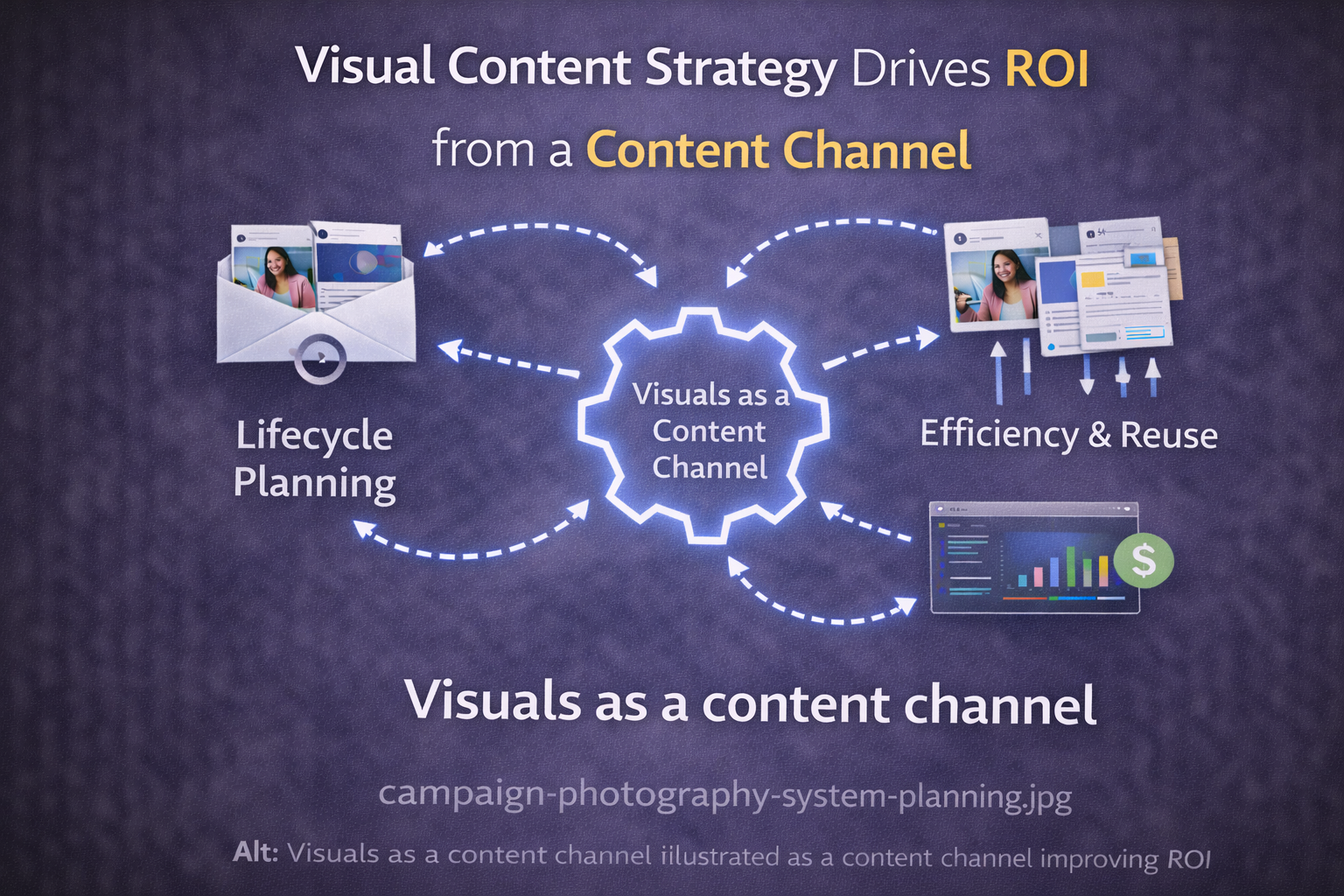
Once visuals as a content channel are planned like owned media, efficiency increases immediately. Teams produce fewer shoots, extract more value, and extend asset lifespans.
As a result, content creation ROI improves without increasing production volume.
Why We Treat Visuals As A Content Channel
Most brands treat visual content as a production activity. They plan a photoshoot, create assets, launch a campaign and then they move on to the next project.
While this approach is common, it often creates a cycle of content shortages, repeated production costs, and underutilized assets.
We take a different approach. We treat visuals as a content channel.
Rather than viewing photography and visual content as isolated deliverables, we view them as an ongoing marketing system that supports visibility, customer acquisition, campaign execution, and long-term growth.
This philosophy influences how we plan, produce, distribute, and measure visual content. The goal is not simply to create more content but to create assets that continue generating value long after production is complete.
Content Systems Scale Better
One of the primary reasons we believe in visuals as a content channel is that systems scale better than projects. Projects solve immediate problems, systems solve recurring problems.
Many brands operate through a cycle of reactive production.
- They need content
- They book a shoot
- They launch a campaign
- They run out of assets
- Then the process repeats
This approach creates ongoing pressure while limiting marketing efficiency.
Content systems work differently. They create a repeatable framework for:
- Content Planning
- Production
- Asset Management
- Distribution
- Performance Optimization
When brands embrace visuals as a content channel, every production contributes to a larger system rather than a single campaign.
The result is greater consistency, stronger asset utilization, and more scalable marketing operations.
We Treat Visuals As A Content Channel Because Of Media-First Thinking
Most brands already understand the value of media. They carefully plan:
- Advertising Campaigns
- Email Marketing
- Social Media
- Content Marketing
These channels are managed strategically because they influence business outcomes.
We believe visual content deserves the same level of planning. Visuals as a content channel are built on media-first thinking.
Instead of asking: What Content Should We Create?
we ask:
- What Marketing Objectives Must This Content Support?
- What Assets Are Required?
- What Channels Need Content?
- How Will The Assets Be Distributed?
This shift transforms visual content from a creative expense into a strategic marketing asset. Every image is created with a clear purpose and a defined role within the broader marketing ecosystem.
We Treat Visuals As A Content Channel Because We Believe In Owned Assets
One of the biggest differences between short-term content creation and long-term content strategy is ownership. Many marketing activities rely on rented platforms. Algorithms change, advertising costs increase, reach fluctuates, and platform rules evolve.
Visual assets, however, remain owned by the brand. When brands embrace visuals as a content channel, they begin building a library of owned assets. These assets may include:
- Campaign Photography
- Advertising Creative
- Website Content
- Email Marketing Assets
- E-Commerce Photography
- Social Media Libraries
Unlike rented channels, these assets remain available and continue generating value over time. The more extensive the asset library becomes, the stronger the marketing foundation becomes.
Asset Utilization Drives ROI
Many brands focus heavily on production. Far fewer focus on asset utilization. Yet asset utilization is often one of the biggest drivers of marketing ROI.
A single production may generate hundreds of usable assets. The question is not simply how many assets are created but how effectively those assets are used.
Visuals as a content channel prioritize maximizing asset value. Assets are deployed across:
- Advertising Campaigns
- Websites
- Email Marketing
- Social Media
- E-Commerce Platforms
- Public Relations
Every additional use increases the value generated from the original production investment. Instead of creating content that expires quickly, brands create assets that continue supporting future marketing initiatives.
We Treat Visuals As A Content Channel Because It Supports Long-Term Growth
The greatest advantage of treating visuals as a content channel is its impact on long-term growth. Every production contributes to future business performance, every asset strengthens the marketing system and every campaign builds upon previous investments.
This creates a compounding effect. Recognition increases, trust grows, asset libraries expand, marketing efficiency improves and customer acquisition becomes more effective.
Over time, brands stop operating campaign by campaign. They begin operating through systems that continuously support growth.
This is why long-term growth is one of the strongest arguments for treating visuals as a content channel.
Project-Based Content vs Visuals As A Content Channel
| Project-Based Content | Visuals As A Content Channel |
|---|---|
| Campaign Focused | System Focused |
| Short-Term Thinking | Long-Term Thinking |
| Content Creation | Asset Creation |
| One-Time Usage | Continuous Utilization |
| Reactive Production | Strategic Planning |
| Content Shortages | Content Infrastructure |
| Linear ROI | Compounding ROI |
Why We Treat Visuals As A Content Channel
The purpose of visuals as a content channel is not simply to create more photography or more content. The purpose is to create a more effective marketing system. By focusing on:
- Content Systems
- Media-First Thinking
- Owned Assets
- Asset Utilization
- Long-Term Growth
brands can generate significantly more value from every production investment.
Ultimately, the strongest brands are not necessarily the brands producing the most content. They are the brands building the most valuable content systems.
That is why we treat visuals as a content channel because when visual content is planned strategically, managed as an asset, and deployed consistently, it becomes far more than content.
It becomes a growth engine.
Final Thoughts
Photography doesn’t fail because of creativity — it fails because of structure. When brands move from shoot-based thinking to systems thinking, everything changes.
By treating visuals as a content channel, brands unlock scalability, alignment, and sustained content creation ROI across their entire marketing ecosystem.
Recommended Next Reads
What Happens When You Are Planning Photography Like Media Buys