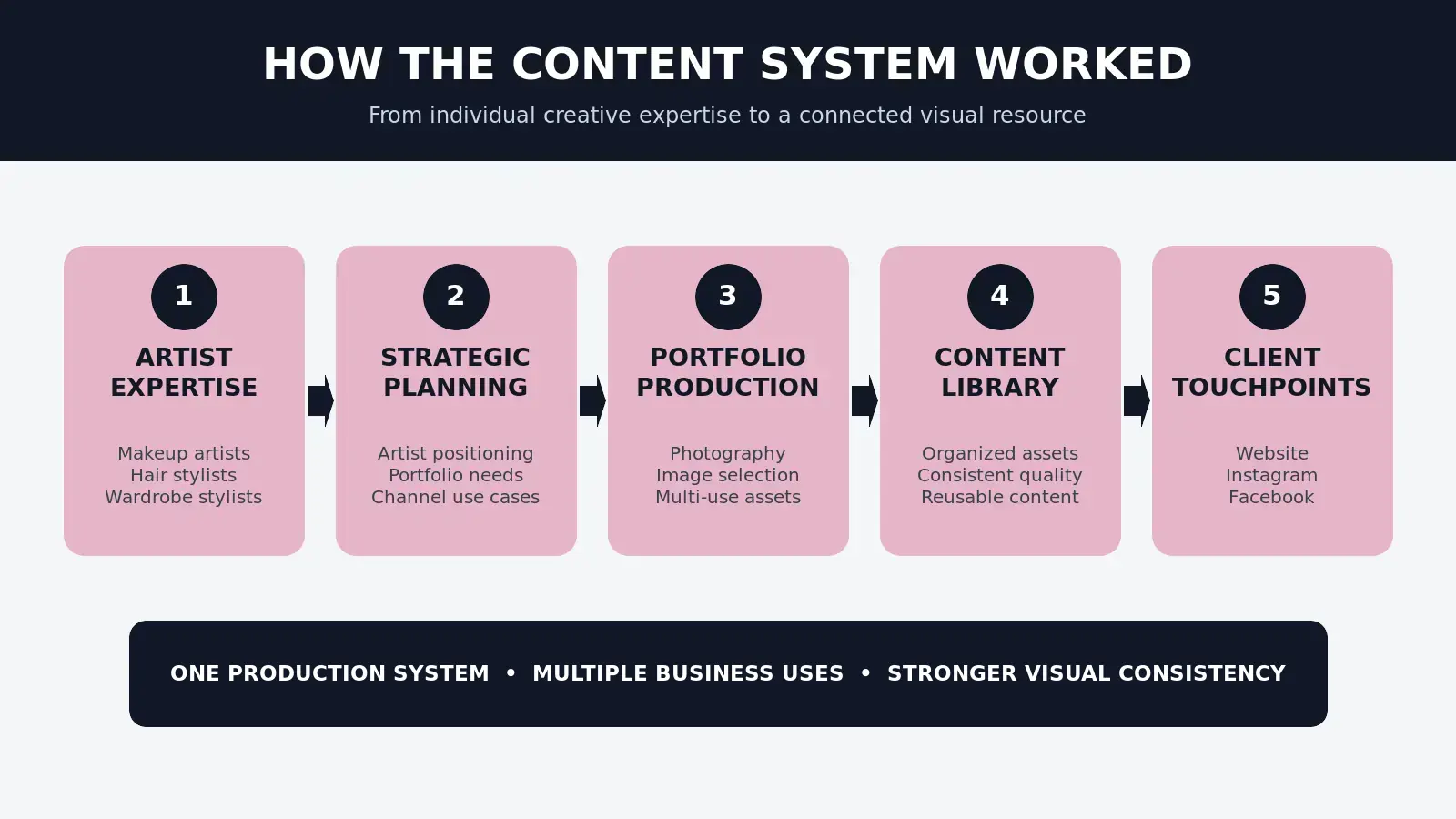
An end-to-end content system is not a single shoot, a campaign, or a batch of deliverables. It is a structured, repeatable way of planning, producing, distributing, and refining content over time — so brands can scale without starting from zero every quarter.

Instead of treating content as a series of disconnected projects, we treat it as infrastructure. As a result, brands gain consistency, efficiency, and a clearer path to long-term ROI.


What Will You Learn About End-to-End Content Systems?


What Is An End-To-End Content System?

End-to-end content system illustrated as a structured, repeatable content workflow for brands
An end-to-end content system is a structured process that manages every stage of content creation—from planning and production to distribution and performance analysis.

Many brands approach content as a series of isolated projects. They run a photoshoot. Launch a campaign. Post on social media. Then start over again.

An end-to-end content system takes a different approach. Instead of treating content as individual tasks, it creates a repeatable framework that supports ongoing marketing, advertising, product launches, and business growth.

The goal is not simply to create more content. The goal is to create a system that consistently produces valuable marketing assets while maximizing the return on every production investment.


Content Planning

Every successful content system begins with planning. Before any photography, video production, or campaign development takes place, the brand identifies:

Content planning helps answer questions such as:

Without planning, content creation often becomes reactive. With planning, every asset is connected to a larger marketing strategy.


Production

Once the strategy is defined, production begins. Production is where ideas become assets. Depending on the brand’s needs, production may include:

The key difference in an end-to-end system is that production is planned around multiple future uses. Rather than creating content for a single channel, assets are developed to support:

Every production investment is designed to create maximum value.


Asset Management

Creating content is only part of the process. The assets must also be organized and managed effectively. Asset management includes:

Examples of managed assets include:

Strong asset management ensures valuable content remains usable long after production is complete. Without it, brands often waste assets simply because they cannot find or reuse them efficiently.


Content Distribution

Content only creates value when it reaches the right audience. An end-to-end content system includes a distribution strategy that determines where and how assets will be used. Examples include:

A single campaign asset may be adapted for multiple channels.

For example:

One campaign image might support:

Distribution planning helps maximize the value of every asset created.


Performance Measurement

The final stage of an end-to-end content system is performance measurement. Many brands stop after content is delivered. The strongest brands evaluate results. Performance measurement includes:

The goal is to understand:

This information improves future content planning and production decisions.


Why An End-To-End System Matters

Without a system, brands often experience:

An end-to-end content system helps eliminate these challenges by connecting every stage of the content lifecycle. Each stage supports the next. Planning informs production. Production creates assets. Assets support distribution.

Distribution generates performance data. Performance data improves future planning. The system continuously improves over time.


The Difference Between Content Creation And A Content System

Content creation focuses on producing assets. An end-to-end content system focuses on managing the entire process. Content creation asks:

What Should We Create?

An end-to-end content system asks:

This shift creates more strategic marketing and significantly stronger content ROI.


Why Most Brands Struggle With Content

Most brands understand the importance of content. They know they need assets for:

Yet despite investing significant time and money into content creation, many brands still experience the same recurring problems. Marketing teams constantly need more content.

Campaigns launch without enough assets. Photoshoots happen under pressure. Creative resources become stretched. The issue is rarely a lack of effort. More often, the problem is a lack of systems.

Without a structured content strategy, brands find themselves reacting to immediate needs rather than building a sustainable content engine.


Content Shortages

One of the most common complaints among marketing teams is: “We don’t have enough content.”

Ironically, many of these brands have already invested heavily in content creation. The problem is often not the amount of content produced. The problem is how that content is planned, organized, and utilized.

Without a content system, brands frequently create content for immediate needs rather than long-term use.

As a result:

Content shortages are often a planning problem rather than a production problem.


Last-Minute Shoots

Many brands operate in a constant state of content urgency. Examples include:

The response is often the same: Schedule another shoot.

These last-minute productions are typically:

Because the shoot was not planned within a larger content strategy, the resulting assets often solve only the immediate problem.

A few weeks later, the cycle begins again. Brands become trapped in continuous production rather than building long-term marketing infrastructure.


Inconsistent Visuals

When content is created reactively, consistency often suffers. Different shoots may involve different:

Over time, customers experience a fragmented brand identity.

Examples include:

Consistency is one of the strongest drivers of brand recognition and trust. Without a content system, maintaining consistency becomes increasingly difficult as content volume grows.


Reactive Marketing

Many brands spend their time reacting instead of planning. Marketing becomes driven by immediate needs rather than long-term objectives.

Examples include:

Reactive marketing often leads to:

The strongest brands operate differently. They build content systems that anticipate future needs rather than constantly responding to current problems.


Asset Waste

Perhaps the most expensive content problem is asset waste. Many brands create valuable content that is never fully utilized.

Examples include:

This creates a significant ROI problem.

The brand pays for:

Yet only a fraction of the assets created are actually used effectively. Without systems for organization and reuse, content investments often fail to reach their full value.


The Real Problem Isn’t Content

Many brands assume their problem is: “We need more content.”

In reality, the problem is often:

Producing more content rarely solves these issues. It often makes them worse. The solution is not simply increasing output. The solution is creating a better system.


Strong Content Systems Solve These Problems

A well-designed content system helps eliminate:

Instead, it creates:

The result is a marketing operation that feels more strategic, more efficient, and more scalable.


The Brands That Win Build Systems

The most successful brands do not rely on constant content creation alone. They build systems that ensure content is planned, produced, managed, and utilized effectively.

Content should not be a recurring emergency. It should be a strategic asset. Ultimately, brands struggle with content not because they create too little of it.

They struggle because they lack the systems needed to maximize the value of what they already produce.


The Traditional Content Creation Problem

Most brands understand they need content. They invest in photography, social media, advertising, websites, and marketing campaigns.

Yet despite these investments, many organizations still experience:

The problem is often not a lack of content. The problem is how content is created. Traditional content creation is typically reactive, fragmented, and disconnected from broader marketing objectives.

Instead of building a system, brands create content project by project. As a result, valuable opportunities are lost and marketing performance suffers.


One-Off Shoots

One of the most common content creation mistakes is relying on one-off shoots. A typical process looks like this:

The cycle repeats indefinitely. While one-off shoots may solve immediate content needs, they rarely create long-term marketing value. The resulting assets are often designed for a single campaign or short-term objective.

As a result:

For a deeper look at this issue, see The Real Cost Of One-Off Shoots.


Disconnected Campaigns

Many brands create campaigns independently from one another. Each campaign is treated as a separate project with its own:

While each campaign may succeed individually, the brand often struggles to create a cohesive customer experience.

Customers encounter:

This fragmentation weakens recognition and makes it harder to build long-term brand equity. Strong content systems ensure campaigns build upon one another rather than operating in isolation.


Random Content Production

Another common issue is creating content without a clear strategic framework. Marketing teams often produce content because:

The result is random content production. Content may be published consistently, but it lacks a clear connection to:

Over time, brands accumulate large amounts of content that contribute very little strategic value. The issue is not production volume. The issue is purpose.


Siloed Marketing

Traditional content creation often suffers from organizational silos. Different teams work independently.

Examples include:

Each department may create or request content separately. This often leads to:

A content system aligns teams around shared campaigns and shared assets. Instead of creating content for individual departments, brands create assets that support the entire marketing ecosystem.


Inefficient Workflows

Traditional content creation is frequently characterized by inefficient workflows. Examples include:

These inefficiencies consume time, budget, and creative resources. Marketing teams spend significant energy solving operational problems rather than focusing on strategic growth.

As content demands increase, these inefficiencies become even more costly. A scalable content system replaces reactive workflows with repeatable processes that support consistent execution.


Why This Approach No Longer Works

Modern marketing requires content for:

The traditional approach struggles because every new need creates another content request. Over time, production becomes increasingly difficult to manage.

This is why many brands feel like they are constantly creating content but never have enough of it.


The Better Alternative

The solution is not creating more content. The solution is building a system.

As discussed in How To Build A Scalable Content Strategy, scalable brands plan content around campaigns, business objectives, and long-term asset creation.

Instead of producing content one project at a time, they create content ecosystems that support multiple channels and future marketing initiatives.

This approach improves:


The Traditional Model Creates Marketing Friction

Traditional content creation often leads to:

These challenges make marketing more expensive, less consistent, and harder to scale. The most successful brands move beyond isolated content projects and build systems that connect planning, production, asset management, distribution, and performance measurement.

Ultimately, content becomes far more valuable when it is created as part of a system rather than as a series of disconnected tasks.


Step 1: Strategy & Campaign Planning

Every successful content system begins with strategy. Before a single photo is taken, video is recorded, or social post is scheduled, brands must determine what they are trying to achieve.

Many content problems originate long before production. They begin when brands create content without a clear strategic direction.

The result is often:

Strategy and campaign planning ensure that content creation supports business objectives rather than simply filling content calendars. This stage provides the foundation for everything that follows.


Business Objectives

Content should always support a business objective. Unfortunately, many brands begin creating content before defining what success looks like.

Examples of business objectives include:

Every content investment should contribute to one or more of these outcomes. Before planning production, brands should ask:

When content is connected to business objectives, it becomes easier to prioritize investments and measure success.


Marketing Goals

Once business objectives are established, marketing goals help translate those objectives into actionable initiatives.

Examples include:

Marketing goals provide direction for content creation. They help determine:

Without clear marketing goals, content often becomes disconnected from measurable outcomes.


Product Launches

For many brands, product launches are one of the most important drivers of content production. Every launch creates specific content requirements.

Examples include:

The strongest brands plan launches well before production begins.

They identify:

This ensures the content system supports the launch rather than reacting to it at the last minute.


Customer Acquisition

Most marketing investments ultimately support customer acquisition. Content should help move potential customers through the buying journey.

Examples include:

Customer acquisition goals influence the type of content that should be created.

For example:

Awareness Campaigns

May require lifestyle and brand storytelling content.

Conversion Campaigns

May require product-focused advertising assets.

Retargeting Campaigns

May require additional creative variations and offer-driven content.

When acquisition goals are defined early, content becomes more effective because it is built around customer behavior rather than content volume.


Content Priorities

Not all content delivers the same business value. One of the biggest mistakes brands make is treating every content request as equally important. A strong planning process identifies priorities.

Examples include:

The order matters.

For many brands:

Website Content

and

Advertising Assets

often create more direct business impact than daily social posts. Prioritization helps allocate resources effectively and ensures production focuses on the assets that contribute most to marketing performance.


Strategy Creates Direction

Without strategy, content production often becomes reactive. Teams create content because:

Strategy changes the conversation.

Instead of asking: “What content do we need?”

brands begin asking: “What business objective are we supporting?”

This simple shift dramatically improves content quality, asset utilization, and marketing performance.


Great Content Systems Start Before Production

The strongest content systems begin with:

These elements provide the strategic foundation that guides every future decision. Production becomes easier. Campaigns become more effective. Assets become more valuable.

Ultimately, content performs best when it is created with a clear purpose. That purpose is established during strategy and campaign planning — the most important step in any end-to-end content system.


Step 2: Content Mapping

Once the strategy is defined, the next step is content mapping. This is where business objectives and campaign goals are translated into specific content requirements.

Many brands move directly from strategy into production. As a result, important assets are overlooked, channels become under-supported, and marketing teams find themselves requesting additional content after production has already finished.

Content mapping helps prevent these problems. It identifies exactly what content is needed, where it will be used, and how it will support marketing objectives.

The goal is simple: Plan every asset before production begins.

This ensures content creation is intentional, efficient, and aligned with the entire marketing ecosystem.


Website Needs

For most brands, the website is one of the most important marketing assets. It often serves as the:

During content mapping, brands identify all website requirements before production.

Examples include:

This process ensures photography and content are created specifically for the website experience rather than repurposed later as an afterthought.

Strong website planning often leads to:


Social Media Needs

Social media requires a consistent flow of content. Without proper planning, brands frequently experience content shortages and reactive production. Content mapping helps identify:

The focus should not be on individual posts. Instead, brands should determine:

This approach allows one production to support months of social media activity.


Advertising Needs

Advertising is one of the most overlooked areas during content planning. Many brands complete production first and then attempt to create advertising assets afterward. This often limits campaign performance.

Advertising content should be mapped before production begins. Examples include:

Content mapping helps determine:

When advertising requirements are planned in advance, brands create significantly more effective customer acquisition campaigns.


Email Marketing Needs

Email marketing is often one of the highest-performing marketing channels. However, it is frequently overlooked during content planning. Content mapping identifies assets needed for:

Examples of required assets may include:

Planning these assets before production helps create more cohesive campaigns across channels.


Product Launch Support

Product launches should be one of the primary drivers of content production. Every launch requires a coordinated set of assets. Content mapping identifies requirements such as:

By mapping launch requirements early, brands avoid the common problem of discovering missing assets after the launch date approaches. The result is smoother execution and stronger launch performance.


PR Requirements

Public relations opportunities often require content that differs from traditional marketing assets. Examples include:

PR content may require:

Including PR requirements during content mapping ensures the brand is prepared when opportunities arise.


Content Mapping Reduces Marketing Gaps

Without content mapping, production often creates:

Mapping content before production helps ensure every important channel receives the support it needs. Instead of guessing what content might be useful, brands know exactly what assets need to be created.


Every Asset Should Have A Purpose

A strong content mapping process identifies:

This creates a clear production roadmap before any content is created. Every asset has a destination and supports a business objective. Every asset contributes to a larger marketing strategy.

Ultimately, content mapping transforms production from a creative exercise into a strategic asset-building process that improves efficiency, consistency, and content ROI.


Step 3: Photography & Content Production

Once strategy and content mapping are complete, production begins. This is where plans become assets. Many brands approach production with a narrow objective: Create enough content for the next campaign.

However, an end-to-end content system takes a different approach. Production is designed to create assets that support multiple marketing channels, campaigns, and business objectives simultaneously.

Instead of producing content for a single use, brands create content ecosystems that can support marketing efforts for months. This approach improves asset utilization, increases content ROI, and reduces the need for constant production.


Campaign Photography

Campaign photography is often the foundation of content production. A campaign shoot should do more than create attractive imagery. It should communicate:

Campaign photography typically supports:

Strong campaign photography creates the visual language that ties marketing activities together. Rather than producing isolated images, the goal is to build a library of assets that can be deployed across multiple channels.

For a deeper look at this process, see How Photography Fits Into A Content System.


Product Photography

Product photography plays a critical role in supporting both e-commerce and customer decision-making. Customers often rely heavily on product imagery when evaluating purchases. Content production should include:

Product photography supports:

Unlike many forms of content, product photography often remains valuable for extended periods, making it one of the most important long-term assets within a content system.


Lifestyle Content

Lifestyle content helps customers understand how products fit into their lives. Rather than focusing solely on the product itself, lifestyle photography creates context.

Examples include:

Lifestyle content is particularly valuable because it supports:

It often creates stronger emotional connections than traditional product photography alone. The strongest brands combine both product-focused and lifestyle-focused content within their production strategy.


Advertising Assets

Advertising should be considered before production begins — not after. One of the biggest mistakes brands make is attempting to create advertising assets from content that was never intended for advertising use.

Advertising content often requires:

Examples include:

Planning advertising requirements during production allows brands to create assets that support performance marketing objectives from the outset.


Short-Form Video

Short-form video has become a critical component of modern content production. Many platforms now prioritize video content, making it an essential part of a comprehensive content system.

Examples include:

Short-form video can often be captured during photography production with minimal additional resources when planned properly. This increases the value of every production day and creates more opportunities for content distribution.


Production Should Create Assets, Not Just Content

One of the most important principles of an end-to-end content system is understanding the difference between content and assets. Content is often viewed as something that gets posted. Assets are resources that continue generating value.

Production should focus on creating:

This approach dramatically increases the return generated from every production investment.


How Much Content Should Be Produced?

One of the most common questions brands ask is: “How much content do we actually need?”

The answer depends on:

For a deeper breakdown, see How Much Content Does A Brand Need?

The important point is that production should be driven by strategic requirements rather than arbitrary content quotas.


Production Is The Asset Creation Engine

A strong production phase includes:

Together, these assets provide the visual foundation that supports campaigns, customer acquisition, brand building, and long-term marketing performance.

Ultimately, photography and content production should not be viewed as isolated creative projects.

They should be viewed as strategic asset creation events that strengthen the entire content system and provide resources that continue delivering value long after production is complete.


Step 4: Asset Library Development

Many brands invest significant resources into content creation but fail to maximize the value of the assets they produce. Photography is delivered. Campaigns launch. Content gets published.

Then the assets often disappear into folders that are difficult to search, difficult to organize, and rarely used again. As a result, brands frequently create new content when valuable assets already exist.

This is where asset library development becomes essential. An asset library transforms content from a short-term marketing output into a long-term business resource.

Rather than treating content as disposable, brands create a structured system that allows assets to be organized, reused, and leveraged across future campaigns.


Content Organization

The first step in building an effective asset library is content organization. Without organization, even high-quality content becomes difficult to use. Marketing teams often waste valuable time searching for:

A structured library organizes assets based on categories such as:

This creates a system where content can be located quickly and deployed efficiently. The easier assets are to find, the more likely they are to be used.


Asset Tagging

Asset tagging adds another layer of usability. Tags provide searchable metadata that helps teams locate specific assets without manually reviewing thousands of files.

Examples of asset tags include:

Examples:

Effective tagging dramatically improves content accessibility and reduces the time spent searching for assets. As content libraries grow, tagging becomes increasingly valuable.


Asset Reuse

One of the biggest advantages of a content library is asset reuse. Many brands underutilize their content because assets are viewed as campaign-specific rather than business assets. However, a single image may support:

Asset reuse improves:

The goal is not to create more content. The goal is to extract more value from existing content.


Brand Libraries

A brand library is the central repository that houses all approved marketing assets. Examples include:

Over time, the brand library becomes one of the company’s most valuable marketing resources. Instead of constantly creating content from scratch, teams can draw from an expanding collection of proven assets.

Each production investment strengthens the library and increases its value. This creates a compounding effect where content becomes more useful over time.


Marketing Accessibility

A content library only creates value if people can access and use it. One of the most common content management failures is storing assets in ways that limit accessibility. Marketing teams should be able to quickly locate assets for:

When assets are easily accessible, marketing execution becomes significantly faster. Campaigns launch more efficiently. Content shortages decrease.

Production requests become more strategic. Accessibility transforms the asset library from storage into a working marketing tool.


Asset Libraries Improve Marketing Performance

Strong asset libraries create benefits across the entire marketing organization. Examples include:

Every asset becomes easier to find, easier to use, and easier to repurpose.


The Goal Is To Build Marketing Infrastructure

Many brands focus exclusively on content creation. The strongest brands focus on asset accumulation. Every photoshoot should contribute to:

The Campaign

and

The Library

Every production should create:

Immediate Marketing Value

and

Long-Term Marketing Value

This is what separates content creation from content infrastructure.


A Strong Asset Library Creates Long-Term Value

An effective asset library includes:

Together, these elements help brands maximize the value of every production investment while improving marketing efficiency and consistency.

Ultimately, the goal of asset library development is simple: Create a system where content continues generating value long after production is complete.

The strongest brands do not simply create assets. They build libraries that become more valuable with every campaign, every photoshoot, and every marketing initiative.


Step 5: Multi-Channel Distribution

Creating great content is only half the process. For content to generate meaningful business value, it must be distributed effectively across the channels where customers interact with the brand.

Many brands invest heavily in photography, video production, and campaign development but fail to maximize the reach and value of those assets.

As a result, content often becomes underutilized. A strong end-to-end content system ensures every asset is strategically distributed across multiple channels.

The goal is simple: One production investment should support multiple marketing activities.

This approach increases asset utilization, improves consistency, and significantly enhances content ROI.


Website

For most brands, the website is the most important owned marketing channel. It is where customers:

Content distribution begins with the website because it often serves as the central destination for marketing efforts. Examples of website assets include:

Strong website content helps create:

Many campaign assets remain active on websites for months or even years, making the website one of the highest-value distribution channels.


Social Media

Social media extends the reach of campaign assets and helps maintain ongoing brand visibility. Rather than creating content exclusively for social platforms, brands should adapt existing campaign assets for:

Examples include:

When social media content is connected to larger campaigns, the brand presents a more consistent and recognizable experience across channels.


Paid Advertising

Paid advertising is often one of the most important content distribution channels because it directly supports customer acquisition. Examples include:

Advertising requires content designed for:

A strong distribution system ensures campaign assets are adapted specifically for advertising rather than simply repurposed after production.

This often results in:


Email Marketing

Email marketing remains one of the highest-performing owned channels available to brands. However, many companies fail to integrate email requirements into their content distribution strategy.

Campaign assets can support:

Examples of assets include:

Consistent visual content helps strengthen brand recognition across email touchpoints and improve overall campaign performance.


PR

Public relations is another valuable distribution channel that is frequently overlooked during content planning. PR distribution may include:

PR often requires:

Including PR within the distribution strategy ensures assets are available when media opportunities arise. This improves brand visibility and extends the reach of content beyond owned channels.


Retail Marketing

For many fashion and beauty brands, retail marketing remains an important customer touchpoint. Campaign assets can support:

The same photography used for websites and advertising can often be adapted for physical retail environments. This improves consistency across online and offline experiences while maximizing asset value.


One Asset, Multiple Uses

The most effective content systems are built around the principle of asset multiplication. A single campaign image may support:

This dramatically increases the value generated from every production investment. Instead of creating separate content for every channel, brands create strategic assets that work across the entire marketing ecosystem.


Distribution Maximizes Content ROI

Without distribution planning, valuable assets often remain underutilized. With a structured distribution strategy, brands can:

The objective is not simply to create content. The objective is to ensure that every asset reaches the channels where it can create the greatest business impact.


Great Content Needs Great Distribution

A successful end-to-end content system includes:

Together, these channels transform content from a creative asset into a business asset. Ultimately, the value of content is not determined solely by how it is created.

It is determined by how effectively it is distributed, utilized, and leveraged across the entire marketing ecosystem.


Step 6: Content Repurposing

One of the biggest mistakes brands make is treating content as a one-time asset. A campaign launches. Content gets published. The assets are used once and then forgotten.

This approach dramatically reduces content ROI and creates unnecessary pressure to constantly produce new content. An effective end-to-end content system takes a different approach.

Instead of creating content for a single use, brands create assets that can be repurposed across multiple channels, campaigns, and marketing initiatives.

The goal is not simply to create content. The goal is to maximize the value of every asset produced.

Content repurposing helps brands extend asset lifespan, improve efficiency, reduce production waste, and support ongoing marketing efforts without requiring constant new productions.


Cross-Channel Use

One of the simplest ways to improve content ROI is through cross-channel use. Many marketing assets can support multiple channels simultaneously. For example, a single campaign image may be used for:

Rather than creating separate content for each channel, brands create versatile assets that work across the entire marketing ecosystem.

This approach improves:

The more channels an asset supports, the greater its overall value.


Campaign Extensions

Many campaigns have far more potential than brands realize. A campaign often launches with a specific objective, but the assets created can continue supporting marketing long after the initial launch.

Examples include:

A campaign that initially supports a collection launch may later provide content for:

Extending campaign assets helps brands extract significantly more value from every production investment.


Advertising Variations

Advertising is one of the strongest applications of content repurposing. Performance marketing requires multiple:

Rather than creating entirely new campaigns, brands can repurpose existing assets into:

The same campaign photography may generate dozens of advertising variations.

This helps:

Repurposing is often more efficient than producing new advertising content from scratch.


Content Lifespan

One of the biggest drivers of content ROI is lifespan. The longer an asset remains useful, the more value it creates. Unfortunately, many brands treat content as temporary.

Assets are used once and then replaced. A stronger approach focuses on extending asset lifespan.

Examples include:

Some assets may continue generating value for:

The goal is to create assets with long-term utility rather than short-term relevance.


Asset Utilization

Asset utilization measures how effectively content is being used. Many brands invest heavily in production but use only a fraction of the assets created.

Examples include:

Strong content systems focus on maximizing utilization.

Questions include:

The more value extracted from each asset, the higher the overall return on investment.


Content Repurposing Improves Efficiency

Repurposing helps brands reduce the need for constant production.

Instead of solving every marketing challenge with a new shoot, brands leverage existing assets strategically.

Benefits include:

This allows marketing teams to focus on strategy rather than constantly generating new content.


Every Asset Should Work Harder

The strongest content systems operate on a simple principle: Every asset should serve multiple purposes.

A campaign image should not support only one post. A photoshoot should not support only one launch. A video should not support only one channel.

The objective is to create assets that continue generating value long after production is complete.


Repurposing Creates Compounding Value

A successful content repurposing strategy includes:

Together, these elements help brands maximize every production investment while reducing the need for constant content creation.

Ultimately, the brands with the highest content ROI are rarely the brands creating the most content. They are the brands that extract the most value from the content they already have. That is the true power of content repurposing.


Step 7: Performance Analysis & Optimization

Creating and distributing content is not the final step of an end-to-end content system. In fact, some of the most valuable insights emerge after content has been published.

Many brands invest heavily in production but fail to analyze how assets actually perform. As a result, future content decisions are often based on assumptions rather than data.

Performance analysis helps brands understand:

The goal is not simply to measure content. The goal is to continuously improve marketing performance through better decision-making. Every campaign should generate insights that strengthen future production investments.


Asset Performance

Not all assets contribute equally to marketing success. Some images become top-performing website assets. Some advertising creatives generate exceptional results.

Others receive little engagement or fail to support conversions. Performance analysis helps identify:

Questions include which assets:

Understanding asset performance allows brands to invest more confidently in future content production.


Advertising Performance

Advertising is one of the clearest indicators of creative effectiveness. Paid campaigns generate valuable performance data that can influence future production decisions.

Examples include:

Performance analysis helps identify which:

The strongest brands do not treat advertising performance as a media-buying exercise alone. They use advertising data to improve creative strategy and future content production.


Conversion Metrics

Ultimately, content should support business outcomes. This is why conversion metrics are so important.

Examples include:

Conversion analysis helps answer questions such as which:

These insights help ensure future content investments align with business objectives rather than vanity metrics.


Engagement Metrics

Engagement metrics provide insight into how audiences interact with content.

Examples include:

While engagement alone should not define success, it often reveals:

Engagement data can help identify themes, formats, and visual approaches that resonate most strongly with customers.


Future Production Decisions

The ultimate purpose of performance analysis is improving future production. Every campaign should create insights that influence future content investments.

Examples include:

Instead of starting every production cycle from scratch, brands build upon previous learnings. This creates a continuous improvement process where each campaign becomes more strategic than the last.

The result is better content, stronger campaigns, and more efficient marketing investments.


Optimization Is A Competitive Advantage

Many brands focus exclusively on production. Fewer brands focus on optimization. This creates an opportunity. Brands that consistently analyze performance can:

Optimization helps transform content creation from a creative expense into a measurable business investment.


Data Should Inform Creativity

Performance analysis does not replace creativity. It strengthens it. The goal is not to create content solely based on metrics. The goal is to understand which creative approaches are helping the brand achieve its objectives.

The strongest content systems balance:

Creative Vision

and

Performance Data

This combination creates more effective campaigns and stronger long-term results.


Every Campaign Should Make The Next Campaign Better

A successful performance analysis process includes:

Together, these insights create a feedback loop that continuously improves marketing performance. Rather than treating campaigns as isolated projects, brands use performance data to refine strategy, strengthen creative execution, and improve future results.

Ultimately, the most successful content systems do not end with content delivery. They end with learning. And those learnings become the foundation for the next phase of growth.


How Our System Improves Content ROI

Most brands do not struggle because they create too little content. They struggle because they fail to maximize the value of the content they already produce. Photoshoots happen. Campaigns launch. Assets are delivered.

Then much of that content is underutilized, forgotten, or replaced long before its full value has been realized. This creates a costly cycle of constant production without maximizing return on investment.

Our content system is designed to solve this problem. Rather than focusing solely on content creation, we focus on asset creation, asset utilization, and long-term marketing value.

The goal is simple: Generate more business value from every production investment.


Longer Asset Lifespan

One of the biggest drivers of content ROI is asset lifespan. The longer an asset remains useful, the greater the return it generates. Many brands create content with a lifespan of only a few days or weeks.

Examples include:

Our system focuses on creating assets with long-term value. Examples include:

These assets are designed to support marketing efforts for months — and often years — rather than a single campaign cycle. When assets continue working long after production is complete, ROI improves naturally.


Reduced Production Waste

Content production requires significant investment. Examples include:

Unfortunately, many brands use only a small percentage of the assets they create. This leads to unnecessary waste. Our system reduces production waste by planning asset usage before production begins.

Every asset is mapped to specific marketing objectives and distribution channels. This ensures content is created intentionally rather than reactively. The result is:


Better Asset Utilization

Many brands evaluate content based on production volume. We focus on utilization.

The question is not: “How much content did we create?”

The question is: “How much value did we extract from every asset?”

Our system helps assets support:

A single campaign image may support multiple channels and campaigns simultaneously. This dramatically increases the return generated from each production investment.


Cross-Channel Performance

Customers rarely interact with a brand through a single channel. A typical customer journey may include:

Strong content performs best when it supports the entire customer journey. Our system creates assets specifically designed for cross-channel deployment. Instead of producing isolated content, we create content ecosystems that support:

This approach improves consistency while increasing the overall effectiveness of marketing efforts.


Fewer Emergency Shoots

One of the most expensive content problems brands face is the emergency shoot. Examples include:

Without a content system, the solution is often another last-minute production. These emergency shoots tend to be:

Our system reduces this problem by building content libraries that support future marketing needs. Because assets are planned strategically, brands have resources available before problems arise.

The result is:


ROI Improves When Assets Work Harder

Many brands attempt to improve ROI by reducing production costs. In reality, ROI often improves more effectively when assets generate more value. Our system helps assets:

This shifts the conversation from:

Content Creation

to

Asset Performance

The focus becomes maximizing value rather than maximizing output.


Building A Compounding Marketing Asset

Every production should strengthen future marketing efforts. That is why our system focuses on building:

Every campaign contributes to a larger content ecosystem and every production increases the value of the library. Every asset creates future opportunities.

This creates a compounding effect where content becomes more valuable over time.


Why Our Approach Produces Better ROI

As discussed in How Campaign Photography Improves ROI and How Content Systems Improve Content ROI, the highest-performing brands are not necessarily the brands producing the most content. They are often the brands extracting the most value from every asset they create.

Our system improves content ROI through:

Together, these elements create a marketing system that is more efficient, more scalable, and more effective. Ultimately, the goal is not simply to create content.

The goal is to create assets that continue generating value long after production is complete—and that is where the greatest return on investment is found.


End-To-End Content System Example

To understand how an end-to-end content system works in practice, let’s look at a typical example for a fashion brand. Rather than creating content reactively throughout the year, the brand uses a structured system built around quarterly campaigns.

Every stage—from planning and production to distribution and optimization — is connected. The result is a marketing system that produces more consistent content, improves asset utilization, supports customer acquisition, and generates stronger ROI.


Quarterly Campaign

The process begins with quarterly campaign planning. Rather than focusing on individual social posts or isolated content requests, the brand identifies the primary marketing initiatives for the next 90 days.

For example:

The marketing team defines:

This planning stage determines what content will be required before production begins. Instead of reacting to future content needs, the brand prepares for them.


Content Production

Once the campaign strategy is established, production begins. The objective is not simply to create content. The objective is to create a complete asset ecosystem.

A typical production may include:

For example:

Campaign Photography

30–50 Hero Images

Product Photography

75–150 Images

Lifestyle Content

25–40 Images

Short-Form Video

15–30 Video Assets

Advertising Variations

20–40 Assets

Every asset is planned around future usage requirements. This maximizes value and reduces future production needs.


Asset Library

Following production, assets are organized within a structured brand library. Content is categorized by:

Examples include:

This library becomes a central resource for the entire marketing team. Instead of constantly requesting new content, teams can access existing assets quickly and efficiently.

The library grows more valuable with every campaign.


Advertising Deployment

Once assets are available, advertising campaigns launch. The content system provides creative assets for:

Advertising teams deploy:

Because advertising requirements were considered during planning and production, campaigns launch with sufficient creative resources.

This supports:


Product Launch

As launch dates approach, assets are already prepared. The product launch receives support across all major channels. Examples include:

Instead of scrambling to create assets at the last minute, the brand executes from an existing content library.

This creates:

Every channel presents a unified campaign experience.


Performance Review

After launch, the process does not stop. The final stage is performance analysis. The team evaluates:

Questions include:

These insights become the foundation for future planning. Rather than guessing what content to create next, the brand uses real performance data to guide decisions.


How One Campaign Supports Multiple Channels

One quarterly campaign may generate assets that support:

Instead of producing separate content for every initiative, the brand creates a unified asset ecosystem. This dramatically improves content ROI and marketing efficiency.


The Difference Between Reactive And Strategic Content

Reactive brands often operate like this:

An end-to-end content system operates differently:

This creates a repeatable framework for growth.


Why This System Works

This end-to-end approach improves marketing performance because every stage is connected.

Together, these components create a system that helps brands maximize every production investment while improving consistency, efficiency, and long-term marketing performance.

Ultimately, the goal is not simply to create content. The goal is to build a content engine that continuously supports campaigns, customer acquisition, brand growth, and business results.


Common Results Brands Experience

A well-designed content system does more than improve content production. It improves how marketing operates as a whole. Many brands initially invest in content systems because they want more content or better organization.

What they often discover is that the benefits extend far beyond content creation. As content becomes more strategic, organized, and scalable, marketing performance improves across multiple areas of the business.

While every brand experiences different outcomes, several results appear consistently among organizations that move from reactive content creation to a structured content system.


Improved Consistency

Consistency is often one of the first improvements brands notice. Without a content system, marketing assets are frequently created by different teams, at different times, and for different objectives.

This often leads to:

A content system creates alignment across:

As a result, customers experience a more cohesive brand presence. Improved consistency helps strengthen trust and makes the brand easier to recognize across channels.


Better Campaign Performance

Campaigns perform better when they are supported by the right assets. Many marketing campaigns underperform because they launch without:

A content system ensures campaigns are planned and supported before launch.  This typically leads to:

Rather than reacting to campaign requirements, brands are prepared for them.


More Efficient Marketing

Efficiency improves when content becomes organized and reusable. Without a content system, teams often spend time:

A structured system reduces this friction. Marketing teams can access assets more easily and execute campaigns faster.

This creates:

Instead of constantly producing content, teams spend more time using content effectively.


Higher Content ROI

One of the most valuable outcomes is improved content ROI. Content becomes more valuable when it supports:

A strong content system improves:

As a result, every production investment generates more value. Rather than constantly replacing content, brands maximize the assets they already have. This often produces significantly stronger returns on marketing investments.


Faster Campaign Launches

Many brands struggle with slow campaign execution because assets are not prepared in advance. Examples include:

A content system helps eliminate many of these challenges. Because assets are planned and organized ahead of time, campaigns can launch more efficiently.

Benefits often include:

This allows brands to respond more quickly to opportunities while maintaining quality and consistency.


Stronger Brand Recognition

Brand recognition is one of the most important long-term outcomes. Customers are exposed to thousands of marketing messages every day.

Brands that consistently present:

are more likely to be remembered. A content system helps reinforce these elements across every customer touchpoint.

Over time, this creates:

Recognition compounds over time and often becomes one of the most valuable competitive advantages a brand can develop.


The Results Compound Over Time

The most important thing to understand is that these benefits are connected. Improved consistency often leads to stronger recognition. Stronger recognition can improve campaign performance.

Better campaign performance often increases ROI. Higher ROI creates opportunities for better marketing investments. The system becomes more valuable as it matures.

Each campaign strengthens the next and each production expands the asset library while each marketing initiative builds on previous efforts.


Content Systems Create More Than Content

Brands that implement a structured content system frequently experience:

These results are not driven by producing more content. They are driven by creating a system that allows content to work harder, last longer, and support more business objectives.

Ultimately, the strongest brands do not win because they create the most content. They win because they create systems that consistently turn content into long-term business value.


Why An End-to-End System Requires A Retainer

A system cannot function without continuity. This is why our work is delivered through a content production retainer, not one-off engagements.

A retainer supports the system by enabling:

As a result, the content production process becomes stable, scalable, and easier to forecast.


Content Retainer Packages

Package Investment What’s Included Best For
Essential Brand Content From €3,000 / month
3-month minimum
1 content shoot per month
Up to 40 edited images
Short-form video clips
Multi-format delivery (vertical, square, landscape)
Web & organic social usage license
Emerging brands
Seasonal collections
Content refreshes
Growth Brand Partnership (Most Popular) From €5,000 / month
3–6 month commitment
1–2 shoots per month
Campaign-style & lifestyle imagery
60–80 edited images
Video content optimized for ads
Paid ads usage included
Quarterly creative alignment
Brands running paid ads
Launching products
Scaling visibility
Full Creative Partnership From €8,000 / month
6-month minimum
Monthly campaign-level productions
100+ images per month
Advanced short-form video
Priority scheduling
Paid ads, web & print usage
Category exclusivity
Creative direction & concept development
Established brands
Rebrands
Global campaigns

Why This Matters Long-Term

An end-to-end content system removes guesswork. It gives brands clarity, momentum, and control — without constant reinvention.

Over time, this approach supports stronger brand consistency, faster execution, and a more reliable return on content investment.


Related Articles

Fashion Content Production Retainer: How Fashion Brands Build Consistent Content That Actually Scales

Why a Fashion Content Retainer Is the Smartest Investment for Scalable Brand Growth

Why Consistent Content Production Outperforms Better Content