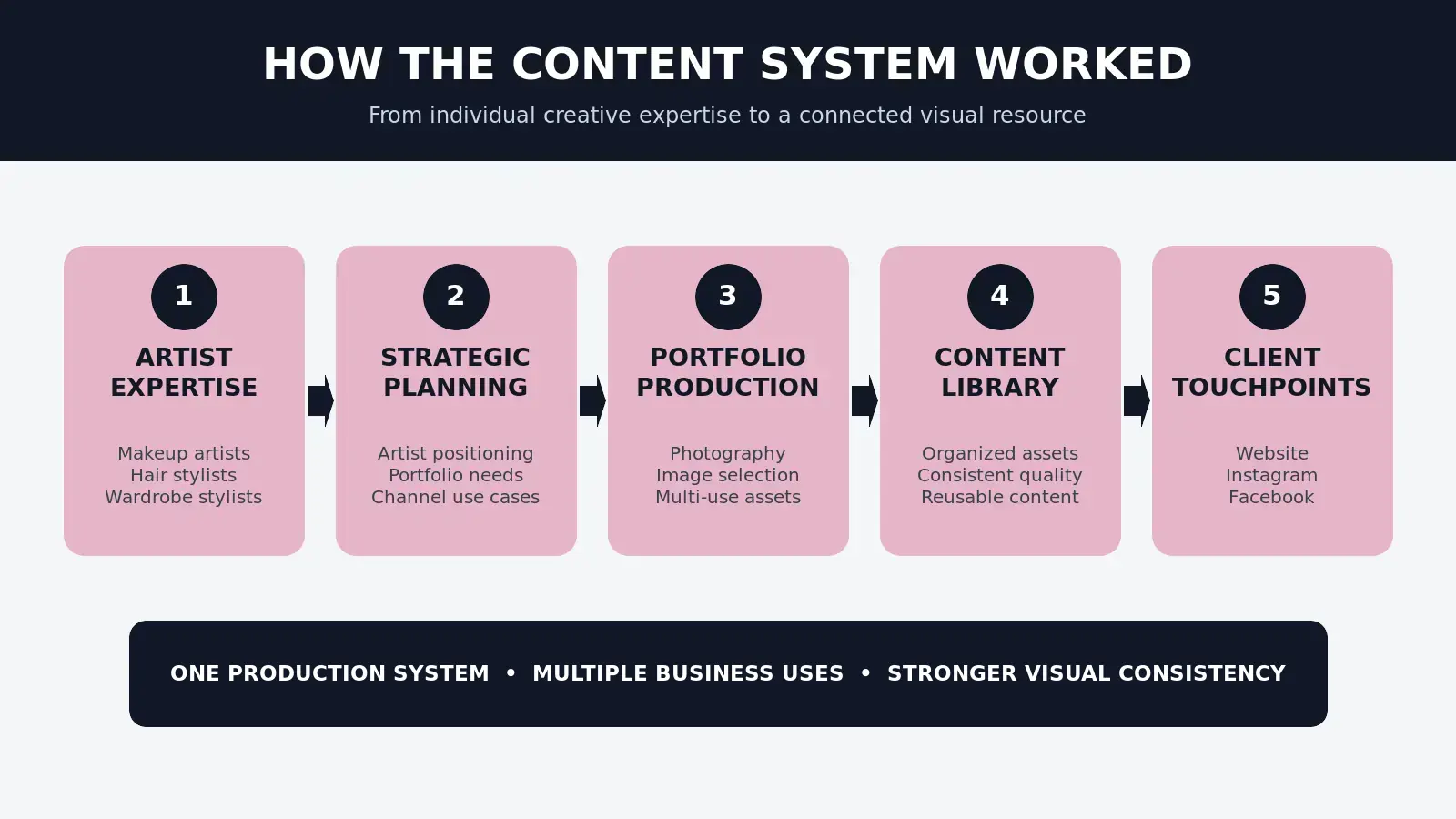
Most brands are busy creating content. Far fewer are focused on building a content system. While both approaches produce assets, only one scales. The difference isn’t creative quality — it’s structure, repeatability, and intent.
In short, content fills feeds. Systems build momentum.
What Will You Learn About Building A Content System?
- What is a content system?
- What is content creation?
- Why content creation alone doesn’t scale?
- Content creation produces assets. content systems produce outcomes.
- Why content systems improve campaign performance?
- Signs you’re creating content without a system
- What a content system actually looks like?
- Real-World example: creating content vs building a content system
What Is A Content System?

A content system is a structured framework that helps brands consistently plan, create, manage, distribute, and improve content over time.
Many brands focus primarily on content creation. They produce photography, videos, social media posts, and campaign assets as needs arise. While content creation is important, it is only one part of the process.
Without a system, content often becomes:
- reactive
- inconsistent
- difficult to scale
- inefficient to manage
- challenging to measure
A content system solves these challenges by creating repeatable processes that connect content directly to business and marketing objectives.
Rather than treating content as isolated assets, a content system treats content as part of a larger marketing infrastructure.
For a broader explanation of this concept, see What We Mean By Content System For Brands.
Planning
Every successful content system begins with planning. Planning ensures content is created intentionally rather than reactively. Before production begins, brands define:
- Business Objectives
- Marketing Goals
- Campaign Priorities
- Target Audience
- Customer Acquisition Goals
- Distribution Requirements
Planning helps answer questions such as:
- What Content Do We Need?
- Why Do We Need It?
- Where Will It Be Used?
- How Will It Support Marketing Objectives?
Without planning, content often becomes disconnected from larger business goals. With planning, every asset serves a specific purpose.
Production
Production is the stage where strategy becomes tangible assets. This includes creating the photography, video, and creative resources needed to support marketing initiatives. Examples include:
- Campaign Photography
- Product Photography
- Lifestyle Content
- Advertising Assets
- Website Content
- Short-Form Video
- Brand Storytelling Assets
In a content system, production is designed around future usage. Rather than creating content for a single post or campaign, brands create assets that can support multiple channels and objectives.
This increases the value generated from every production investment.
Asset Management
Creating content is only valuable if teams can find, access, and reuse it. This is where asset management becomes critical. Asset management includes:
- Content Organization
- Asset Libraries
- File Structures
- Asset Tagging
- Searchability
- Usage Tracking
Examples of managed assets include:
- Campaign Photography
- Product Photography
- Advertising Creative
- Website Assets
- Video Content
- Marketing Resources
Strong asset management helps prevent:
- Lost Content
- Duplicate Production
- Asset Waste
- Marketing Delays
Over time, organized asset libraries become one of a brand’s most valuable competitive advantages.
Distribution
Content only creates value when it reaches the right audience. Distribution determines how and where content is deployed. Examples include:
- Website Content
- Social Media
- Paid Advertising
- Email Marketing
- Public Relations
- Retail Marketing
- Sales Materials
A strong content system plans distribution before production begins. This ensures assets are designed specifically for the channels that will use them.
As a result:
- Asset Utilization Improves
- Campaign Performance Improves
- Consistency Improves
- Content ROI Improves
The more channels an asset supports, the more valuable it becomes.
Performance Measurement
The final component of a content system is performance measurement. Many brands stop after content is published. The strongest brands continue by analyzing results.
Examples include:
- Asset Performance
- Campaign Performance
- Advertising Results
- Conversion Metrics
- Engagement Metrics
- Content Utilization
- ROI
Performance measurement helps answer questions such as:
- Which Assets Perform Best?
- Which Campaigns Generate Results?
- Which Channels Deliver The Highest Return?
- What Should We Create More Of?
These insights improve future planning, production, and distribution decisions. Every campaign becomes an opportunity to learn and optimize.
Why Content Systems Matter
Without a content system, brands often experience:
- Content Shortages
- Reactive Marketing
- Inconsistent Branding
- Asset Waste
- Duplicate Production
- Lower ROI
A content system helps solve these challenges by creating structure. Instead of creating content whenever problems arise, brands build a repeatable framework that supports long-term growth.
The result is better:
- Planning
- Execution
- Asset Utilization
- Marketing Performance
- Content ROI
Content Systems Turn Content Into A Business Asset
A complete content system includes:
- Planning
- Production
- Asset Management
- Distribution
- Performance Measurement
Together, these components create a framework that allows content to support campaigns, customer acquisition, brand building, and business growth more effectively.
Ultimately, content creation produces assets. A content system ensures those assets continue generating value long after they are created.
What Is Content Creation?
Content creation is the process of producing marketing assets that help brands communicate with their audience. These assets may be used to build awareness, support campaigns, promote products, drive engagement, or generate sales.
For most brands, content creation is one of the most visible parts of marketing. It includes activities such as:
- Photography
- Video Production
- Social Media Content
- Campaign Development
- Design
- Creative Production
Content creation is essential because marketing cannot function without assets. However, content creation itself is an activity. It produces content.
What happens after content is created often determines whether that content generates meaningful business value.
Producing Assets
At its core, content creation is about producing assets. Assets are the visual and creative resources a brand uses to communicate with customers. Examples include:
- Images
- Videos
- Graphics
- Advertising Creative
- Campaign Photography
- Product Photography
- Brand Storytelling Content
These assets help brands attract attention and communicate their message across different marketing channels. The goal of content creation is to transform ideas, products, and campaigns into tangible marketing resources.
Without assets, brands have nothing to publish, distribute, or promote.
Photography
Photography remains one of the most important forms of content creation for many brands. It supports:
- Websites
- Product Pages
- Advertising Campaigns
- Social Media
- Email Marketing
- Public Relations
- Retail Marketing
Examples include:
- Campaign Photography
- Product Photography
- Lifestyle Photography
- Editorial Photography
- Brand Photography
Strong photography helps brands communicate quality, positioning, and brand identity. In many industries, photography is often one of the most valuable content investments a company can make.
Video Production
Video has become an increasingly important component of modern content creation. Brands use video to:
- Capture Attention
- Explain Products
- Tell Stories
- Improve Engagement
- Support Advertising
Examples include:
- Brand Films
- Campaign Videos
- Product Videos
- Behind-The-Scenes Content
- Short-Form Video
- Social Media Reels
Video often allows brands to communicate more information in less time while creating stronger emotional engagement. As digital platforms continue prioritizing video, production has become a critical part of many content strategies.
Social Content
Social content refers to assets specifically designed for social media platforms. Examples include:
- Instagram Posts
- TikTok Content
- Facebook Content
- LinkedIn Posts
- Pinterest Assets
- Stories
- Reels
- Short-Form Video
Social content helps brands maintain visibility and engage with audiences regularly. However, social content is often one of the most reactive forms of content creation.
Many brands create social content continuously without connecting it to broader marketing objectives. The strongest brands ensure social content supports larger campaigns and business goals.
Campaign Assets
Campaign assets are content pieces designed to support specific marketing initiatives. Examples include:
- Product Launch Campaigns
- Seasonal Promotions
- Brand Awareness Campaigns
- Customer Acquisition Campaigns
- Collection Launches
Campaign assets may include:
- Photography
- Video
- Advertising Creative
- Website Assets
- Email Marketing Content
- Social Media Content
Campaign assets are often created as part of a coordinated effort to achieve a specific business objective. Unlike standalone content, campaign assets work together toward a common goal.
Creative Production
Creative production is the process of bringing content ideas to life. It includes everything required to create finished marketing assets. Examples include:
- Creative Direction
- Concept Development
- Photography
- Videography
- Styling
- Hair And Makeup
- Design
- Editing
- Retouching
- Post-Production
Creative production transforms strategy into assets that customers can see, experience, and interact with. It is often where significant time, effort, and budget are invested.
Why Content Creation Matters
Content creation is essential because it provides the assets marketing teams need to operate. Without content creation, brands would lack:
- Advertising Creative
- Website Content
- Product Photography
- Campaign Assets
- Social Media Content
- Brand Storytelling Resources
Content creation fuels marketing activity across every channel. It is the engine that produces the raw materials of modern marketing.
Content Creation Is Only One Part Of The Process
While content creation is important, it is not the same as a content system. Content creation focuses on:
- Producing Assets
- Photography
- Video Production
- Social Content
- Campaign Assets
- Creative Production
These activities generate content. However, generating content alone does not guarantee results. Without planning, asset management, distribution, and performance measurement, even high-quality content can become underutilized.
Ultimately, content creation produces the assets. A content system ensures those assets create long-term value for the business.
Why Content Creation Alone Doesn’t Scale

Many brands assume that creating more content will solve their marketing challenges. When content runs low, they schedule another shoot, when campaigns need assets, they produce more content and when advertising requires fresh creative, they create additional assets.
At first, this approach appears logical. More content should create more opportunities. However, many brands eventually discover that despite producing large amounts of content, they continue experiencing the same problems.
They still run out of assets, face marketing delays and struggle with consistency.
The reason is simple: Content creation alone does not scale.
While content creation produces assets, it does not create the systems needed to manage, distribute, and maximize those assets over time. As a result, growth becomes increasingly difficult and inefficient.
Content Shortages
One of the clearest signs that content creation alone does not scale is the constant return of content shortages. A common pattern looks like this:
- Create Content
- Publish Content
- Launch Campaign
- Run Out Of Content
- Schedule Another Shoot
- Repeat
The cycle never ends.
The problem is not necessarily that brands are creating too little content. The problem is that content is often created without a long-term plan.
Assets are designed for immediate needs rather than future marketing requirements. As a result:
- Content Gaps Reappear
- Teams Feel Constantly Behind
- Marketing Remains Reactive
- Production Becomes Continuous
Without systems, more content simply postpones the next shortage.
Repeated Production
Content creation without infrastructure often leads to repeated production. Marketing teams frequently request new assets because existing content:
- Cannot Be Found
- Was Not Designed For Current Needs
- Was Never Properly Organized
- Was Used Only Once
- Is No Longer Accessible
This creates a situation where brands repeatedly solve the same problems through additional production.
Examples include:
- Additional Photoshoots
- New Advertising Creative
- Last-Minute Video Projects
- Emergency Content Requests
Instead of maximizing previous investments, brands continually invest in new content. This increases costs without necessarily improving results.
Asset Waste
Many brands already possess valuable content assets. The challenge is that those assets are often underutilized.
Examples include:
- Campaign Photography Used Once
- Product Images Buried In Folders
- Advertising Assets Never Repurposed
- Website Content Forgotten After Launch
- Video Assets Left Unused
This creates significant waste. A large portion of production investments may never reach their full potential. The issue is not content volume. The issue is asset utilization.
Without systems for organizing, managing, and distributing content, brands frequently create more assets than they can effectively use.
Operational Bottlenecks
As content volume increases, operational challenges often increase as well. Many marketing teams spend significant time:
- Searching For Assets
- Requesting New Content
- Managing Content Gaps
- Coordinating Production
- Solving Workflow Issues
- Tracking Deliverables
These bottlenecks slow execution and create unnecessary friction. The problem becomes more noticeable as brands grow. More content does not automatically improve efficiency.
In some cases, it creates more complexity. Without systems, scaling content production often means scaling operational problems as well.
Inconsistent Results
Another challenge is inconsistency. Content creation alone does not guarantee consistent:
- Branding
- Messaging
- Campaign Execution
- Performance
Because content is often created reactively, brands may experience:
- Different Visual Styles
- Disconnected Campaigns
- Shifting Messaging
- Variable Performance
- Unpredictable Results
One campaign performs well. The next struggles. One launch is successful. Another lacks the assets needed for success.
Without a repeatable system, results become difficult to predict and even harder to improve.
More Content Doesn’t Automatically Create Growth
Many brands believe growth comes from producing more content. In reality, growth often comes from creating more value from existing content. The brands that scale successfully focus on:
- Planning
- Asset Management
- Distribution
- Performance Measurement
- Asset Utilization
- Content Systems
These elements help content support long-term marketing objectives rather than short-term needs.
Systems Scale Better Than Production
Production is important. Without production, there are no assets. However, production alone cannot solve:
- Content Shortages
- Asset Waste
- Operational Inefficiencies
- Inconsistent Results
- Marketing Complexity
Systems solve these problems. They help brands maximize the value of every asset they create. They improve efficiency, consistency and ROI. Most importantly, they make growth more sustainable.
Why Content Systems Scale
Content creation alone often creates:
- Content Shortages
- Repeated Production
- Asset Waste
- Operational Bottlenecks
- Inconsistent Results
Content systems help brands achieve better:
- Planning
- Asset Utilization
- Distribution
- Efficiency
- Performance
- ROI
Ultimately, content creation produces assets. Content systems ensure those assets continue generating value over time.
That is why brands that build systems often scale more efficiently than brands that simply create more content.
Content Creation Produces Assets – Content Systems Produce Outcomes
Many brands invest heavily in content creation. They produce photography. Create videos. Launch campaigns. Publish social media content. Develop advertising creative.
These activities are important because marketing cannot function without assets. However, there is an important distinction that many brands overlook: Content creation produces assets. Content systems produce outcomes.
Creating assets is only the beginning. Business results occur when those assets are strategically planned, distributed, utilized, and optimized.
This distinction often explains why some brands create enormous amounts of content yet struggle to achieve meaningful marketing performance.
The issue is rarely content quantity. The issue is whether content is supported by a system.
Assets vs Results
Content creation focuses on producing assets. Examples include:
- Campaign Photography
- Product Photography
- Videos
- Advertising Creative
- Social Media Content
- Website Assets
These deliverables are valuable. However, assets alone do not automatically generate results. Results include:
- Sales
- Leads
- Customer Acquisition
- Brand Awareness
- Website Conversions
- Customer Retention
- Revenue Growth
A photoshoot creates assets. A content system helps those assets contribute to measurable business outcomes.
The distinction is important. Many brands measure content creation success by asking: How Much Content Did We Produce?
The better question is: What Results Did That Content Generate?
Activity vs Strategy
Content creation is often activity-driven. Examples include:
- Scheduling Shoots
- Producing Content
- Publishing Posts
- Launching Creative
- Meeting Deadlines
These activities create motion. However, motion does not always create progress. A content system introduces strategy.
Instead of asking: What Should We Create Next?
brands begin asking:
- What Are We Trying To Achieve?
- Which Assets Support That Goal?
- How Will Success Be Measured?
Strategy ensures content serves a purpose beyond simply being published. This transforms content from an activity into a business tool.
Deliverables vs Business Objectives
Many content projects are evaluated based on deliverables. Examples include number of:
- Images
- Videos
- Posts
- Assets Produced
These metrics are easy to measure. However, they often reveal very little about marketing effectiveness.
Content systems focus on business objectives instead. Examples include:
- Product Launch Success
- Customer Acquisition
- Advertising Performance
- Website Conversions
- Brand Growth
- Revenue Generation
In this model, deliverables are not the destination. They are resources that help achieve larger objectives.
The goal is not simply to produce assets. The goal is to use those assets to support business growth.
Production vs Performance
Content creation emphasizes production. The focus is on:
- Creating Assets
- Completing Projects
- Delivering Content
- Executing Productions
Production is necessary. Without it, there are no marketing assets. However, production alone does not guarantee performance. Content systems expand the focus to include:
- Distribution
- Asset Utilization
- Campaign Support
- Advertising Performance
- Conversion Metrics
- ROI
A content system asks:
- How Did The Assets Perform?
- Which Assets Drove Results?
- Which Channels Generated The Highest Return?
- What Should Be Improved Next Time?
Performance becomes part of the process rather than an afterthought.
Why Many Brands Get Stuck
Many brands operate almost entirely on the content creation side of the equation. Their process often looks like this:
- Create Content
- Deliver Assets
- Publish Content
- Repeat
As a result, they frequently experience:
- Content Shortages
- Inconsistent Results
- Asset Waste
- Reactive Marketing
- Lower ROI
Because there is no system connecting content to outcomes, the focus remains on production volume rather than performance.
What Content Systems Do Differently
Content systems connect content creation to business objectives. The process becomes:
- Strategy
- Campaign Planning
- Asset Creation
- Asset Management
- Distribution
- Performance Measurement
- Optimization
Every asset has a purpose, every campaign has objectives and every production contributes to a larger marketing ecosystem.
As a result:
- Assets Last Longer
- Campaigns Perform Better
- Marketing Becomes More Efficient
- ROI Improves
- Growth Becomes More Predictable
The Most Successful Brands Focus On Outcomes
The strongest brands understand that content itself is not the goal. The goal is what content helps the business achieve. Content creation focuses on:
- Assets
- Deliverables
- Production
- Activity
Content systems focus on:
- Results
- Business Objectives
- Performance
- Growth
Both are important.
However, one creates content while the other creates outcomes. Ultimately, content creation produces the raw materials of marketing.
Content systems transform those materials into measurable business results. That is why brands that build systems often outperform brands that simply produce more content.
Why Content Systems Improve Campaign Performance

Great campaigns rarely succeed because of creative execution alone. They succeed because the right assets are available, the right channels are supported, and every element works toward a common objective.
Many brands invest heavily in campaign production but struggle with execution because content is created reactively. Assets are missing. Advertising creative is limited. Deadlines become compressed. Teams scramble to fill content gaps.
A content system helps eliminate these challenges by creating structure around how content is planned, produced, managed, and deployed.
The result is stronger campaign execution and more consistent marketing performance.
Better Planning
Campaign performance often improves before production even begins. The strongest campaigns start with planning. A content system helps brands identify:
- Campaign Objectives
- Marketing Goals
- Required Assets
- Distribution Channels
- Advertising Requirements
- Launch Timelines
- Success Metrics
Without planning, content is often created after campaign requirements become apparent. This leads to:
- Missing Assets
- Last-Minute Requests
- Production Delays
- Reduced Campaign Effectiveness
With a content system, content requirements are identified early. Teams know exactly what needs to be created and why. This reduces uncertainty and improves campaign readiness.
Better Asset Availability
One of the most common reasons campaigns struggle is asset availability. Marketing teams often discover they are missing:
- Product Photography
- Advertising Creative
- Website Assets
- Social Media Content
- Email Marketing Assets
- Launch Materials
As a result, campaigns launch with incomplete support. Content systems improve asset availability by creating:
- Campaign-Based Production
- Asset Libraries
- Organized Content Repositories
- Future-Focused Planning
Instead of searching for content or creating assets at the last minute, teams can access resources that already exist. This allows campaigns to launch more smoothly and with stronger creative support.
Advertising Support
Modern campaigns rely heavily on advertising. Whether the goal is awareness, customer acquisition, or product sales, advertising often plays a central role. However, advertising requires more than a few images.
Effective campaigns often need:
- Multiple Formats
- Multiple Messages
- Creative Variations
- Audience-Specific Assets
- Testing Opportunities
Content systems help ensure these requirements are considered during planning and production. As a result, campaigns launch with:
- Static Ads
- Carousel Ads
- Video Assets
- Retargeting Creative
- Conversion-Focused Assets
This provides advertising teams with the resources they need to optimize performance and improve results.
Faster Execution
Campaign execution becomes faster when systems are in place. Without a content system, teams often spend valuable time:
- Searching For Assets
- Requesting New Content
- Managing Content Gaps
- Coordinating Emergency Production
- Solving Operational Problems
These delays can slow campaign launches and reduce effectiveness. Content systems improve execution through:
- Asset Libraries
- Organized Workflows
- Defined Processes
- Campaign Planning Frameworks
- Distribution Strategies
When assets are available and workflows are established, campaigns can move from planning to launch much more efficiently. This creates greater agility and reduces operational friction.
Better Results
Ultimately, the purpose of a content system is not simply to improve organization. It is to improve performance. Better planning, stronger asset availability, advertising support, and faster execution all contribute to better outcomes.
Examples include:
- Improved Campaign Reach
- Better Advertising Performance
- Higher Engagement
- Stronger Conversion Rates
- Faster Product Launches
- Greater Marketing Efficiency
- Higher Content ROI
Because campaigns are supported by a complete ecosystem of assets, they are more likely to achieve their intended objectives.
Instead of relying on isolated content pieces, campaigns benefit from coordinated support across multiple channels.
Why Campaigns Struggle Without Content Systems
Campaigns often underperform when brands rely solely on content creation. Common challenges include:
- Missing Assets
- Last-Minute Production
- Inconsistent Messaging
- Weak Advertising Support
- Operational Delays
- Limited Asset Availability
These issues are rarely caused by a lack of creativity. More often, they are caused by a lack of infrastructure. Without systems, even strong creative work can struggle to reach its full potential.
Content Systems Create Campaign Momentum
Strong campaigns are rarely the result of a single asset. They are the result of multiple assets working together. Content systems help create:
- Strategic Alignment
- Asset Availability
- Consistency
- Faster Execution
- Better Performance
Each component strengthens the next. The result is a campaign that is better equipped to achieve its objectives.
Better Systems Create Better Campaigns
Content systems improve campaign performance through:
- Better Planning
- Better Asset Availability
- Advertising Support
- Faster Execution
- Better Results
These advantages help brands launch campaigns more efficiently, support more channels, and maximize the value of every production investment.
Ultimately, successful campaigns are not built on content alone. They are built on systems that ensure the right content is available, accessible, and strategically deployed when it matters most.
Signs You’re Creating Content Without A System
Many brands assume their content challenges are caused by a lack of content. The typical response is:
- Create More Content
- Schedule Another Shoot
- Produce More Assets
- Publish More Frequently
However, in many cases, the real issue is not content volume. It is the absence of a content system.
Without a structured framework for planning, production, asset management, distribution, and measurement, content creation often becomes reactive and inefficient.
The result is a cycle of recurring problems that limit marketing performance and reduce content ROI. If any of the following signs sound familiar, your brand may be creating content without a system.
Always Running Out Of Content
One of the most obvious warning signs is the constant feeling that there is never enough content. The cycle often looks like this:
- Create Content
- Publish Content
- Launch Campaign
- Run Out Of Content
- Schedule Another Shoot
- Repeat
Despite investing in production, content shortages continue to return. The problem is rarely that brands are creating too little content. More often, content is being created without:
- Long-Term Planning
- Asset Reuse Strategies
- Distribution Planning
- Future Campaign Requirements
Without a system, every production solves a short-term problem but fails to address future needs.
Frequent Emergency Shoots
Another common symptom is the emergency shoot. Examples include:
- A Product Launch Needs Assets
- Advertising Needs New Creative
- Social Content Is Running Low
- Website Updates Are Required
- A Campaign Deadline Is Approaching
Instead of working from a planned content library, marketing teams constantly react to content gaps. Emergency shoots often create:
- Higher Costs
- Increased Stress
- Compressed Timelines
- Reduced Strategic Thinking
- Inconsistent Results
When content infrastructure is missing, urgency becomes a normal part of the workflow.
Disorganized Assets
Many brands have more content than they realize. The challenge is that they cannot find it. Common symptoms include:
- Assets Stored Across Multiple Locations
- Poor File Organization
- Missing Naming Conventions
- No Asset Tagging
- Difficulty Finding Previous Content
- Duplicate Content Requests
Marketing teams may spend hours searching for assets that already exist. As a result:
- Valuable Content Goes Unused
- Production Is Repeated Unnecessarily
- Campaign Execution Slows Down
A strong content system ensures assets remain accessible, searchable, and reusable.
Inconsistent Branding
Without a content system, consistency becomes difficult to maintain. Content is often created at different times, by different people, for different objectives. The result may include:
- Different Photography Styles
- Different Visual Standards
- Inconsistent Messaging
- Unrelated Campaigns
- Fragmented Customer Experiences
Customers encounter a brand that feels different across channels and campaigns. Over time, this weakens:
- Recognition
- Familiarity
- Trust
- Brand Equity
Consistency is rarely achieved through volume. It is achieved through systems.
Low Content ROI
Many brands invest significant resources into content creation but struggle to see meaningful returns. Examples include investments in:
- Photography
- Video Production
- Models
- Styling
- Creative Direction
- Advertising Assets
Yet despite these investments:
- Assets Are Used Once
- Campaigns Lack Support
- Content Lifespans Remain Short
- Production Costs Continue Rising
- Marketing Efficiency Remains Low
Low content ROI is often a sign that assets are not being fully utilized. The issue is not necessarily production quality. The issue is often infrastructure.
Reactive Marketing
Perhaps the most common sign of all is reactive marketing. Instead of operating from a strategic plan, content decisions are driven by immediate needs. Examples include:
- Last-Minute Content Requests
- Empty Social Calendars
- Upcoming Deadlines
- Missing Campaign Assets
- Competitor Activity
- Trending Topics
Marketing becomes a constant effort to solve today’s problem. Long-term planning takes a back seat. As a result:
- Campaigns Become Less Effective
- Resources Become Stretched
- Teams Become Less Efficient
- Growth Becomes Harder To Scale
Reactive marketing is often a symptom of missing systems rather than missing creativity.
The Pattern Behind These Problems
At first glance, these issues may appear unrelated. However, they often share the same root cause. Without a content system, brands frequently experience:
- Always Running Out Of Content
- Frequent Emergency Shoots
- Disorganized Assets
- Inconsistent Branding
- Low Content ROI
- Reactive Marketing
These problems are rarely solved by producing more content. In many cases, more production simply creates more complexity.
The Solution Is A System
Brands that overcome these challenges typically focus on building:
- Content Strategy
- Campaign Planning
- Asset Libraries
- Distribution Processes
- Performance Tracking
Instead of relying on constant production, they create systems that maximize the value of every asset. The result is:
- Better Organization
- Better Consistency
- Better Campaign Performance
- Better Marketing Efficiency
- Higher Content ROI
Ultimately, the strongest brands are not necessarily the brands creating the most content. They are the brands with systems that allow content to work harder, last longer, and support business growth more effectively.
What A Content System Actually Looks Like

Many brands hear the phrase content system and assume it means posting more consistently on social media or organizing files more effectively.
While those activities can be part of the process, a true content system is much broader. A content system is the framework that connects strategy, production, asset management, distribution, and performance measurement into a repeatable marketing process.
It ensures content is not created randomly or reactively. Instead, every asset supports a larger business objective. The strongest brands do not simply create content.
They build systems that allow content to generate value long after production is complete. For a complete breakdown of this process, see Our End-To-End Content System Explained.
Strategy
Every content system begins with strategy. Strategy provides the foundation for every future content decision. Before creating content, brands define:
- Business Objectives
- Marketing Goals
- Target Audience
- Brand Positioning
- Customer Acquisition Priorities
- Growth Initiatives
This stage answers critical questions:
- Why Are We Creating Content?
- Who Are We Trying To Reach?
- What Business Objective Does It Support?
- How Will Success Be Measured?
Without strategy, content often becomes reactive. With strategy, content becomes intentional. Every asset serves a purpose.
Campaign Planning
Once strategy is established, content requirements are organized around campaigns. Campaigns provide structure and direction. Examples include:
- Product Launches
- Seasonal Promotions
- Customer Acquisition Campaigns
- Brand Awareness Initiatives
- Collection Releases
- Promotional Campaigns
Campaign planning identifies:
- Required Assets
- Distribution Channels
- Advertising Requirements
- Production Timelines
- Success Metrics
Instead of creating isolated content pieces, brands create coordinated asset ecosystems that support specific business objectives. This dramatically improves marketing efficiency and campaign performance.
Production
Production is where strategy becomes assets. This stage includes creating the content required to support campaigns and marketing initiatives. Examples include:
- Campaign Photography
- Product Photography
- Lifestyle Content
- Advertising Assets
- Website Content
- Short-Form Video
- Brand Storytelling Assets
In a strong content system, production is designed around future usage. A single production may generate content for:
- Websites
- Paid Advertising
- Social Media
- Email Marketing
- Product Launches
- Public Relations
Rather than producing content for one immediate need, brands create assets that support multiple objectives simultaneously.
Asset Libraries
Once assets are created, they need to be organized and managed. This is where asset libraries become critical. Asset libraries provide a centralized repository for:
- Campaign Photography
- Product Photography
- Advertising Creative
- Video Content
- Website Assets
- Brand Resources
- Marketing Materials
Strong libraries include:
- Clear Organization
- Searchable Categories
- Asset Tagging
- Usage Information
- Easy Accessibility
Asset libraries help teams:
- Find Assets Faster
- Reuse Existing Content
- Improve Consistency
- Reduce Duplicate Production
- Increase Content ROI
Over time, the library becomes a valuable business asset that grows with every campaign.
Distribution
Content only creates value when it reaches the right audience. Distribution determines how assets are deployed across marketing channels. Examples include:
- Website Content
- Social Media
- Paid Advertising
- Email Marketing
- Public Relations
- Retail Marketing
- Sales Materials
Strong content systems plan distribution before production begins. This ensures assets are designed specifically for the channels that will use them. The result is better:
- Asset Utilization
- Campaign Support
- Customer Experience
- Marketing Efficiency
- ROI
The goal is not simply to create content. The goal is to ensure content is used effectively.
Performance Tracking
The final stage is performance tracking. Many brands stop once content is published. The strongest brands continue by measuring outcomes. Examples include:
- Asset Performance
- Campaign Results
- Advertising Performance
- Conversion Metrics
- Engagement Metrics
- Content Utilization
- ROI
Performance tracking helps answer questions such as:
- Which Assets Performed Best?
- Which Campaigns Generated Results?
- Which Channels Delivered The Highest Return?
- What Should We Produce More Of?
- What Should We Improve Next Time?
These insights become the foundation for future planning and production decisions. Every campaign becomes a learning opportunity.
How The System Works Together
A content system is not a collection of separate activities. Each component supports the next.
Strategy
creates direction.
Campaign Planning
defines requirements.
Production
creates assets.
Asset Libraries
manage those assets.
Distribution
deploys those assets.
Performance Tracking
improves future decisions.
When these components work together, content becomes significantly more valuable.
The Difference Between Content Creation And A Content System
Content creation alone often looks like this:
- Need Content
- Create Content
- Publish Content
- Run Out Of Content
- Repeat
A content system looks like this:
- Define Strategy
- Plan Campaigns
- Create Assets
- Build Libraries
- Distribute Content
- Measure Results
- Improve Future Campaigns
One approach creates activity. The other creates a scalable marketing asset.
What Successful Brands Build
The strongest brands rarely rely on random content production. Instead, they build systems that include:
- Strategy
- Campaign Planning
- Production
- Asset Libraries
- Distribution
- Performance Tracking
Together, these components create a repeatable framework that supports customer acquisition, brand growth, campaign performance, and long-term marketing success.
Ultimately, a content system is not about producing more content. It is about creating a structure that allows every asset to generate more value, support more objectives, and contribute more effectively to business growth.
Real-World Example: Creating Content vs Building A Content System
Many brands believe they have a content problem. When marketing performance slows or content runs low, the immediate response is often:
- Create More Content
- Schedule Another Shoot
- Produce More Assets
- Publish More Frequently
However, content volume alone rarely creates sustainable growth. The real difference often lies in how content is managed. Consider two fashion brands with similar budgets, similar products, and similar target audiences.
Both invest in photography and marketing. The key difference is their approach to content. One focuses on creating content. The other focuses on building a content system.
Brand A: Creates Content
Brand A approaches content as a series of individual projects. Typical workflow:
- Need Content
- Schedule A Shoot
- Produce Assets
- Publish Content
- Run Out Of Content
- Repeat
Content is created to solve immediate marketing needs. Examples include:
- Social Media Posts
- Product Launch Assets
- Advertising Creative
- Website Updates
- Seasonal Promotions
While content is regularly produced, there is little long-term infrastructure supporting it. Marketing remains largely reactive.
Brand B: Builds A Content System
Brand B takes a different approach. Instead of focusing solely on production, the brand builds systems around content. Typical workflow:
- Strategy
- Campaign Planning
- Asset Creation
- Asset Libraries
- Distribution
- Performance Tracking
Every production is designed to support multiple future initiatives. Assets become part of a growing marketing ecosystem rather than isolated deliverables.
The objective is not simply to create content. The objective is to create long-term marketing assets.
Asset Lifespan
Brand A: Creates Content
Most assets support one:
- Campaign
- Launch
- Promotion
- Social Media Cycle
Once the immediate need has passed, assets are rarely reused.
Typical asset lifespan: Days Or Weeks
Result:
- Constant Content Shortages
- Frequent New Productions
- Limited Long-Term Value
Brand B: Builds A Content System
Assets are created with future usage in mind. Examples include:
- Website Content
- Advertising Assets
- Social Content
- Email Marketing
- Product Launch Support
- Future Campaign Resources
Typical asset lifespan: Months Or Years
Result:
- Better Asset Utilization
- Longer-Term Value
- Stronger Content ROI
- Reduced Production Pressure
Campaign Performance
Brand A: Creates Content
Campaigns often launch with:
- Limited Asset Availability
- Few Advertising Variations
- Minimal Cross-Channel Support
- Reactive Content Creation
As a result:
- Campaign Quality Varies
- Execution Is Less Consistent
- Marketing Opportunities Are Missed
Campaign success often depends on how quickly new content can be produced.
Brand B: Builds A Content System
Campaigns launch with:
- Campaign Photography
- Product Photography
- Advertising Creative
- Website Assets
- Social Media Assets
- Email Marketing Assets
Because content is planned in advance, campaigns receive comprehensive support.
Result, better:
- Launches
- Advertising Performance
- Customer Experiences
- Marketing Outcomes
Efficiency
Brand A: Creates Content
Marketing teams spend significant time:
- Requesting New Assets
- Managing Content Gaps
- Scheduling Shoots
- Searching For Files
- Solving Operational Problems
Content creation becomes a continuous process of catching up.
Result:
- Higher Workload
- More Stress
- Slower Execution
- Increased Operational Complexity
Brand B: Builds A Content System
Marketing teams work from:
- Campaign Plans
- Asset Libraries
- Distribution Frameworks
- Established Workflows
- Performance Data
Assets are easier to access and easier to deploy.
Result:
- Faster Campaign Execution
- Better Collaboration
- Less Production Waste
- Greater Scalability
- More Efficient Marketing Operations
Consistency
Brand A: Creates Content
Because content is often created reactively, branding may vary over time. Examples include:
- Different Photography Styles
- Different Messaging
- Disconnected Campaigns
- Inconsistent Customer Experiences
Result:
- Weaker Recognition
- Lower Recall
- Slower Trust Building
Brand B: Builds A Content System
Campaigns are planned around consistent:
- Visual Standards
- Messaging
- Brand Positioning
- Customer Experiences
Every new asset reinforces the same strategic direction. Result:
- Stronger Recognition
- Greater Familiarity
- More Trust
- Stronger Brand Equity
ROI
Brand A: Creates Content
Content investments often generate:
- Short-Term Value
- Limited Asset Reuse
- Frequent Production Costs
- Lower Asset Utilization
The brand continually invests in new production to maintain marketing activity. Result:
- Lower Overall ROI
- Higher Cost Per Asset
- Less Efficient Marketing Spend
Brand B: Builds A Content System
Content investments generate:
- Long-Term Asset Value
- Cross-Channel Support
- Campaign Extensions
- Asset Reuse Opportunities
- Future Marketing Resources
Every production contributes to a larger infrastructure. Result:
- Higher Content ROI
- Better Asset Utilization
- Lower Production Waste
- Stronger Marketing Efficiency
Side-By-Side Comparison
| Category | Brand A: Creates Content | Brand B: Builds A Content System |
|---|---|---|
| Asset Lifespan | Days or weeks | Months or years |
| Campaign Performance | Inconsistent | More predictable and effective |
| Efficiency | Reactive | Proactive and scalable |
| Consistency | Difficult to maintain | Built into the process |
| Asset Utilization | Low | High |
| Production Waste | Higher | Lower |
| Marketing Efficiency | Lower | Higher |
| ROI | Lower | Higher |
The Difference Is Not More Content
The most important takeaway is this: Brand B does not necessarily create more content than Brand A.
Instead, Brand B creates more value from every asset.
The advantage comes from:
- Longer Asset Lifespans
- Better Campaign Performance
- Greater Efficiency
- Stronger Consistency
- Higher ROI
Ultimately, creating content is important. But content alone rarely creates a competitive advantage.
The brands that scale most effectively are often the brands that build systems around content—systems that help every asset work harder, last longer, and contribute more directly to business growth.
Final Thoughts
Creating content keeps you busy. Building a content system makes you effective.
Brands that understand the difference stop chasing output and start investing in systems that scale, stabilize, and improve long-term content ROI.
Next Recommended Reads
Fashion Campaign Photography: The Foundation of High-Performing Fashion Brands
From Chaos to Content System – How Prestige Artists Rebuilt Their Visual Strategy