
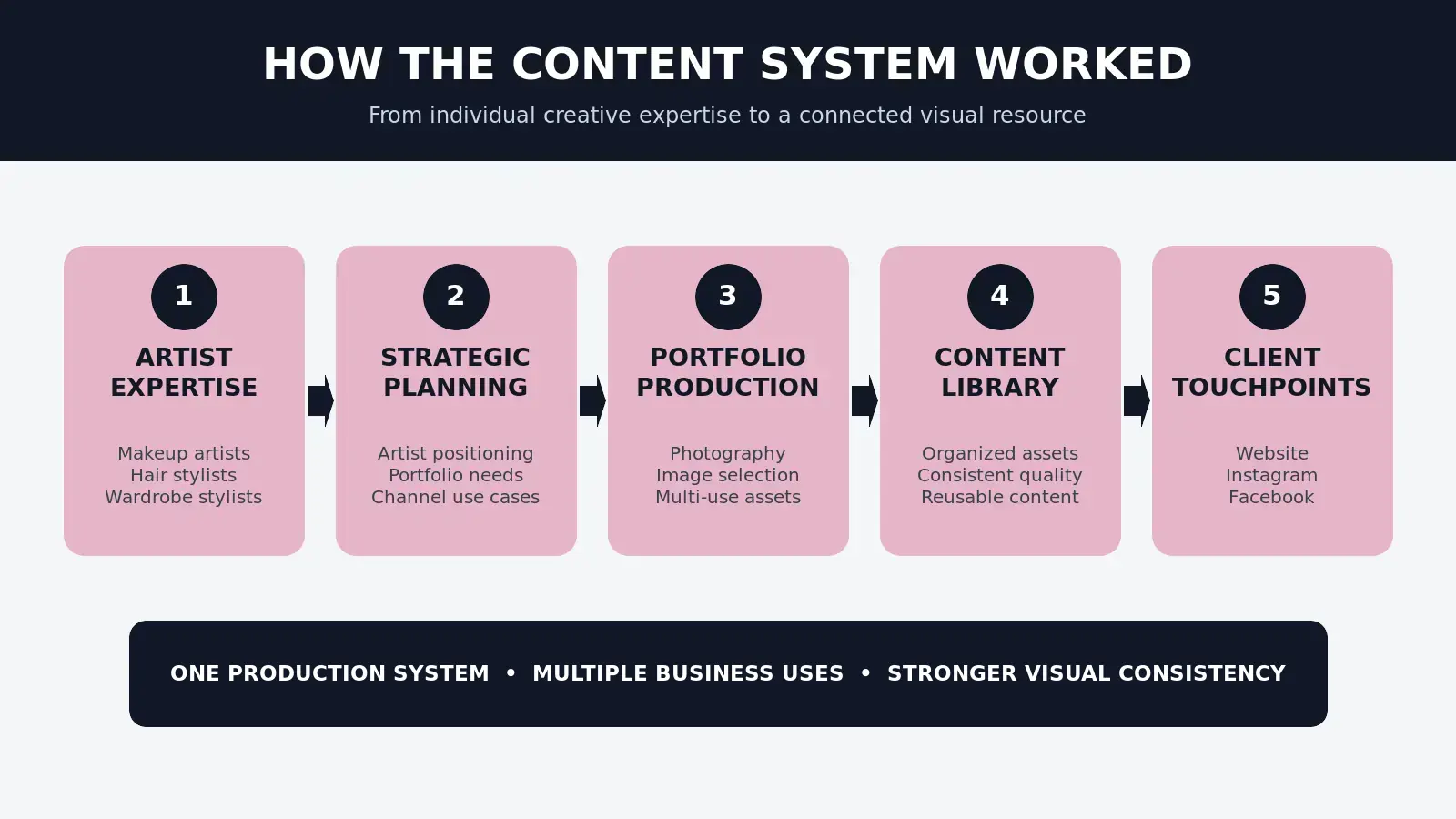
A brand content system framework connects strategy, campaign planning, production, asset governance, distribution, licensing and measurement. It gives a marketing team a repeatable way to decide what to create, why it matters, where each asset will be used and what should improve next.
That is fundamentally different from ordering more images or filling a content calendar. A calendar schedules publication. A content system governs the full lifecycle of an asset—from the business objective and creative brief to approval, deployment, reuse and performance review.

What a Brand Content System Is
A brand content system is the operating model behind consistent, useful marketing content. It defines the decisions, standards, people, workflows and feedback loops that connect one campaign to the next.
This broader lifecycle view is consistent with the Nielsen Norman Group’s definition of content strategy, which treats planning, creation, delivery and governance as an ongoing practice rather than a one-time publishing task.
In practice, the system should answer seven questions:
- Objective: What business or communication outcome should the content support?
- Audience: Who needs to see it, and at which stage of the customer journey?
- Requirements: Which assets, formats and variations does each channel need?
- Production: How will the team create those assets efficiently and consistently?
- Governance: Who approves the work, where is it stored and which version is final?
- Usage: Which media, territories and time periods are covered by the license?
- Learning: Which assets performed, which were underused and what changes next?
For the complete sequence from briefing through optimization, see the end-to-end brand content workflow.
What It Is Not
The phrase “content system” is often used too loosely. A shared drive is storage, not a system. A calendar is a schedule, not a system. A retainer is a commercial arrangement, not automatically a system. And a large batch of photographs is still only a batch if nobody has defined how the assets should be selected, governed, distributed and measured.
| Tool or output | What it does | What it does not solve |
|---|---|---|
| Content calendar | Schedules what will be published and when | Production requirements, rights, asset reuse or performance learning |
| Photoshoot | Creates a defined set of visual assets | Cross-channel planning, library governance or future demand |
| Asset folder | Stores files in one place | Approval status, metadata, licensing clarity or retrieval confidence |
| Brand guidelines | Define visual and verbal standards | Campaign workflow, production cadence or measurement |
| Content system | Connects all of the above around business objectives | It still requires ownership, discipline and regular review |
If your team is deciding between isolated productions and a repeatable operating model, compare content systems and random shoots.
The Seven Parts of a Working Brand Content System Framework
1. Business and Campaign Strategy
The system begins with a commercial reason to create content. A launch may need product discovery and conversion. A rebrand may need recognition and trust. An always-on campaign may need enough creative variation to prevent ad fatigue while maintaining a consistent visual identity.
Define the objective, audience, offer, channels, timing and success criteria before discussing image count. Otherwise, production becomes a list of creative preferences with no reliable way to judge whether the result is useful.
2. Content Mapping
Content mapping translates strategy into a channel-by-channel asset plan. It identifies the homepage hero, product-page images, paid-social variations, organic crops, email banners, PR selects, retailer files and short-form video required for the campaign.
This stage prevents the expensive discovery that a beautiful shoot did not produce a vertical ad, a clean product frame or enough negative space for copy. Every required output should be mapped to a purpose, format, owner and delivery date.
3. Production and Creative Standards
Production turns the map into coordinated photography and video. The brief, shot list, casting, styling, lighting, location, retouching and file specifications should all support the intended use.
Consistency does not mean making every campaign look identical. It means protecting recognizable principles—such as color, contrast, composition, casting, product clarity or tone—while allowing the creative idea to evolve.
4. Asset Governance
After production, content needs one source of truth. Approved masters, working files and channel exports should be clearly separated. Naming conventions, metadata, version status and ownership should make each asset easy to find and safe to use.
The practical test is simple: can a team member who did not attend the shoot find the correct approved asset six months later? The guide to campaign asset organization explains how to structure that handoff.
5. Distribution and Adaptation
A strong campaign asset should be designed for more than one placement, but reuse is not the same as posting the identical file everywhere. A homepage image, paid-social ad, email banner and PR image have different aspect ratios, copy requirements and attention patterns.
The system defines which master assets can be adapted, who creates the derivatives and how brand consistency is protected across web, ecommerce, organic social, paid media, email, PR and retail.
6. Licensing and Usage Control
Content is not operationally usable if the team cannot confirm its rights. Each asset should be connected to the permitted media, territory, duration, paid-ad scope, third-party use and renewal date.
This is especially important when campaigns scale. The commercial value of photography depends on reach, duration and visibility—not only on the number of delivered files. Review the photography licensing and usage framework before production so the planned channels and the granted rights match.
7. Measurement and Improvement
The feedback loop turns repeated production into a system that improves. Review both performance and utilization:
- Which assets drove clicks, engagement, product views or conversions?
- Which formats were requested after delivery because they were missed?
- Which images were repeatedly used across channels?
- Which assets were approved but never deployed?
- Where did approvals, exports or licensing create delays?
- Which visual patterns should the next campaign repeat or test?
That information should change the next brief. Without this loop, a brand may repeat its production schedule without becoming more effective.
How Photography Fits Into the System
Photography is often the visual engine of a fashion or beauty content system, but the system should not be built around “shoot days.” It should be built around campaign and channel requirements.
One carefully planned production can create hero images, product-led frames, lifestyle storytelling, detail shots, vertical compositions, clean layouts for copy, paid-ad variations and short-form motion. The value comes from coordinated usefulness, not raw volume.
This also explains when an ongoing partnership is appropriate. A retainer can support continuity, faster planning and a growing library when a brand has recurring demand. However, it is not automatically the right model for every client. A defined launch or seasonal campaign may be better served by a focused one-off production. The production model should follow the real demand.
A Practical Fashion Brand Example
Consider a fashion brand preparing a 90-day collection launch. Instead of starting with “How many images do we need?”, the team maps the campaign:
- Website: homepage hero, collection landing page, category crops and product-supporting lifestyle images
- Paid media: vertical, square and landscape variations with room for copy and multiple creative concepts
- Organic social: launch sequence, product details, styling stories and behind-the-scenes material
- Email: launch banner, product modules and follow-up creative
- PR and retail: high-resolution selects, credits and approved product information
The production plan then captures these requirements within one coherent visual language. After retouching, approved masters and channel exports enter a tagged library with rights information. The team records where each asset is deployed and reviews performance and utilization after the launch.
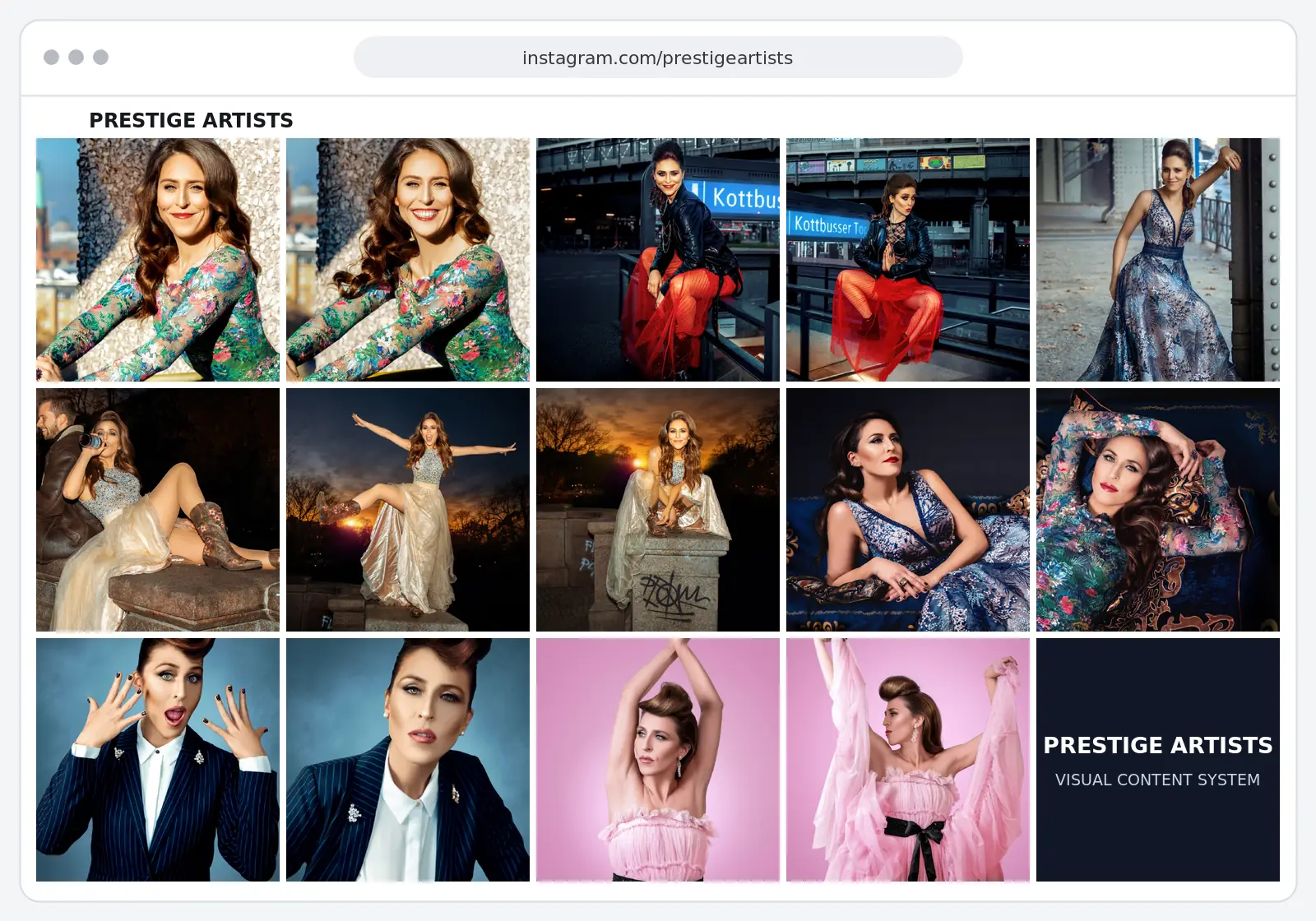
The Prestige Artists content-system case study shows how this approach can work with real fashion and beauty photography.
How to Know Whether Your Brand Needs a System
Your brand is likely ready for a more structured approach if several of these problems occur repeatedly:
- Campaigns launch before every required format is available.
- Teams request emergency shoots or last-minute exports.
- Visuals feel inconsistent across website, social and paid media.
- Approved files are scattered across inboxes, drives and transfer links.
- Nobody can quickly confirm usage rights or expiration dates.
- The same content gaps return every quarter.
- Production success is measured by image count rather than use or performance.
Download the Content System Readiness Scorecard
Use the scorecard with your marketing or brand team to assess planning, production, asset organization, distribution and measurement. It turns a vague “we need a better system” discussion into a practical review.
Measure Value Beyond Content Volume
A content system should not be justified with vague claims that consistency automatically creates revenue. The stronger case is operational and measurable: fewer missing assets, faster launches, higher utilization, clearer rights, less duplicate production and better-informed creative decisions.
Useful indicators include asset utilization rate, time from approval to deployment, number of channels supported per production, percentage of requested formats delivered on time, repeat use, licensing renewals, creative testing coverage and campaign performance by asset type.
Over time, the system becomes more valuable because each campaign adds knowledge and reusable assets. That is the mechanism behind the compounding ROI of planned content systems.
Frequently Asked Questions
What is a brand content system framework?
It is a repeatable operating model that connects content strategy, campaign planning, production, asset management, distribution, licensing and measurement. Its purpose is to make content more consistent, usable and aligned with business objectives.
How is a content system different from a content calendar?
A calendar determines what will be published and when. A content system also determines why the content is needed, how it will be created, who approves it, where it is stored, which rights apply and how performance will inform future work.
Does every brand need a content retainer?
No. A retainer can be effective for brands with recurring campaigns and continuous multi-channel demand. A focused one-off production may be more appropriate for a defined launch, seasonal campaign or specific asset gap.
What should a content asset library include?
It should separate approved masters from working files and channel exports, use consistent naming and metadata, record approval and licensing status, and make assets easy for authorized team members to retrieve.
How should a brand measure content-system ROI?
Measure both marketing performance and operational efficiency. Track asset utilization, launch speed, channel coverage, reuse, production waste, licensing clarity and the performance of specific creative formats against the campaign objective.
Find the Gaps in Your Current Visual System
A Free Visual Audit is a practical working session for fashion and beauty brands. We review how your visuals support campaigns, website, paid media and ongoing channels—and identify where planning, consistency or reuse is breaking down.