If you’re asking what images do I need for ads, you’re already ahead of many businesses. Most brands don’t ask this question until after the campaign starts underperforming.
Then the panic begins. The marketing team wants new visuals, agency requests more assets and ads stop converting. And suddenly everyone is scrambling to create more content.
However, the real problem often started before the campaign launched. Many businesses assume any professional photo can become an ad. Unfortunately, that’s rarely true.
As a buyer, I’ve seen countless brands create beautiful imagery that completely fails as advertising. Not because the photos were bad. But because they were the wrong advertising campaign images for the job.
What You Will Learn About What Images Do I Need For Ads?
- Why “What Images Do I Need for Ads” is the wrong question
- What images do buyers actually respond to?
- What images do I need for ads? The content planning advantage
- How to create images for facebook ads
- How to create images for google ads
- What images do I need for ads? The campaign planning framework
- Best practices for facebook ad images
- Best practices for google ad images
- What images do I need for ads? A practical checklist
- How long should advertising images last?
- Why most businesses keep reshooting ad content
Why “What Images Do I Need for Ads” Is The Wrong Question
Most businesses focus on quantity.
They ask:
- How many images do we need?
- How many ad variations should we create?
- How many deliverables should we receive?
However, buyers care about something entirely different. They care about relevance.
Because the truth is simple: One strong image can outperform twenty weak ones.
Therefore, instead of asking “What images do I need for ads?” many brands should ask: “What problems are our customers trying to solve?”
This is where many marketing campaign visuals fail. They focus on aesthetics instead of customer intent.
Free Ad Creative Planning Template
Take a look at Content Planning For Fashion Brands: How One Campaign Generated 6 Months Of Marketing Assets
Situation #1: Your Ads Only Show Products
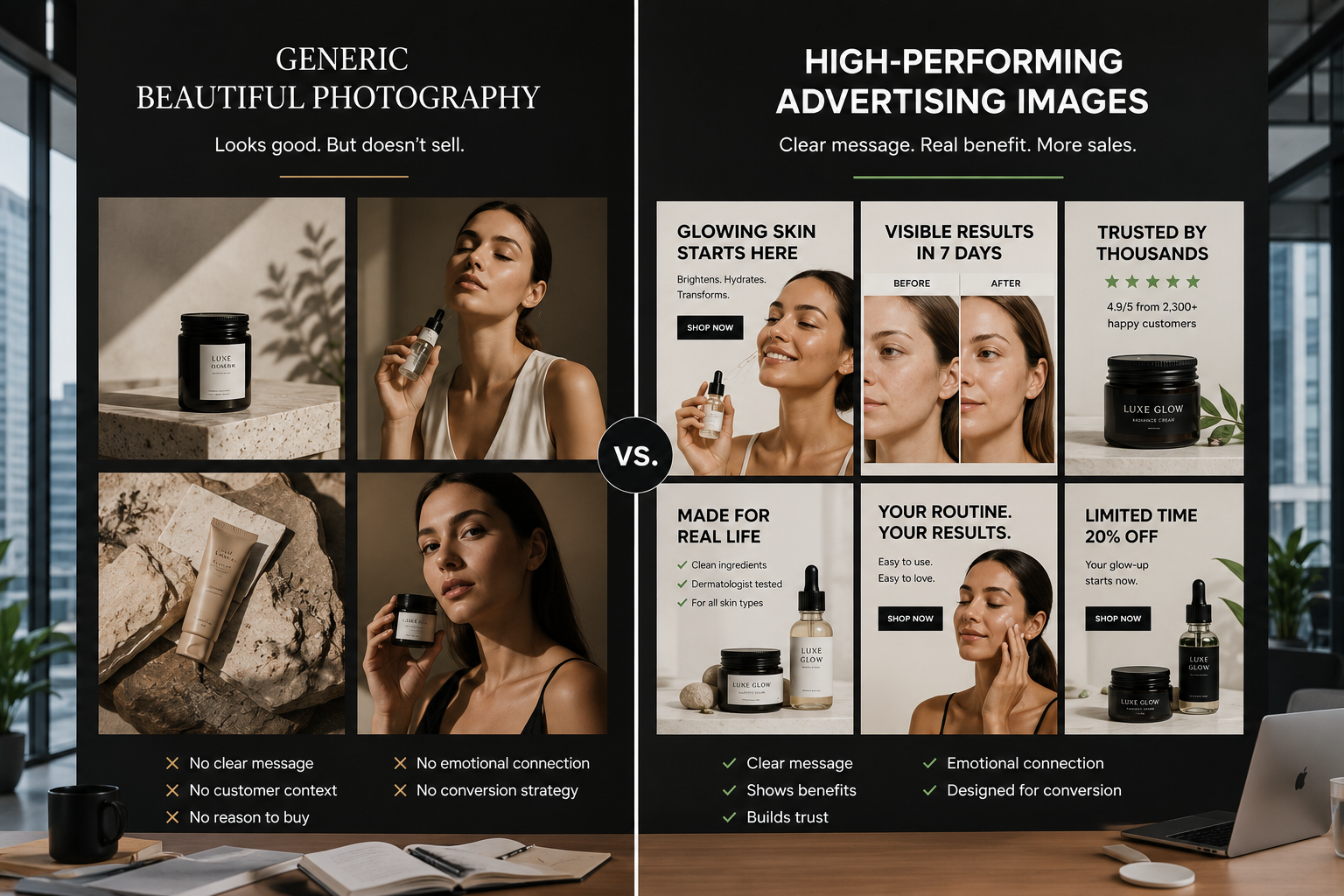
One of the most common mistakes in advertising campaign images is showing products without context.
For example:
- product on white background
- product close-up
- product detail shot
These images work for e-commerce. However, they often struggle in paid advertising. Why? Because buyers aren’t searching for products. They’re searching for outcomes.
As a customer, I want to know:
- How does this fit into my life?
- What problem does it solve?
- Why should I care?
Therefore, successful paid social ad creatives often show the product in use rather than simply showing the product itself.
Situation #2: Every Image Looks Like A Magazine Editorial
Brands often assume beautiful imagery automatically creates results. Unfortunately, that’s another expensive mistake. Many luxury brands create stunning content that generates attention but not action.
As a buyer, I may admire the photography.
However, I still don’t understand:
- what you’re selling
- why it’s different
- why I should trust it
This is where conversion focused photography becomes important. Good ad images don’t just look impressive. They reduce friction, answer questions and create clarity.
And therefore they generate stronger results.
Situation #3: Your Campaign Has No Variety
Another reason businesses struggle with marketing campaign visuals is lack of variation. Many campaigns only produce one type of image.
For example:
- only lifestyle images
- only product images
- only studio images
- only model images
However, advertising platforms reward testing. Consequently, successful paid social ad creatives usually include:
Awareness Images
Introduce the brand.
Problem Images
Highlight customer pain points.
Product Images
Show the offer clearly.
Social Proof Images
Build trust.
Lifestyle Images
Create emotional connection.
Without these categories, brands quickly run out of usable content. Then the marketing team asks for more assets. Then production costs increase and the cycle repeats.
Situation #4: You Created Photos Instead Of Advertising Assets

This is perhaps the biggest reason brands struggle. Most companies create photographs. Few companies create advertising assets. There is a difference.
Advertising assets are designed to work across:
- Meta ads
- Instagram ads
- Facebook ads
- landing pages
- email marketing
- retargeting campaigns
- website banners
Strong advertising campaign images are built for distribution from the beginning. As a result, they create more value over time.
What Images Do Buyers Actually Respond To?
Most customers don’t want artistic photography. They want confidence, clarity and proof. Therefore, the strongest conversion focused photography usually includes:
People Using The Product
Customers imagine themselves using it.
Before And After Results
Customers understand outcomes immediately.
Product In Context
Customers see practical usage.
Founder Or Team Images
Customers trust people more than logos.
Customer Experience Images
Customers understand the buying journey.
These images consistently outperform purely aesthetic content.
What Images Do I Need For Ads? The Content Planning Advantage
One of the biggest mistakes brands make is asking “What images do I need for ads?” after the shoot is already finished.
At that point, the opportunity to influence production has largely passed. The available assets are limited to what was captured during the shoot.
If important advertising assets were not planned in advance, they often do not exist. This is why content planning creates such a significant advantage.
The highest-performing campaigns are rarely built from content that happened to work. They are built from content that was intentionally created to support specific marketing objectives.
When brands answer the question “What images do I need for ads?” before production begins, they create stronger campaigns, more usable assets, and better long-term marketing performance.
For an example of this approach in practice, see How We Planned One Shoot To Generate 6 Months Of Content.
Planning Before Production Improves Advertising Performance
Many brands begin content production with creative concepts. They discuss mood boards, styling and locations. These elements matter.
However, advertising performance often depends on a different question: What assets will the campaign actually require?
Before production begins, brands should identify:
- Campaign Objectives
- Advertising Platforms
- Audience Segments
- Creative Variations
- Content Formats
This planning process helps ensure the production generates assets designed specifically for campaign execution. Instead of hoping the content will work, brands create assets with a defined purpose.
This is one of the biggest advantages of planning before production.
Asset Mapping Helps Answer What Images Do I Need For Ads
Asset mapping is one of the most effective ways to determine what images do I need for ads. It identifies every content requirement before the shoot takes place.
Rather than simply producing images, brands create a roadmap for asset creation. This process may include identifying:
- Hero Advertising Images
- Lifestyle Campaign Assets
- Product-Focused Assets
- Vertical Advertising Formats
- Square Advertising Formats
- Retargeting Assets
- Email Marketing Content
- E-Commerce Photography
When asset mapping occurs before production, the same budget often generates significantly more usable content. The result is stronger campaign support and fewer content gaps after launch.
Take a look at Beauty Campaign Photography: The Strategic Foundation of High-Performing Beauty Brands.
Campaign Requirements Should Drive Content Creation
One of the biggest reasons campaigns underperform is that content was created without a clear understanding of campaign requirements. Brands frequently create beautiful photography that lacks the assets necessary to support actual advertising activity.
Effective campaign planning identifies:
- Awareness Assets
- Consideration Assets
- Conversion Assets
- Retargeting Assets
- Promotional Assets
Each stage of the customer journey may require different creative approaches. By identifying these requirements before production, brands dramatically improve their ability to answer the question: What images do I need for ads?
The content is no longer created based solely on creative preferences. It is created based on marketing objectives.
Deployment Strategy Determines Asset Value
Many brands focus heavily on production. Far fewer focus on deployment. Yet deployment often determines the actual value of the content.
A strong deployment strategy identifies where assets will be used before they are ever created.
This may include:
- Meta Advertising
- Instagram Advertising
- TikTok Advertising
- Google Display Advertising
- Email Marketing
- Website Content
- E-Commerce Platforms
When deployment requirements are identified in advance, content creation becomes significantly more efficient. The production generates assets designed specifically for those environments.
This increases asset utilization while reducing the likelihood of content shortages later.
The Content Planning Advantage Creates More Usable Assets
The greatest advantage of planning is not necessarily creating more content. It is creating more useful content. Brands that plan before production often generate more:
- Advertising Assets
- Creative Variations
- Campaign Support Content
- Testing Opportunities
- Cross-Channel Assets
The budget may remain unchanged. The production team may remain unchanged. The difference is that the assets are intentionally designed to support marketing performance.
This creates a much higher return on the original production investment.
What Images Do I Need For Ads? The Content Planning Advantage
Ultimately, the answer to what images do I need for ads should be determined long before the camera comes out. The strongest campaigns begin with:
- Planning Before Production
- Asset Mapping
- Defined Campaign Requirements
- Clear Deployment Strategies
- Marketing Objectives
When these elements are in place, content production becomes far more effective. Brands create assets that support advertising, strengthen campaign performance, and remain valuable long after the initial launch.
That is the true content planning advantage. It ensures every production generates assets designed not just to look good, but to perform.
How To Create Images For Facebook Ads
Many brands make the mistake of creating campaign photography first and then trying to turn those images into Facebook ads later. However, the best advertising campaign images are designed for advertising from the beginning.
Before the shoot, ask:
- What offer are we promoting?
- What customer problem are we solving?
- What stage of the customer journey is this ad targeting?
- Will this image be used for awareness, retargeting, or conversion?
Strong paid social ad creatives typically include:
Product-Focused Images
Clearly show the product.
Lifestyle Images
Show the product being used naturally.
Founder Images
Build trust and authenticity.
Problem-Solution Images
Demonstrate the customer transformation.
Social Proof Images
Show reviews, testimonials, or customer results. As a result, your content library becomes far more useful for future campaigns.
How To Create Images For Google Ads
Google advertising often requires a different approach than social media advertising. Unlike Facebook or Instagram, Google users frequently have stronger buying intent.
Therefore, conversion focused photography becomes even more important.
The strongest Google ad images typically:
- highlight the product clearly
- show benefits immediately
- avoid unnecessary distractions
- focus on customer outcomes
- work at smaller display sizes
Furthermore, clean compositions generally outperform overly artistic images because they communicate value more quickly. When creating marketing campaign visuals for Google Ads, simplicity often wins.
Facebook Ad Image Dimensions
One reason brands struggle with ad performance is that they create one image and try to use it everywhere. Unfortunately, every placement requires different dimensions.
Recommended Facebook Ad Image Sizes
Square (Most Versatile)
1080 × 1080 px
Aspect Ratio: 1:1
Best For:
- Facebook Feed
- Instagram Feed
- Retargeting Ads
Vertical (Highest Mobile Real Estate)
1080 × 1350 px
Aspect Ratio: 4:5
Best For:
- Facebook Feed
- Instagram Feed
- Mobile-first campaigns
This is often the highest-performing format because it occupies more screen space.
Stories & Reels
1080 × 1920 px
Aspect Ratio: 9:16
Best For:
- Instagram Stories
- Facebook Stories
- Reels Ads
Most brands should create dedicated vertical assets rather than cropping horizontal images.
Google Display Ad Image Dimensions
Google Display Network uses multiple placements. Therefore, it’s important to create several versions.
Recommended Google Display Sizes
Large Rectangle: 336 × 280 px
Medium Rectangle: 300 × 250 px
Leaderboard: 728 × 90 px
Large Leaderboard: 970 × 90 px
Half Page: 300 × 600 px
Mobile Banner: 320 × 100 px
Responsive Display Ads
Google also recommends uploading:
- landscape images
- square images
- logos
so the platform can automatically optimize placements.
What Images Do I Need For Ads? The Campaign Planning Framework
One of the biggest reasons advertising campaigns underperform is not poor creative quality. It is poor planning. Many brands invest significant resources into content production without first determining exactly what assets the campaign will require.
The result is predictable. Campaigns launch with content gaps, advertising teams lack creative variations and marketing departments request additional assets after production has already ended.
This is why the question “What images do I need for ads?” should be answered through a structured campaign planning framework before production begins.
A campaign planning framework helps brands identify asset requirements, deployment opportunities, content system needs, and scalable content creation strategies.
Rather than creating content and hoping it works, brands create content intentionally designed to support marketing performance.
Asset Requirements Define What Images You Need For Ads
The first step in answering what images do I need for ads is identifying asset requirements. Many brands begin production with a creative concept.
However, effective campaign planning starts with understanding the assets required to execute marketing activities successfully.
Before production begins, brands should identify:
- Hero Advertising Images
- Lifestyle Campaign Photography
- Product-Focused Assets
- Detail And Close-Up Images
- Vertical Ad Formats
- Square Ad Formats
- Landscape Ad Formats
- Retargeting Assets
Each asset serves a specific purpose within the campaign. Without clear asset requirements, brands often discover missing content after launch.
When asset requirements are defined in advance, production becomes significantly more efficient.
Deployment Plans Determine Asset Value
Creating assets is only part of the process. The next step is determining where those assets will be deployed. This is where deployment planning becomes critical.
A strong deployment plan identifies every marketing channel that will require content.
This may include:
- Meta Advertising
- Instagram Advertising
- TikTok Advertising
- Google Display Advertising
- Email Marketing
- Website Content
- E-Commerce Platforms
- Retail Marketing
Each channel has different requirements.
Different image formats, creative approaches and customer expectations. Brands that plan deployment before production create content specifically designed for these environments.
Brands that skip this step often find themselves lacking critical assets once campaigns begin running.
Content Systems Create Better Advertising Assets
Many brands approach advertising content as a single project. They create assets for one campaign and move on. High-performing brands often take a different approach.
They build content systems. A content system ensures every production contributes to a larger marketing infrastructure.
Instead of asking only: “What images do I need for ads today?”
they also ask:
- What Assets Will Future Campaigns Need?
- How Can These Assets Be Reused?
- How Can We Extend Asset Lifespans?
- How Can We Build A Larger Content Library?
This system-based approach increases asset utilization and improves the return generated from every production investment.
The result is stronger advertising performance and greater long-term efficiency.
Scalable Content Creation Supports Long-Term Growth
One of the biggest advantages of a campaign planning framework is scalability. As brands grow, content requirements typically increase. More campaigns, products, advertising and marketing channels.
Without a scalable production process, content creation becomes increasingly difficult and expensive. Scalable content creation focuses on generating assets that support multiple initiatives simultaneously.
A single production may create content for:
- Current Campaigns
- Future Product Launches
- Email Marketing
- Website Updates
- Social Media Publishing
- Paid Advertising
This approach increases efficiency while reducing the need for repeated productions. The same investment generates significantly more marketing value.
Why Most Brands Struggle To Answer What Images Do I Need For Ads
Many brands struggle with the question “What images do I need for ads?” because they focus on creative execution before strategic planning.
The production is organized, the mood board is approved and the shoot takes place. Only afterward do marketing teams realize critical assets are missing.
The issue is not creative quality but that campaign requirements were never properly defined. A campaign planning framework solves this problem by connecting production directly to marketing objectives.
Every asset has a purpose, every image has a deployment strategy and every deliverable supports campaign performance.
What Images Do I Need For Ads? The Campaign Planning Framework
Ultimately, the best way to answer what images do I need for ads is through a structured campaign planning framework. Strong campaigns begin with:
- Asset Requirements
- Deployment Plans
- Content Systems
- Scalable Content Creation
- Clear Marketing Objectives
When these elements are established before production begins, content becomes significantly more valuable.
Brands generate more usable assets, campaigns launch with fewer content gaps, advertising teams gain more flexibility and marketing efficiency improves.
Most importantly, every production investment works harder because the content was designed to support performance from the very beginning.
Best Practices For Facebook Ad Images
Many businesses assume beautiful photography automatically creates strong advertising. However, performance often depends on usability.
Show The Product Immediately
Don’t make customers guess what is being advertised.
Create Variations
Strong paid social ad creatives usually include:
- lifestyle versions
- product versions
- founder versions
- testimonial versions
- offer-driven versions
Design For Mobile First
Most users will never see the desktop version. Therefore, always review ad creatives on a smartphone before launch.
Use Real People
People generally respond better to people than products alone. This is especially true for fashion, beauty, wellness, and lifestyle brands.
Create Multiple Crops During Production
Plan for:
- 1:1
- 4:5
- 9:16
- 16:9
during the shoot itself. This dramatically improves content flexibility.
Best Practices For Google Ad Images
Google users often have stronger intent than social media users. Therefore, clarity becomes even more important.
Keep Compositions Clean
Simple images generally outperform cluttered images.
Highlight The Product
The product should remain obvious even at smaller sizes.
Show Benefits Quickly
Customers should understand the offer within seconds.
Create Multiple Versions
Successful advertisers continuously test:
- different products
- different crops
- different headlines
- different visual approaches
Build For Landing Pages Too
The best marketing campaign visuals often work across:
- Google Ads
- landing pages
- email marketing
- website banners
- retargeting campaigns
That consistency increases trust and improves conversion rates.
What Images Do I Need for Ads? A Practical Checklist
If you’re planning a campaign, make sure you create:
Awareness Images
Build recognition.
Product Images
Show the offer clearly.
Lifestyle Images
Create emotional engagement.
Trust Images
Show reviews, customers, founders, or social proof.
Conversion Images
Support calls-to-action and landing pages.
Retargeting Images
Re-engage interested customers.
This combination creates a stronger library of marketing campaign visuals while improving overall campaign performance.
Read more on Marketing Content Budget Waste – From $20k Shoot to 3 Posts.
How Long Should Advertising Images Last?
One of the most common misconceptions in marketing is that advertising images should continue performing indefinitely. In reality, every creative asset has a lifecycle.
The question is not whether advertising images will eventually lose effectiveness. The question is how long they remain valuable before performance begins to decline.
The answer depends on factors such as audience size, advertising spend, campaign objectives, creative diversity, and content planning. However, most advertising assets move through several predictable stages.
Launch Phase
The launch phase occurs when new advertising assets are first introduced to the market.
At this stage:
- Audiences have not seen the content before
- Engagement is often strongest
- Click-through rates may increase
- Creative performance is typically at its highest
New content naturally attracts attention because it is unfamiliar.
For fashion brands, launch-phase assets may include:
- Collection launch imagery
- New product announcements
- Hero campaign visuals
- Seasonal campaign photography
The launch phase often lasts anywhere from a few days to several weeks depending on audience size and advertising spend.
Testing Phase
Once a campaign is active, the next objective is identifying which assets perform best.
During the testing phase, marketing teams evaluate:
- Different image styles
- Different messaging approaches
- Different audience segments
- Different creative formats
- Different placements
For example, a fashion brand may test:
- Product-focused images
- Lifestyle photography
- Founder-focused content
- Social proof assets
- Campaign storytelling visuals
The goal is not to find one winning image. The goal is to identify patterns that can improve future campaign performance.
Brands with a larger content library generally perform better during this stage because they have more creative options available for testing.
Scaling Phase
Once high-performing assets are identified, campaigns often enter the scaling phase.
This is where advertising spend increases and winning creatives are shown to larger audiences.
During scaling:
- Reach expands significantly
- Audience exposure increases
- Asset utilization accelerates
- Revenue opportunities grow
This is often when advertising images generate the greatest business value.
However, scaling also creates a new challenge.
The more frequently audiences see the same creative, the faster creative fatigue begins to develop.
Creative Fatigue
Creative fatigue occurs when audiences become overly familiar with an advertisement.
Even excellent advertising images eventually lose effectiveness when exposed repeatedly to the same audience.
Common signs of creative fatigue include:
- Lower click-through rates
- Higher advertising costs
- Reduced engagement
- Declining conversion rates
- Lower return on ad spend
Importantly, creative fatigue does not necessarily mean the photography is weak.
Often the content performed extremely well. The audience has simply seen it too many times.
This is one of the primary reasons successful brands create multiple advertising assets during production rather than relying on a single hero image.
Refresh Cycles
The strongest brands anticipate creative fatigue before it becomes a problem.
Instead of waiting for performance to decline dramatically, they implement refresh cycles.
A refresh cycle may involve:
- Introducing new image variations
- Rotating creative formats
- Updating messaging
- Deploying previously unused assets
- Launching new campaign concepts
Brands that plan refresh cycles during production often extend campaign lifespans significantly.
For example, a single photoshoot may generate:
- Launch assets
- Testing assets
- Scaling assets
- Retargeting assets
- Future refresh assets
This approach allows campaigns to evolve over time without requiring immediate reshoots.
How Long Should Advertising Images Last?
There is no universal answer.
However, well-planned advertising assets often remain useful for:
- Launch campaigns: 2–6 weeks
- Active advertising campaigns: 1–3 months
- Retargeting campaigns: 3–6 months
- Website and landing page content: 6–12 months
- Evergreen brand content: 12 months or longer
The strongest brands do not measure success by how long a single image lasts.
They measure success by how effectively an entire content library supports growth over time.
The Real Goal Is Content Longevity
The most effective advertising strategy is not constantly creating new content. It is creating enough strategic content to support launch, testing, scaling, and refresh cycles without repeatedly returning to production.
When content is planned as a system rather than a single campaign, brands reduce creative fatigue, improve content ROI, and extend the value of every production investment.
That is why the highest-performing brands rarely ask how long one image should last. They ask how long their content system can continue generating results.
Why Most Businesses Keep Reshooting Ad Content
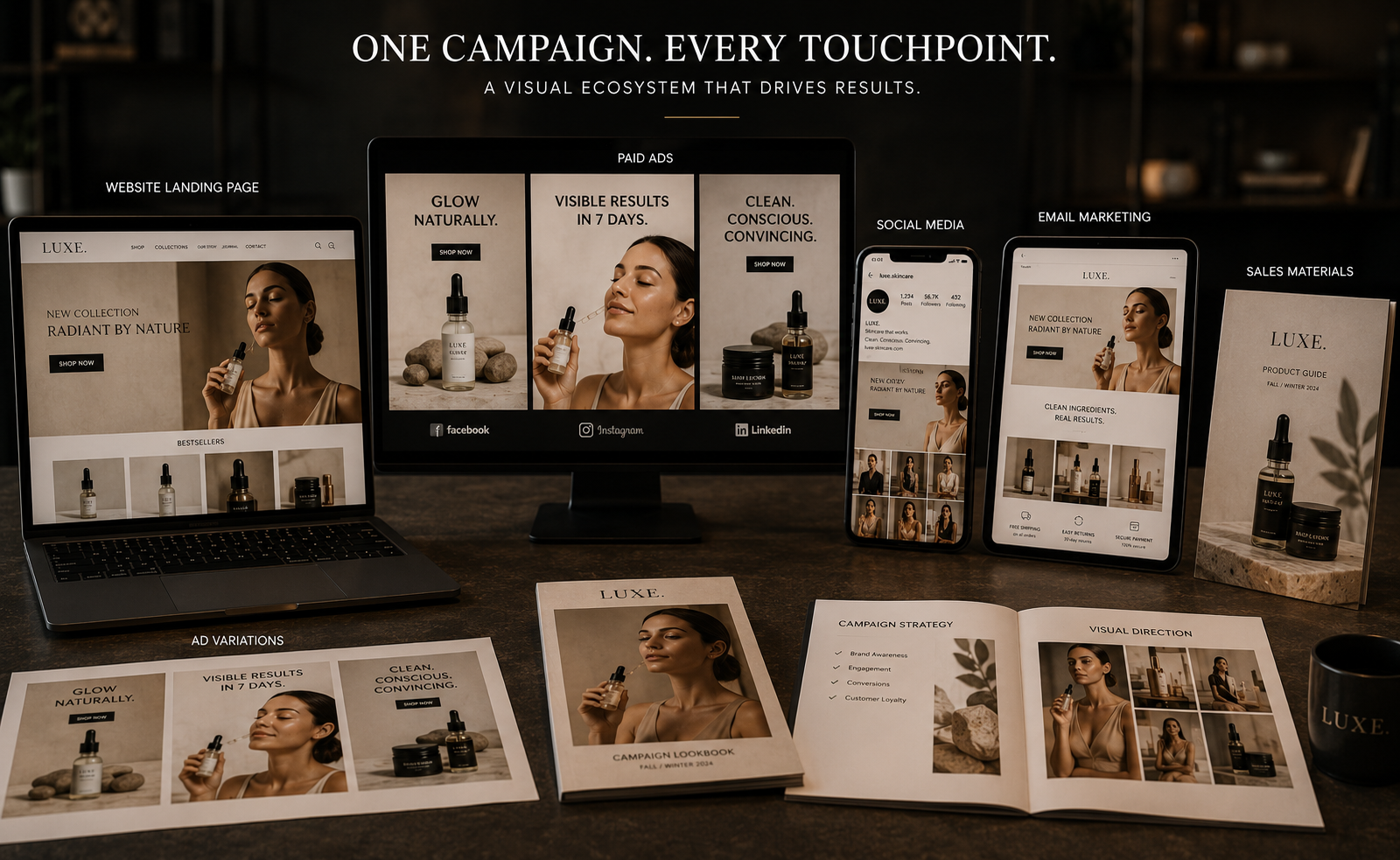
The answer is simple. They never created enough useful assets in the first place.
Without strategic advertising campaign images, businesses end up:
- rebuilding campaigns
- requesting more production
- creating more variations
- increasing marketing costs
Meanwhile, brands with strong paid social ad creatives continue testing and scaling existing assets. That difference compounds over time. Take a look at Paid Ads Usage Explained.
Free Download: Visual Content Checklist
If you’re currently asking “What images do I need for ads?”, start by auditing your current content library.
Download the free Visual Content Checklist to identify:
- missing ad assets
- campaign content gaps
- weak creative variations
- conversion bottlenecks
👉 https://philhalfmann.com/free-resources/
Frequently Asked Questions About Advertising Images
What Images Do I Need For Ads?
Most advertising campaigns require a combination of image types rather than a single creative. High-performing campaigns typically include:
- Awareness Images
- Product Images
- Lifestyle Images
- Trust-Building Images
- Conversion Images
- Retargeting Images
Each image type serves a different purpose within the customer journey and helps improve campaign performance across multiple platforms.
What Images Work Best For Facebook Ads?
The best Facebook ad images clearly communicate the offer, capture attention quickly, and are optimized for mobile viewing. Successful Facebook ad campaigns often use:
- Product-focused images
- Lifestyle photography
- Founder images
- Social proof content
- Problem-solution visuals
Strong Facebook advertising relies on testing multiple creative approaches rather than depending on a single image.
What Images Work Best For Google Ads?
Google Ads users often have stronger buying intent than social media users. As a result, effective Google ad images typically:
- Highlight the product clearly
- Focus on customer benefits
- Reduce visual distractions
- Communicate value quickly
- Work effectively at smaller display sizes
Clarity usually outperforms highly artistic imagery in Google advertising environments.
How Many Ad Creatives Should A Campaign Have?
There is no universal number, but most campaigns benefit from multiple creative variations. A typical campaign may include:
- 5–10 awareness images
- 5–10 product-focused images
- 5–10 lifestyle images
- Multiple ad formats
- Multiple crops and variations
Advertising platforms reward testing, so having creative diversity often improves performance over time.
Why Do Ad Images Stop Performing?
Advertising images often decline in effectiveness because audiences experience creative fatigue. After repeated exposure, customers become less responsive to the same visual content.
Common reasons ad performance declines include:
- Creative fatigue
- Audience saturation
- Lack of image variation
- Limited content library
- Poor campaign planning
Brands that create more advertising assets during production can often extend campaign lifespan significantly.
What Is Conversion-Focused Photography?
Conversion-focused photography is imagery designed to drive action rather than simply create visual appeal.
These images help customers:
- Understand the offer
- Build trust
- Visualize outcomes
- Reduce uncertainty
- Move closer to purchase decisions
The goal is not only to create beautiful photography but to create photography that supports business objectives.
What Are Advertising Campaign Images?
Advertising campaign images are visuals specifically created to support marketing and advertising efforts across multiple channels.
They may be used for:
- Meta Ads
- Instagram Ads
- Facebook Ads
- Google Display Ads
- Landing Pages
- Email Marketing
- Retargeting Campaigns
Unlike general brand photography, advertising images are designed to generate measurable marketing results.
What Are Paid Social Ad Creatives?
Paid social ad creatives are images and videos specifically developed for paid advertising platforms such as:
- Facebook Ads
- Instagram Ads
- TikTok Ads
- Pinterest Ads
- LinkedIn Ads
These assets are designed to capture attention, communicate value quickly, and encourage users to take action.
Should Advertising Images Be Planned Before The Shoot?
Yes. The highest-performing campaigns typically identify advertising requirements before production begins.
Planning before the shoot helps brands:
- Create the right assets
- Produce multiple formats
- Build creative variations
- Support different campaign objectives
- Increase content lifespan
This approach often generates significantly more value from the same production budget.
Why Do Brands Keep Reshooting Ad Content?
Many brands run out of content because they create photographs instead of advertising assets.
Without strategic planning, campaigns often lack:
- Creative variations
- Retargeting assets
- Multiple formats
- Customer journey content
- Cross-channel assets
As a result, marketing teams frequently request additional production after launch. Strategic content planning helps reduce these content shortages and improve long-term content ROI.
Recommended Next Reads
Beauty Campaign Photography: The Strategic Foundation of High-Performing Beauty Brands
How Many Images Does a Fashion Brand Actually Need? (What Most Brands Get Wrong)