

Concept proof: In the Colour Me Beautiful case study, one cultural reference was translated into two distinct color worlds and eleven planned setups. That is the standard a campaign concept should meet: specific enough to guide production, but flexible enough to create a complete asset system. Continue with the campaign shoot planning guide.
What Is Campaign Concept Development?
Campaign concept development creates the central idea that holds a campaign together. That idea should answer three questions: What does the brand need the audience to understand? Why should that message matter now? How can the campaign express it in a way that only this brand could credibly own?
A concept is not merely a theme such as “summer freedom”, “modern luxury” or “confidence.” Those phrases may describe a territory but they do not yet create a strategic idea. A useful campaign concept contains tension, meaning and a point of view. It gives the product a role in a story rather than placing it inside a fashionable setting without context.
For example, a skincare brand may want to communicate efficacy. “Clinical beauty” is only a broad territory. A stronger concept could explore the tension between visible scientific precision and the deeply personal ritual of caring for one’s skin. That idea can then shape casting, environments, lighting, copy, movement and product detail while staying connected to the commercial objective.
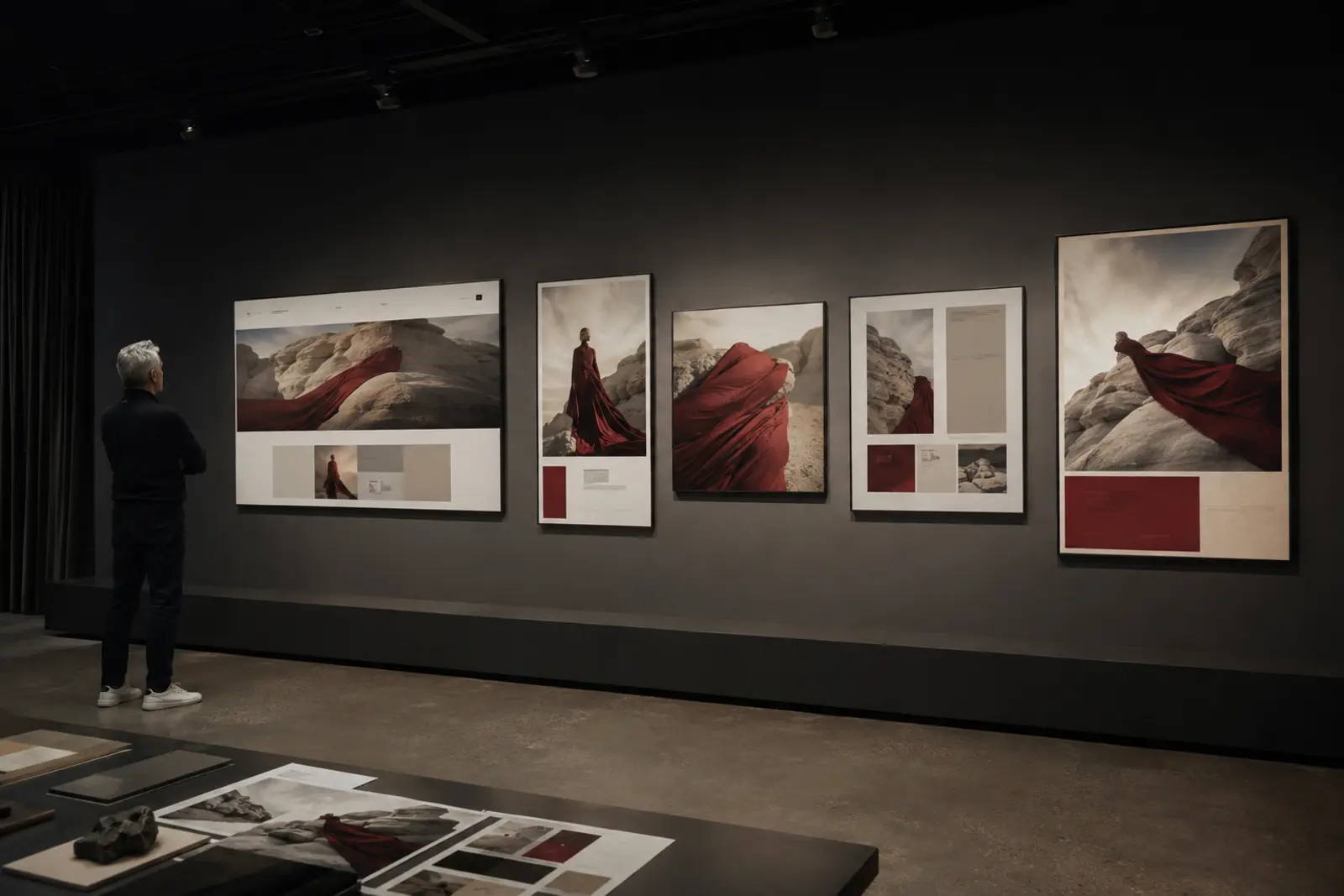
In other words, campaign concept development is the bridge between fashion brand content strategy and production. It determines what the campaign means before the team decides exactly how it looks. The Colour Me Beautiful music-inspired beauty editorial shows how that translation moved from a cultural reference to two color worlds and eleven planned setups.
See how a creative concept moves from strategic idea to executable campaign production.

Campaign Concept vs. Creative Direction, Art Direction and Mood Boards
These terms are closely related, yet they are not interchangeable. Confusing them causes teams to approve aesthetics before they have agreed on the idea.
| Element | Primary question | Typical output |
|---|---|---|
| Campaign strategy | What business and audience outcome must the campaign create? | Objective, audience, offer, channels and measurement plan |
| Campaign concept | What is the central idea that makes the message meaningful and distinctive? | Concept statement, narrative, message and creative territory |
| Creative direction | How should the idea behave and feel across the campaign? | Visual and verbal principles, casting, tone, motion and content system |
| Art direction | How will the idea become visible in each execution? | Lighting, composition, styling, set, color and design choices |
| Mood board | Which references help the team understand the intended visual language? | Curated images, materials, colors and visual cues |
| Shot list | Which specific assets must production capture? | Scenes, products, talent, crops, movements and priorities |
The order matters. First, the campaign needs a job. Next, it needs an idea. Only then should the team define the visual system and production details. Your creative direction for fashion campaigns can then translate the approved concept into a coherent world. Likewise, a focused fashion mood board can communicate that world without replacing the strategic thinking behind it.
See how an initial beauty concept developed from a visual idea into a finished editorial production.
Once the campaign concept is established, it should be translated into a campaign brief that connects the creative idea with production requirements.
A Strategic Campaign Concept Development Process
Strong ideas rarely appear fully formed. Instead, they emerge through a structured process that alternates between expansion and selection. The goal is not to generate the most ideas. It is to identify the strongest idea for the objective, audience, brand and available production reality.
Once the concept is established, fashion storytelling photography can translate that idea into a meaningful visual narrative.
1. Define the Commercial Objective
Before brainstorming, write one primary objective. A campaign cannot prioritize awareness, conversion, repositioning, education and loyalty equally. Although it may support several outcomes, one job must lead.
A practical objective should identify the desired change. For example: “Move the new collection from product awareness to qualified consideration among style-conscious professionals”. This is more useful than “create buzz” because it clarifies the audience stage and expected response.
Also define the campaign’s success signals. These may include qualified reach, product-page visits, saves, email sign-ups, retailer interest, conversion rate or creative performance in paid media. The concept should serve the outcome, even when the campaign’s immediate role is brand building.
Before creative development progresses, teams should establish who approves the campaign concept and when that approval becomes final.
2. Identify the Audience Tension
Demographics describe people but tensions often inspire ideas. Ask what the audience wants, what blocks them and what contradiction the product can resolve. The answer should come from evidence: customer interviews, reviews, search behavior, sales conversations, social comments, performance data or cultural research.
For instance, a beauty customer may want visible results without feeling that self-care has become another demanding optimization project. A fashion customer may want distinction without buying into disposable novelty. Those tensions create more useful creative territory than age, income and location alone.
However, an insight is not automatically true because it sounds clever. Treat it as a hypothesis until customer language or behavior supports it. Otherwise, the campaign may be built around an agency observation that the audience does not recognize.
See how a seasonal theme can develop from an initial idea into a complete editorial concept.
3. Clarify the Brand Truth and Product Proof
The concept must be ownable. Therefore, identify what the brand can say credibly that competitors cannot say in the same way. This may come from the founder’s perspective, design process, formula, materials, provenance, community, service model or established visual codes.
Next, separate the promise from the proof. The promise explains the value or transformation. The proof gives the audience a reason to believe it. In beauty, proof may involve ingredients, testing or texture. In fashion, it may involve construction, versatility, craftsmanship or the way a garment changes movement.
Distinctive campaign concept development lives at the intersection of audience relevance and brand credibility. If either side is missing, the idea becomes generic or unbelievable.
See how a campaign concept moved from initial visual thinking into an executable footwear production.
4. Write the Single-Minded Proposition
Reduce the strategic input to one sentence: “For [audience], this campaign demonstrates that [brand or product] delivers [meaningful value] because [proof].” This proposition is not public-facing copy. It is an internal decision tool.
If the sentence contains several benefits joined by commas, it is probably not single-minded. Make a choice. Focus creates room for creative depth, while an overloaded proposition often produces a campaign that says many things weakly.
5. Generate Multiple Creative Territories
Now expand. Develop three to five territories that express the proposition from meaningfully different angles. A territory should include a short premise, audience relevance, brand connection, visual possibilities and potential risks.
Do not mistake different color palettes for different concepts. If every option tells the same story, the team is comparing art direction rather than ideas. One territory might dramatize transformation. Another might use product truth as the visual mechanism. A third might build around a cultural behavior or an unexpected contrast.
At this stage, deliberately include at least one route that is less predictable but still strategically defensible. Safe ideas often survive internal approvals because they offend nobody. Unfortunately, they may also be ignored by the market.
See how a collection of products and wardrobe elements can be developed into one cohesive campaign concept.
6. Develop the Strongest Campaign Concepts
For each shortlisted territory, write a concise concept statement. It should explain the audience tension, central idea, role of the product and intended audience response. Then add a possible campaign line, narrative arc and core visual device.
A useful concept statement is specific enough to guide decisions but open enough to create a family of executions. If it dictates every frame, it is an advertisement layout rather than a campaign platform. Conversely, if it can justify almost any image, it is too vague.
Next, visualize only enough to make the idea understandable. References should illustrate principles, not impersonate the final campaign. Overly polished mockups can cause decision-makers to select their preferred styling while overlooking a weak premise.
See how an initial campaign idea was developed through pre-production and translated into the final shoot.

Translate Campaign Concept Development Into a Visual System
After approval, define how the concept will become recognizable. The visual system may include a repeatable composition, gesture, material, environment, lighting behavior, transition, camera movement or relationship between talent and product. The strongest device is not decoration; it carries the idea.
For example, if the concept explores “precision made personal”, the system might combine exact architectural framing with intimate human detail. That contrast could appear in portraits, product macro photography, video transitions and graphic layouts. As a result, executions can vary without losing conceptual coherence.
Use an art direction checklist to convert the visual rules into decisions around casting, styling, hair, makeup, lighting, color, composition, set design and post-production. Then use a photography shot list template to map those decisions to specific assets.
The concept should help determine what type of model can authentically communicate the campaign idea.
Plan the Idea for Every Channel
A concept that works only as one hero image is not yet a modern campaign system. Before production, test how the idea behaves in a website banner, vertical video, square social post, email header, paid advertisement, product page, PR image and retail placement.
This does not mean repeating the same composition everywhere. Instead, identify which part of the idea must remain constant and which part can adapt. A strong concept has recognizable DNA rather than rigid uniformity.
Channel planning should happen before the shoot because media requirements affect composition, movement, duration and asset volume. The media-first campaign photography approach explains why campaign images should be treated as adaptable media inventory instead of isolated deliverables.
Build Variation Into the Concept
Paid media and always-on channels need variation. Therefore, decide how the concept can produce different hooks, products, talent combinations, framings and levels of visual intensity while preserving one idea.
Variation should be designed, not improvised. Otherwise, the campaign may deliver many files but very few genuinely different creative options. Map each variation to a purpose: awareness, product education, consideration, retargeting, launch-day impact or long-term brand storytelling.
How to Evaluate Campaign Concepts Before Production
Creative preference is unavoidable, but it should not be the only approval criterion. Score each concept against the same questions before seniority, presentation polish or personal taste takes over.
- Strategic relevance: Does the idea directly support the campaign objective?
- Audience resonance: Is it built around a supported audience truth or tension?
- Brand ownership: Could a direct competitor run the same concept unchanged?
- Product role: Is the product essential to the idea, or merely placed inside it?
- Distinctiveness: Will the campaign create recognizable memory structures?
- Scalability: Can it generate a connected family of still and motion assets?
- Channel adaptability: Does it survive different crops, durations and placements?
- Production feasibility: Can the team execute it convincingly within the budget and schedule?
- Brand safety: Are cultural, legal, reputational or claims-related risks understood?
- Longevity: Can it remain useful beyond one launch moment without feeling stale?
A simple weighted scorecard can make trade-offs visible. However, scoring should support judgment, not disguise it as mathematics. A concept with a high average may still fail because of one fatal weakness, such as an unsupported product claim or a visual mechanism the budget cannot execute.
Common Campaign Concept Development Mistakes
Starting With Pinterest Instead of the Brief
Visual research feels productive, so teams often begin there. Yet references can anchor thinking too early and encourage imitation. Start with the objective, insight and proposition. Then use references to communicate the resulting idea.
Calling an Aesthetic a Concept
“Minimal”, “editorial”, “cinematic” and “quiet luxury” describe style. They do not explain what the campaign means. A concept needs a point of view that can guide both visual and verbal communication.
Trying to Communicate Every Benefit
Brands often fear leaving information out. However, adding more messages usually reduces clarity. Select the benefit most relevant to the campaign objective, then let supporting content handle the rest.
Approving the Most Beautiful Presentation
Highly polished mockups can make a familiar idea look stronger than it is. Evaluate the written strategic logic first. Then examine whether the visual system strengthens it.
Copying Category Codes Without Adding Brand Meaning
Category conventions help audiences recognize what is being sold. Nevertheless, using them without a distinctive brand element produces interchangeable work. Keep the useful codes but change the message, relationship or visual device.
Ignoring Distribution Until After the Shoot
A concept may collapse when cropped vertically, reduced to six seconds or adapted for performance creative. Test formats early. Otherwise, the production budget may create one impressive hero asset and a weak content library.
Using Feedback That Has No Decision Criteria
Comments such as “make it pop”, “more premium” or “I do not feel it” do not identify the problem. Ask reviewers to connect feedback to the brief: Which objective is unsupported? Which audience response is missing? Which brand code feels inconsistent?
What a Finished Campaign Concept Document Should Include
The final document should be concise enough to use and specific enough to align strategy, production and distribution. Include:
- Campaign background and business objective
- Primary audience and supported tension or insight
- Brand truth, product promise and proof
- Single-minded proposition
- Concept name and one-sentence idea
- Expanded concept narrative
- Role of the product in the story
- Key message and possible campaign line
- Visual and verbal principles
- Core creative device and non-negotiable brand codes
- Channel behavior and required variations
- Initial execution examples
- Risks, constraints and production implications
- Approval owners and decision date
Once approved, the concept document becomes a filter. It helps the team reject attractive ideas that do not belong, resolve feedback faster and protect coherence as more specialists join the campaign.
Campaign Concept Development Timeline
For a focused campaign, allow approximately one to three weeks for briefing, research, territory development, review and refinement. Larger launches may need more time because stakeholder alignment, research, claims review and international adaptation add complexity.
Concept development should begin before detailed pre-production. Your broader fashion campaign timeline should reserve time for concept approval before casting, location commitments and final shot planning. Otherwise, early production decisions can quietly dictate the idea rather than serve it.
The campaign concept should help determine what type of environment can communicate the intended mood, positioning and story.
Frequently Asked Questions About Campaign Concept Development
What is a campaign concept?
A campaign concept is the central creative idea that connects a business objective, audience insight, brand truth and product message. It guides how the campaign communicates across photography, video, design, copy and channels.
Who develops a campaign concept?
Depending on the project, a strategist, creative director, art director, copywriter, photographer or small cross-functional team may lead development. The most important requirement is shared access to the business brief, audience evidence and brand strategy.
How many campaign concepts should be presented?
Usually, two or three well-developed concepts are enough. Too many options can dilute strategic judgment and encourage stakeholders to combine incompatible elements. Each route should be distinct, credible and strong enough to produce.
What makes a campaign concept strong?
A strong concept is relevant to the audience, credible for the brand, connected to the product, distinctive in the category and scalable across formats. It should also be feasible within the actual budget, schedule and production capabilities.
Can AI develop a campaign concept?
AI can accelerate research organization, generate territories and challenge assumptions. However, it cannot replace proprietary customer insight, brand judgment, cultural sensitivity or accountability for strategic decisions. Generic inputs typically produce generic concepts, regardless of the tool.
When should campaign concept development begin?
It should begin after the business objective, audience and offer are defined, but before detailed creative direction and pre-production. For many fashion and beauty campaigns, this means starting six to twelve weeks before launch as part of a broader planning process.
Build the Idea Before You Build the Shoot
Campaign concept development gives production a strategic center. It replaces disconnected preferences with one idea that the team can explain, evaluate and execute. Consequently, photography, video, copy and design can work as one campaign instead of a collection of separate deliverables.
The uncomfortable truth is that higher production value cannot rescue an unclear concept. It can only make the confusion more expensive. Therefore, invest in the thinking before committing the production budget.
If your next fashion or beauty campaign needs a clearer link between brand strategy, creative direction and channel requirements, book a free Visual Audit. It is a working session designed to identify gaps in your current visual system and clarify what the campaign must produce.